Korea Zinc to build $7.4b critical minerals smelter in Tennessee
전체 맥락을 이해하기 위해서는 본문 보기를 권장합니다.
"President Trump has directed his Administration to prioritize critical minerals as essential to America's defense and economic security," Deputy Secretary of War Steve Feinberg was quoted as saying in the statement. "The Department of War's conditional investment of $1.4 billion to build the first US-based zinc smelter and critical minerals processing facility since the 1970s reverses 50 years of industrial decline."
Secretary of Commerce Howard Lutnick also echoed the sentiment, describing the project as a "transformational deal for America."
이 글자크기로 변경됩니다.
(예시) 가장 빠른 뉴스가 있고 다양한 정보, 쌍방향 소통이 숨쉬는 다음뉴스를 만나보세요. 다음뉴스는 국내외 주요이슈와 실시간 속보, 문화생활 및 다양한 분야의 뉴스를 입체적으로 전달하고 있습니다.
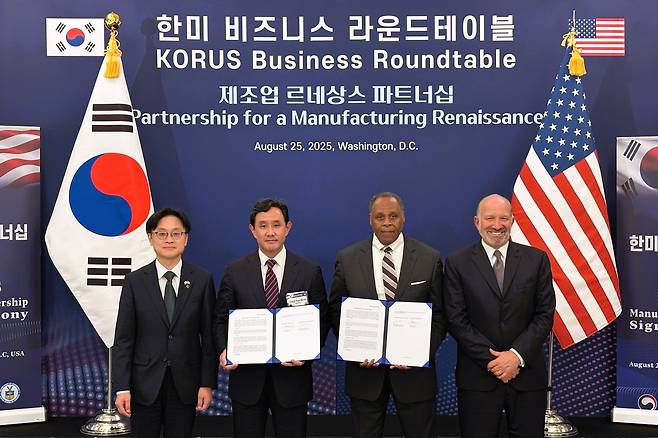
Korea Zinc, the world’s largest zinc smelter, said Monday it plans to build a large-scale facility in Tennessee to process critical materials through a partnership with the US government and private companies. Total investment is estimated at $7.4 billion.
The company explained that the US government has asked Korea Zinc to build the facility in the US as a “strategic partner” amid growing global supply chain risks and rising demand in the US for nonferrous metals and strategic minerals.
Korea Zinc’s board convened earlier in the day and approved the US investment, the company said in a regulatory filing.
Korea Zinc plans to acquire a former smelter site owned by Nyrstar in Clarksville, Tennessee, and rebuild its infrastructure. The facility will be constructed in phases from 2027 to 2029, with commercial operations starting gradually during the period. Spanning 650,000 square meters, the plant is expected to produce 13 products in total, including 11 types of critical minerals and sulfuric acid used in semiconductor manufacturing, once fully operational.
The company said targeted annual output at the site includes 300,000 tons of zinc, 200,000 tons of lead, 35,000 tons of copper and 5,100 tons of rare and strategic metals.
The proposed smelter will be developed through Korea Zinc's US subsidiary, Crucible Metals. It will set up a joint venture with the US government, Crucible JV, and raise $1.94 billion in equity. The US Department of War will become the largest shareholder of the JV with a 40 percent stake, while Korea Zinc’s stake will be less than 10 percent.
Korea Zinc will also issue 2.21 million new shares and allocate them to the JV, resulting in the US-controlled JV holding about a 10 percent stake in the company.
Korea Zinc plans to secure the rest of the fund through $4.7 billion in loans supported by US policy financing programs and private lenders, up to $210 million in subsidies from the US Department of Commerce, and about $585 million in direct investment from Korea Zinc.
The latest investment is widely viewed as part of Washington’s broader effort to reduce reliance on China for critical minerals used in the defense, semiconductor and aerospace industries, as Beijing tightens export controls on strategic resources.
The US remains heavily dependent on China for several essential minerals and has been accelerating efforts to expand domestic processing capacity while partnering with allies. Korea Zinc produces a range of materials considered vital to US national security, including antimony, indium, tellurium, cadmium and germanium, many of which are now subject to stricter Chinese export controls.
Once completed, the US facility is expected to produce antimony and germanium, among other strategic minerals. These materials are currently produced at Korea Zinc’s Onsan smelter in Ulsan and are essential for advanced semiconductors, defense systems and renewable energy technologies.
The US plant will be modeled after the Onsan facility, adopting a similar integrated process combining hydrometallurgical and pyrometallurgical technologies — a technical advantage that has helped Korea Zinc dominate the global zinc market.
“President Trump has directed his Administration to prioritize critical minerals as essential to America’s defense and economic security,” Deputy Secretary of War Steve Feinberg was quoted as saying in the statement. “The Department of War’s conditional investment of $1.4 billion to build the first US-based zinc smelter and critical minerals processing facility since the 1970s reverses 50 years of industrial decline.”
Secretary of Commerce Howard Lutnick also echoed the sentiment, describing the project as a “transformational deal for America.”
”With our investment in this state-of-the-art project, we are decisively strengthening our national and economic security by producing these critical minerals at scale and thus reducing dependence on foreign nations,” he said. “Additionally, the United States has preferred access to a portion of Korea Zinc's expanded production in South Korea.”
The latest plan follows pledges announced in August, when Korea Zinc Chair Choi Yun-beom joined a South Korean business delegation to Washington during a bilateral summit between the two countries’ leaders. At that time, Korea Zinc signed a memorandum of understanding with US defense giant Lockheed Martin covering the supply and procurement of germanium, as well as broader cooperation in critical minerals, aiming to establish what it called a “China-free” supply chain.
Korea Zinc also announced in August that it plans to invest 140 billion won ($95.3 million) in its Onsan smelter to establish a new germanium plant, expanding its supply of critical minerals.
In a statement Monday, Choi said the US smelter would position the company as a “strategic supplier of critical minerals essential to the aerospace and defense industries.”
The project could also affect a separate ongoing corporate governance battle at Korea Zinc. Industry analysts say direct US government investment may strengthen Chair Choi’s position in a management dispute with private equity firm MBK Partners and Young Poong Group, Korea Zinc’s largest shareholder.
The Young Poong-MBK coalition responded with sharp criticism, arguing that the proposed US facility was aimed at defending management control rather than serving business interests.
Still, supporters of the plan say the scale and structure of the investment underscore Korea Zinc’s strategic importance at a time when critical minerals are becoming central to national security and industrial policy, particularly in the US.
If approved, the project would mark one of the largest Korean-led industrial investments in the US critical minerals sector to date, further deepening economic and security ties between the two countries.
Copyright © 코리아헤럴드. 무단전재 및 재배포 금지.