If ‘Life of Pi’ isn’t a musical, why is it listed as one in Korea?
전체 맥락을 이해하기 위해서는 본문 보기를 권장합니다.
In bringing "Life of Pi" -- winner of best play honors at both the Olivier and Tony Awards -- to Korea, local production company S&Co emphasized that the show defies definition. S&Co, the powerhouse behind hit musicals like "Aladdin," "Hadestown," "Phantom of the Opera," "Wicked" and "The Lion King," promoted the show as "live on stage," claiming it was "nearly impossible to fit into the conventional definitions of a musical or a play."
"I suspect the production company wanted to highlight the multidisciplinary nature of the work, emphasizing the blend of video, puppetry, acting and lighting," Choi explained. "Perhaps they thought of it as a musical because musicals are often viewed as a convergence of different arts. However, music -- the most critical element of a musical -- is not the center of this production."
이 글자크기로 변경됩니다.
(예시) 가장 빠른 뉴스가 있고 다양한 정보, 쌍방향 소통이 숨쉬는 다음뉴스를 만나보세요. 다음뉴스는 국내외 주요이슈와 실시간 속보, 문화생활 및 다양한 분야의 뉴스를 입체적으로 전달하고 있습니다.

In a world overflowing with digital technology, the stage production of "Life of Pi" utilizes world-class lighting, video and stage design. Yet, what truly stuns the audience is the analog art of puppetry. The puppet-operating ensemble, though fully visible, works in perfect unison to generate the magic of breathing life into puppets that include a tiger, an elephant, a monkey, a giraffe and more.
However, what is far less impressive is the attempt to distance the production from its true genre: Clearly, it is a play.
In bringing "Life of Pi" -- winner of best play honors at both the Olivier and Tony Awards -- to Korea, local production company S&Co emphasized that the show defies definition. S&Co, the powerhouse behind hit musicals like "Aladdin," "Hadestown," "Phantom of the Opera," "Wicked" and "The Lion King," promoted the show as "live on stage," claiming it was "nearly impossible to fit into the conventional definitions of a musical or a play."
Yet, to sell tickets, a category is required. On local ticketing platforms, it was listed under "Musicals," with a ticket price tag that fits the category -- up to 160,000 won ($108).
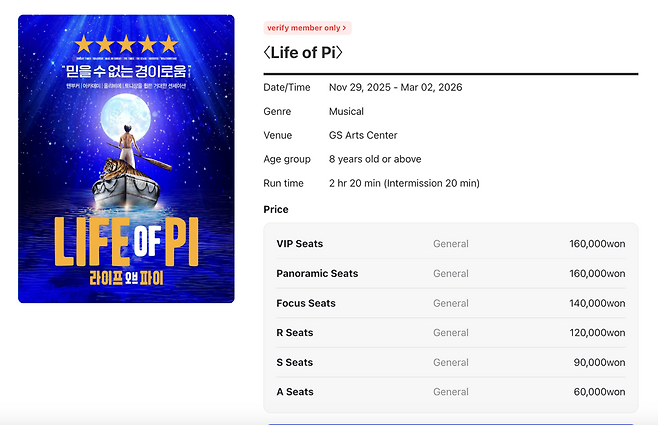
Despite the company’s claims of genre-defying novelty, many audience members seemed unhappy with this categorization. On Nol Ticket, the country’s largest ticketing platform, numerous negative reviews centered specifically on this issue. The confusion was compounded by the casting of Park Kang-hyun, a star famous for vocally demanding musical roles. Fans familiar with Park -- who has done only one play in his 10-year career -- likely bought tickets expecting a musical.
"The theatrical grammar of the piece was excellent. The puppeteers, in particular, were outstanding; the puppets truly felt like they were alive," Choi Seung-youn, a musical critic and professor, told The Korea Herald on Monday.
"I suspect the production company wanted to highlight the multidisciplinary nature of the work, emphasizing the blend of video, puppetry, acting and lighting," Choi explained. "Perhaps they thought of it as a musical because musicals are often viewed as a convergence of different arts. However, music -- the most critical element of a musical -- is not the center of this production."

While a growing number of performances truly defy categorization -- such as the immersive "Sleep No More," which hit Korea this summer -- "Life of Pi" is structurally a traditional play. Therefore, it is difficult to sympathize with the production company’s purported dilemma over genre classification. As one review bluntly asked: "Why is it pretending to be a musical?"
The answer likely lies in market economics. In Korea, musicals dominate the performing arts sector, accounting for approximately 70 percent of total revenue as of 2024. Ticket prices reflect this disparity: top-tier musical tickets range from 160,000 to 190,000 won, whereas plays rarely exceed 100,000 won. Placing a show in the "musical" category not only justifies a higher price point but also guarantees significantly greater exposure.
Unfortunately, the questionable categorization of "Life of Pi" is not an isolated case. It reflects a broader trend where imported plays or avant-garde productions are listed as musicals on local platforms. Recent examples include "Sleep No More" and the stage adaptation of "Spirited Away," both of which were marketed alongside traditional musicals despite their origins.
While there is a need for new categories to accommodate the growing number of genre-defying performances, in the case of "Life of Pi," the focus should have been on its unique contribution to the art of theater. Notably, its seven-person puppetry ensemble became the first collective winner of the best supporting actor award at the 2022 Laurence Olivier Awards -- specifically in the play category.
Copyright © 코리아헤럴드. 무단전재 및 재배포 금지.