Education Ministry to ease tuition control for universities
전체 맥락을 이해하기 위해서는 본문 보기를 권장합니다.
University groups lauded the government's decision. The Korean Council for University Education said Monday that the new policy would "provide an opportunity to restore universities' autonomy and strengthen the qualitative competitiveness of higher education."
It described the move as "a government decision aimed at overcoming the financial constraints facing universities after years of frozen tuition, and at proactively responding to a rapidly changing future society marked by artificial intelligence (AI) and the digital transformation."
이 글자크기로 변경됩니다.
(예시) 가장 빠른 뉴스가 있고 다양한 정보, 쌍방향 소통이 숨쉬는 다음뉴스를 만나보세요. 다음뉴스는 국내외 주요이슈와 실시간 속보, 문화생활 및 다양한 분야의 뉴스를 입체적으로 전달하고 있습니다.
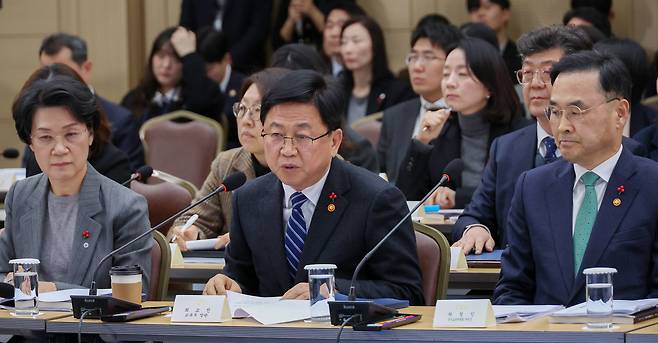
The Ministry of Education is set to ease regulations on private university tuition starting in 2027, confirming plans to end an 18-year-old scholarship system that effectively put restraints on tuition hikes.
The Type II National Scholarship, which couples tuition increases with scholarship eligibility, is to be eliminated in 2027, the ministry said Friday. The decision comes as many universities report mounting financial strain after years of tuition controls.
“Considering the deteriorating financial conditions of private universities and the need to expand investment in education, the government will abolish ancillary regulations beyond the statutory tuition cap,” the ministry said in a policy report submitted to the president.
The Type II National Scholarship is a government program designed to reduce students’ tuition burdens by supporting universities that freeze or lower tuition and maintain their own scholarship funding. Unlike the Type I scholarship, which is awarded directly to students based on household income, Type II funds are allocated to universities after the government evaluates their tuition policies and financial aid efforts.
Universities then distribute the scholarships to students according to their own criteria, with priority often given to students from lower-income backgrounds or those facing heavier tuition burdens.
The government introduced the Type II scholarship program in 2009 to incentivize a de facto tuition freeze across much of the higher education sector, following the 2008 global financial crisis.
According to the Korean Council for University Education, inflation-adjusted tuition at private universities fell 22.5 percent, from 8.85 million won ($6,000) in 2011 to 6.86 million won in 2023.
There have been concerns that the universities are facing steadily worsening finances, as tuition failed to keep pace with inflation. This is thought to have left the institutions struggling to cover personnel and operating costs, let alone invest in educational innovation or campus facilities.
With the ministry signaling that it will no longer enforce a blanket freeze, private universities are expected to move more autonomously this year, setting tuition levels through their internal deliberation committees without concern over government restrictions.
University groups lauded the government's decision. The Korean Council for University Education said Monday that the new policy would “provide an opportunity to restore universities’ autonomy and strengthen the qualitative competitiveness of higher education.”
It described the move as “a government decision aimed at overcoming the financial constraints facing universities after years of frozen tuition, and at proactively responding to a rapidly changing future society marked by artificial intelligence (AI) and the digital transformation."
The Korean Council for University College Education also issued a statement, saying it expects the measure to “help ease the accumulated financial management burden on universities resulting from the long-standing tuition freeze."
Still, some critics say the changes may not amount to steep and immediate tuition hikes. Universities must continue to adhere to the statutory cap on tuition hikes, which limits increases to within 1.2 times the average inflation rate over the previous three years.
Meanwhile, the Education Ministry said Monday that the deregulation move is unrelated to the government’s plan to foster “10 Seoul National Universities,” a flagship pledge by President Lee Jae Myung to significantly boost funding for nine public universities nationwide.
Some had questioned whether the government was turning a blind eye to private universities raising tuition in an effort to placate them after being excluded from the public university initiative. The ministry dismissed the claim, stressing that the two policies are being pursued independently.
Copyright © 코리아헤럴드. 무단전재 및 재배포 금지.