Tariff barriers hit record high as countries race to raise tariffs: WTO
전체 맥락을 이해하기 위해서는 본문 보기를 권장합니다.
The WTO noted, in particular, that "tariffs applied to imports across the G20 expanded by about four times compared with the same period a year earlier."
"The EU is an important region for Korea as a market that can substitute for the United States and China," said Jang Sang-sik, head of the International Trade Research Institute at the Korea International Trade Association. "The U.S. and the EU are also expected to build a shared economic network over the long term."
이 글자크기로 변경됩니다.
(예시) 가장 빠른 뉴스가 있고 다양한 정보, 쌍방향 소통이 숨쉬는 다음뉴스를 만나보세요. 다음뉴스는 국내외 주요이슈와 실시간 속보, 문화생활 및 다양한 분야의 뉴스를 입체적으로 전달하고 있습니다.
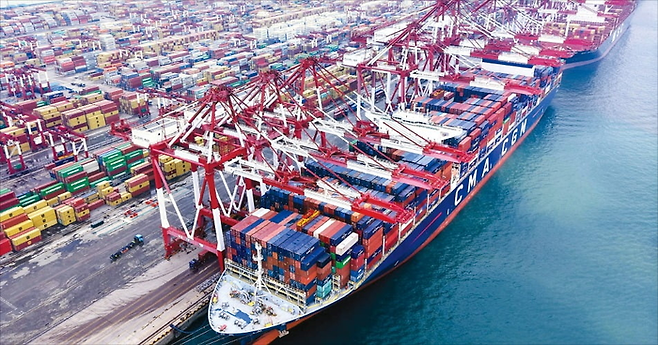
According to a report released on Sunday by the World Trade Organization (WTO), which monitored G20 trade developments over the past year, the value of goods affected by import-restrictive measures taken by individual countries totaled $4.1 trillion during the one-year period from October last year through October this year.
The figure is up 74 percent from $2.35 trillion recorded in the same period a year earlier.
The share of these goods in total G20 imports rose from 12.9 percent to 22 percent over the past year, while their share of global imports increased from 9.9 percent to 16.8 percent.
During this period, G20 countries implemented a total of 185 trade-restrictive measures, the highest number since the WTO introduced its trade monitoring mechanism in 2009.
The WTO noted, in particular, that “tariffs applied to imports across the G20 expanded by about four times compared with the same period a year earlier.”
It added that “the increase is likely a ‘structural change’ rather than a ‘short-term shock.’”
Major economies are also set to roll out an additional series of regulations next year that could affect Korean companies.
A representative example is the European Union’s (EU) Carbon Border Adjustment Mechanism (CBAM), which imposes a cost proportional to carbon emissions on steel, aluminum, cement, and other products exported to the EU, effectively functioning like an additional tariff.
Under this system, companies exporting these products to the EU will face tangible burdens starting next year, such as having to purchase certificates that reflect the prices of the EU Emissions Trading System.
While relevant Korean ministries, including the Ministry of Trade, Industry and Energy, are taking measures such as holding briefings for companies, the impact on exporting companies appears unavoidable.
The EU and Canada are also tightening their steel import rules.
Canada has decided to lower the low-tariff quota threshold from 100 percent to 75 percent for free trade agreement (FTA) partners, including Korea, starting at the end of this month, and to impose a 25 percent tariff on steel derivative products.
The EU is also expected to cut its duty-free steel import quota by 47 percent around June next year.
The tariffs on steel not covered by the quota are projected to rise from the current 25 percent to 50 percent.
“The EU is an important region for Korea as a market that can substitute for the United States and China,” said Jang Sang-sik, head of the International Trade Research Institute at the Korea International Trade Association. “The U.S. and the EU are also expected to build a shared economic network over the long term.”
Even if Korea’s current exports to the EU are not substantial, he emphasized the need for close attention, given the EU’s potential to replace the U.S. as a high-value goods market in the long run and the possibility that EU trade regulations could spread to the U.S.
Jang also noted that Korean electric-vehicle companies may expand their entry into Eastern Europe as the EU builds higher barriers.
Major countries are also taking measures that could affect Korean companies, even beyond traditional trade regulations such as tariff hikes or non-tariff barriers.
The U.S. decision to suspend electric-vehicle subsidies worth $7,500 since September is also aimed at protecting its domestic industries and supply chains.
“The U.S. could roll back benefits or incentives that were implemented under the Joe Biden administration next year as well,” Jang noted.
Furthermore, procedures required to qualify for benefits under the Inflation Reduction Act (IRA) and the CHIPS Act could become more complicated.
Meanwhile, the U.S., which spearheaded these strengthened trade measures, has actually seen its goods trade deficit widen over the past year.
According to the U.S. Department of Commerce on Sunday, the country’s cumulative goods trade deficit from the start of this year through September reached $978.7 billion, up about 12 percent from $872.5 billion in the same period last year.
This was partly due to U.S. companies increasing imports in the first quarter on a stockpiling basis amid expectations of tariff hikes following Donald Trump‘s election as president.
At the same time, side effects such as rising prices are intensifying.
An analysis by regional research units of the U.S. Federal Reserve (Fed) estimates that tariffs pushed up the U.S. personal consumption expenditures (PCE) price index by about 0.5 percentage point as of this summer.
Copyright © 매일경제 & mk.co.kr. 무단 전재, 재배포 및 AI학습 이용 금지
- “10억 굴려서 언제 돈 버나요”…300억 이상 찐부자가 돈 빨아들인다 - 매일경제
- 만원 열차 바닥 주저앉아 과제하던 학생…영국 왕실 공주님이었네 - 매일경제
- “아들이 재수학원에 등록했습니다”…유독 서울에 이런 집 많다는데 - 매일경제
- "강북 대장인데"… 성수 재개발 '빨간불' - 매일경제
- 비만약 지나면 ‘회춘약’ 시대…전세계 노인 지갑 열게 할 기술이 한국에? - 매일경제
- “어머님 김장하셨어? 손맛 여전하시네”…대형마트 PB에 깜빡 속았다 - 매일경제
- “갚으면 다신 이 돈 못 빌려”…돈 생겨도 상환 못 하는 영끌족, 왜? - 매일경제
- “개미들, 매년 4500억씩 월가에 바치는 꼴”...금감원도 뜯어말리는 이 투자 - 매일경제
- “중국인과 식사 중” 눈 찢는 사진에…미스 핀란드, 왕관 박탈 - 매일경제
- 손흥민, MLS 최고 영입 2위 선정…“조금 더 빨리 이적했으면 1위, 데뷔 시즌부터 인상적” - MK스