'Avatar' director James Cameron makes a case for human touch
전체 맥락을 이해하기 위해서는 본문 보기를 권장합니다.
Cameron, speaking to Korean reporters Friday ahead of the film's release, didn't have to think long. "Every shot took a long time and required a lot of energy."
"Fire in this story represents hatred, violence, chaos and trauma," he said. "The Ash clan is the result of that. They've gone through a traumatic time. Their homeland was destroyed, and they've reacted by taking that sense of powerlessness and pain out on everybody else."
이 글자크기로 변경됩니다.
(예시) 가장 빠른 뉴스가 있고 다양한 정보, 쌍방향 소통이 숨쉬는 다음뉴스를 만나보세요. 다음뉴스는 국내외 주요이슈와 실시간 속보, 문화생활 및 다양한 분야의 뉴스를 입체적으로 전달하고 있습니다.
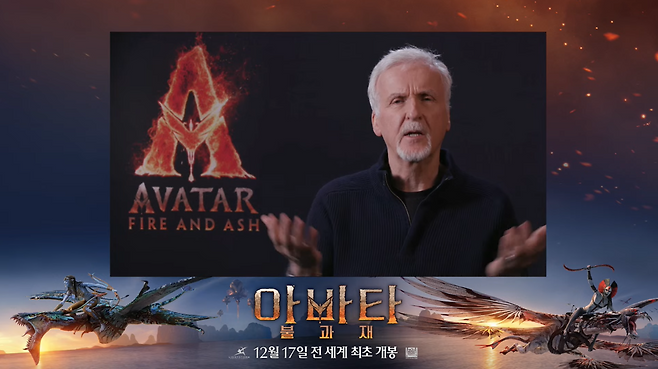
Which scene gave director James Cameron the most trouble on the upcoming "Avatar: Fire and Ash"?
Cameron, speaking to Korean reporters Friday ahead of the film's release, didn't have to think long. "Every shot took a long time and required a lot of energy."
He ticked off the numbers: Over 3,000 people. Four years. Some 3,500 VFX (visual effects) shots. "Basically every shot was a VFX shot," he said.
That's the sheer scale of the operation behind the third "Avatar" instalment, which arrives in Korean theatres on Wednesday -- two days ahead of its US premiere.
Cameron joined Korean reporters via livestream to talk up a film that Disney is banking on to close out the year with a bang. The studio's animated sequel "Zootopia 2" has already been tearing through the local box office — a record clip of 4.36 million admissions in just over two weeks.
"Avatar" plays in a different weight class entirely, and Disney is counting on it to keep the streak going.
They have a good reason to be optimistic. The previous two entries of the franchise — 2009's original and 2022's "The Way of Water" — both cleared 10 million tickets in Korea, the traditional benchmark for megahit status.
The $400 million production picks up after the death of Jake and Neytiri's eldest son, Neteyam. Grief hangs over the Sully clan as they confront a new enemy: the Ash People, a volcanic Na'vi tribe led by Varang, a warrior queen with a chip on her shoulder and a knack for brutality.
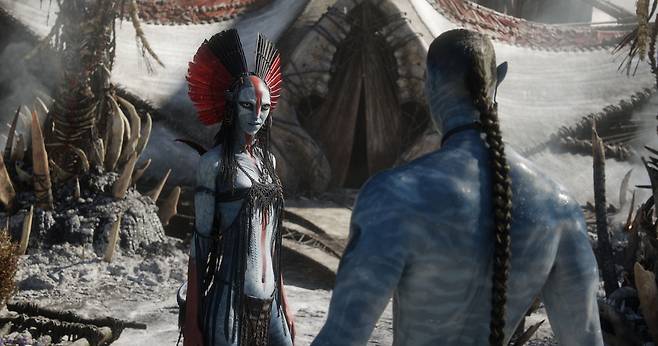
Cameron described the fire-born tribe as the product of catastrophe — survivors of a homeland scorched to nothing who've channelled their trauma into violence against anyone in their path.
"Fire in this story represents hatred, violence, chaos and trauma," he said. "The Ash clan is the result of that. They've gone through a traumatic time. Their homeland was destroyed, and they've reacted by taking that sense of powerlessness and pain out on everybody else."
The director said he drew inspiration from a 2012 National Geographic expedition to Papua New Guinea, where he encountered a town buried under volcanic ash. "That image stuck with me. What if they didn't leave? What if they stayed in the home tree their clan had lived in for thousands of years, and it's just burned down?"
But the heroes-versus-villains stuff isn't really the point. Cameron kept circling back to family at the story's heart — a theme he traced directly to his own life.
"I have five children. I was a kid in a large family growing up," he said. "All my teenage anxieties, my rebellion, I've gotten to see it from the other side now as a father."
That's what he brought to Pandora this time around: the whole messy business of keeping a family together. "People are telling me this is the most emotional of the films. That was certainly our goal."
Then came the question of using generative AI in filmmaking. It's a hot-button issue in Hollywood these days. Actors and writers walked off the job just two years ago, demanding protections from the technology, and studios are still figuring out where the guardrails should go.
For Cameron, the idea of replacing performers with AI was a nonstarter. "We have never used generative AI on the 'Avatar' films," he said. "The broad public doesn't really understand how we make these movies. They see the end result and think it's some kind of computer thing."
What AI can't replicate, he argued, is the singular quality a human actor brings — the specificity, the texture, the lived experience. "If you just want mediocrity and generic, then yes, by all means, use generative AI. But that's not what we want."
The problem is that AI models are trained on vast datasets and produce something that is "simultaneously everything and nothing," to use Cameron's own words. Their output lacks that personal stamp and can't replicate what a performer brings to a role, he explained. "Their entire life goes into every single moment they are creating that character."
Still, Cameron wasn't ready to write off the technology entirely. With VFX costs ballooning and worldwide theatrical revenues down roughly 30 percent from prepandemic levels, AI might be the only way forward for certain kinds of filmmaking, as a tool to streamline workflows and lower costs.
"The type of movies I like to make — fantastic science fiction with a lot of imaginative elements — may become extinct. They may be an unsustainable business model," he said.
"I don't want to replace artists. I certainly don't want to replace actors. I want to empower them to work more efficiently."
Copyright © 코리아헤럴드. 무단전재 및 재배포 금지.