USFK chief says Seoul must be more realistic about timing of OPCON transition
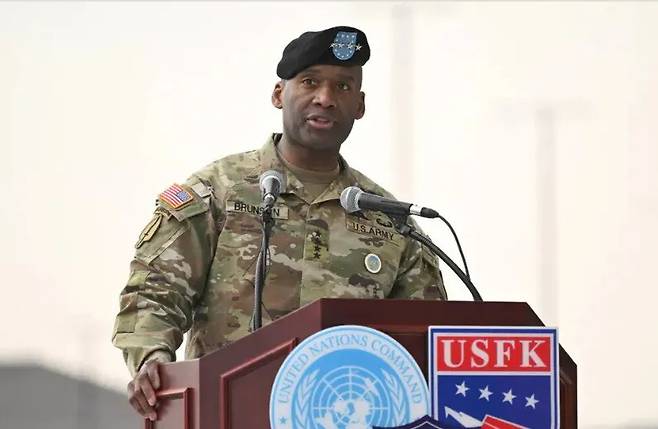
The highest-ranking military officer of the United States Forces Korea called on the allies to reassess conditions for the transfer of wartime operational control, stressing that the process should not be driven by political timelines.
“I know that right now President Lee says he wants to do this during his term of office,” US Gen. Xavier Brunson, also the commander of the South Korea-US Combined Forces Command, said during a webinar hosted by the Korea Defense Veterans Association on Friday.
“Well, we know the start point and we know the endpoint, so we’ve got to meet the conditions in that time — but we’ve also got to be willing to say we can’t get there from here,” he said.
Brunson, who assumed his post in December 2024, said the OPCON transition debate should focus on whether allied forces are genuinely organized, resourced and trained to meet the demands of future conflict, particularly as the nature of warfare continues to evolve.
“Are you truly ready?” he asked. “Is your force-sizing construct correct? Do you have maybe too many corps, when what you really need is fewer corps, better equipped, better manned, better trained?”
Brunson stressed that the OPCON transition remains strictly conditions-based and rejected any notion of flexibility in evaluating readiness.
“There is no sliding scale,” he said, adding that the conditions jointly agreed upon by Seoul and Washington “were written for a reason.”
Seoul has been pushing to complete the transfer within Lee’s term, one of the South Korean president's major policy priorities.
In recent defense ministerial talks, Seoul and Washington also agreed to craft a road map to "expedite" the implementation of OPCON transition conditions, while reaffirming that all bilaterally agreed conditions must be met before wartime operational control is transferred in a "systematic, stable and proactive" manner.
South Korea handed over operational control of its troops to the US-led United Nations Command during the 1950-53 Korean War. It was later transferred to the two allies’ Combined Forces Command when the body was launched in 1978. Wartime OPCON remains under US control, while Seoul regained peacetime operational control in 1994.
For the transition, the allies adopted a conditions-based OPCON transition framework in 2014, requiring Seoul to complete three stages: Initial Operational Capability, verified in 2019; Full Operational Capability, planned for 2026; and Full Mission Capability, the final stage before the handover.
Speaking at the same webinar, however, Brunson cautioned against assuming that such commitments alone would guarantee a smooth transition.
He said allies must engage in what he repeatedly described as “tough conversations” to determine whether current force posture, resources and command arrangements truly meet the agreed conditions.
“We’ve got to start having these conversations now before we get into conflict, and we ought to try to describe the conditions which we believe will exist in the future, as opposed to saying, ‘Yeah, we’ll figure it out when we get there,’” he said.
On the allies' readiness, Brunson stressed that joint exercises remain central to their deterrence posture, describing training as inseparable from real-world warfighting capability.
“An exercise is nothing more than a rehearsal by a new name,” he said, warning that tasks not practiced during training cannot be reliably executed in an actual contingency.
He also emphasized that training must be conducted in a contextual manner, reflecting the actual operational environment commanders may face on the Korean Peninsula, cautioning against reliance on abstract planning or simulations alone.
“We are in contact right now,” he said, referring to ongoing competition across multiple domains, including cyber, electronic warfare and space.
Copyright © 코리아헤럴드. 무단전재 및 재배포 금지.