South Korea’s KAIST to launch stand-alone AI college in 2026 amid global talent race
South Korea’s top science and engineering university will launch a stand-alone artificial intelligence college in 2026, a move aimed at rapidly expanding the country’s capacity to train AI specialists amid intensifying competition for global talent.
According to the Ministry of Science and ICT and the Korea Advanced Institute of Science and Technology, the KAIST board approved the creation of the new AI college at a meeting on Thursday, with student recruitment set to begin next year.
KAIST said the initiative marks the first time a Korean university has elevated AI to an independent college-level unit.
The new college will significantly increase KAIST’s AI education capacity. The university plans to enroll a total of 300 students annually, including 100 undergraduates and 200 graduate students, with the latter split between master’s (150) and doctoral (50) programs, according to KAIST. Overall, student quotas at the university will be expanded by the same number to accommodate the new intake.
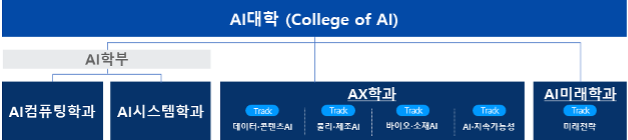
The AI college will comprise four departments covering the full AI value chain, from core software and hardware to industrial applications and societal impact:
- The AI Computing Department will focus on foundational theory, algorithms, mathematics and systems that underpin modern AI models. Government and university briefings said the curriculum will include recent advances such as generative AI, multimodal AI, which integrates text, images and other data types, and agent-based AI systems that can autonomously plan and act.
- The AI Systems Department will train hardware specialists, with coursework spanning AI semiconductors, high-speed communications and power and thermal management. These areas are critical for running large-scale AI models efficiently, particularly in data centers and edge devices.
- The AX, or AI Transformation, Department will emphasize practical deployment, applying AI directly to manufacturing, content, bio and materials science and sustainability challenges across industry and society.
- The AI Futures Department will focus on ethics, policy, economics and governance, examining how AI reshapes regulation, labor markets and public institutions.
Undergraduate programs will begin in the spring semester of 2026. Because KAIST operates a department-free system in the first year, students advancing to their second year will be able to choose one of the four AI majors as their primary field of study, the university said. Graduate programs will open in the fall semester of 2026, with detailed admissions quotas by department to be finalized later based on research demand.
The science ministry said the KAIST initiative is part of a broader national policy to secure leading AI technologies and talent. Beginning in 2027, similar AI colleges are planned at Gwangju Institute of Science and Technology, Daegu Gyeongbuk Institute of Science and Technology, and Ulsan National Institute of Science and Technology, each aligned with regional strategic industries, according to the ministry.
The move comes as KAIST gains stronger global recognition in AI. In ShanghaiRanking Consultancy’s 2025 Global Ranking of Academic Subjects, which introduced AI as a standalone field for the first time, KAIST ranked No. 39 worldwide.
Copyright © 코리아헤럴드. 무단전재 및 재배포 금지.