From Chun Doo-hwan to Yoon Suk Yeol: How a 1979 coup still defines insurrection law
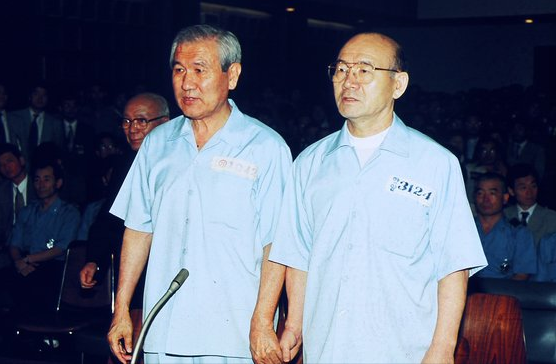
The sky was dark on Aug. 26, 1996, as summer rain tapped gently on the windows of the Seoul Central District Court. A 65-year-old man in a light turquoise prison jumpsuit, the number 3124 stamped on his chest, stood upright with a faint, almost defiant grin.
Beside him, inmate 1042 looked far more shaken, with bloodshot eyes and graying hair parted carefully to the left. The two held hands as the judge read out their names: Chun Doo-hwan and Roh Tae-woo.
Once friends and military comrades, the pair had climbed the ranks together. Their rise began after the 1979 assassination of President Park Chung-hee, when Chun, who led the early investigation, seized control of the military on Dec. 12, 1979. His takeover ushered in yet another decade of authoritarian rule.
Chun’s regime violently suppressed the 1980 Gwangju Democratic Uprising and sent thousands to reformatory camps. Roh, his closest ally, later succeeded him after the 1987 June Democratic Struggle forced Chun to step down.
Both were tried in 1996 for insurrection. Chun received a death sentence, later commuted to life imprisonment by the Supreme Court; Roh was handed a 17-year term.
Friday marked the 46th anniversary of the Dec. 12 coup, an event drawing renewed attention amid comparisons to former President Yoon Suk Yeol’s abrupt martial law decree on Dec. 3, 2024.
Why Chun’s coup was ruled an insurrection
The trial is often remembered for establishing what many Koreans summarize as: “Even successful coups can be punished.” But a larger legacy lies in providing Korea’s first detailed judicial definition of insurrection.
“It was previously regarded that a coup was simply a political act,” said Shin Ha-na, an attorney at Deoksu law firm. “But the trial showed that even if you seize power through military insurrection, it remains unacceptable and punishable if you act outside constitutional and democratic processes.”
Korean law defines insurrection as stirring violence to usurp national territory or subvert the Constitution.
During the trial, Roh argued that insurrection requires the actual violent seizure of part or all of the nation’s territory, something he claimed had not occurred. The Supreme Court rejected that narrow interpretation and expanded the legal meaning of violence to encompass coercive acts.
“Violence includes all forceful actions taken to accomplish the goal of subverting the Constitution. Intimidation, in the broadest sense, refers to any notice of harm capable of coercing a person and causing fear, extending even to acts that prepare for or assist such intimidation.”
In practical terms, the Court found that acts inducing fear — including Chun’s 1980 nationwide expansion of martial law, issued without constitutional grounds — qualified as violent acts under insurrection law.
“The Court held that declaring martial law without meeting its prerequisites, when done to undermine constitutional order, constitutes violence,” said Choi Sae-yan, an attorney with Lawyers for a Democratic Society. She added that deploying troops to surround or enter constitutional institutions inherently violates civil rights and generates fear.
How the court defined ‘subverting the Constitution’
Chun and Roh also argued that they had never intended to overthrow the constitutional system; the Court ruled that the purpose could be inferred from circumstances, even when suspects deny it.
“Subverting the Constitution means forcefully overthrowing a constitutionally established institution or rendering it unable to exercise its lawful powers,” Shin explained.
Choi noted that constitutional subversion does not require permanently banning an institution, and that even temporarily paralyzing its powers can qualify.
How the 1997 Supreme Court ruling applies to Yoon Suk Yeol
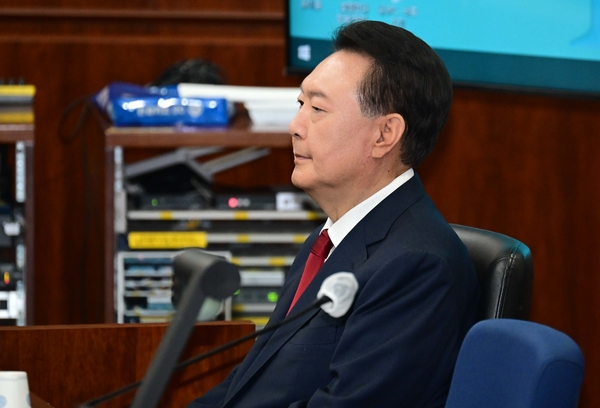
Forty-six years after Chun’s coup, and nearly three decades after the Supreme Court affirmed his life sentence, former President Yoon Suk Yeol now faces trial in the same courtroom, charged with the same offense: leading an insurrection.
Yoon's attorney Seok Dong-hyun argued last year that the former president declared martial law only because he faced “severe political pressure and obstruction from the opposition,” not to seize power. He also contended that “logically, there was no act of violence.”
Legal experts say the 1996 ruling points in a different direction.
Shin noted that investigative records showed discussions within Yoon’s circle about potentially occupying the National Assembly, arresting opposition leaders and even execution in certain scenarios.
“If military forces are mobilized to occupy the National Assembly, arrest opposition leaders, or disable legislative functions through force,” she said, “then the purpose of subverting constitutional order is highly likely to be established.”
Shin added that Yoon’s declaration of martial law without meeting substantive or procedural requirements, combined with the movement and deployment of troops and their entry into the National Assembly grounds, would qualify as violent acts under the Supreme Court’s definition.
Choi’s legal assessment echoed Shin's.
“Attempting to enter the National Assembly with troops, blocking the legislature, forming arrest squads for politicians, attempting detentions, occupying the National Election Commission, and issuing Martial Law Proclamation No. 1 all constitute actions aimed at ‘subverting constitutional order’ and ‘seizing control of the constitutional system,’” she said.
She added that the Constitutional Court’s impeachment decision already found Yoon’s martial law decree lacked both substantive and procedural justification, leaving little room for Yoon’s arguments under the 1996 legal framework.
Shin also criticized aspects of the martial law proclamation that threatened punitive measures against medical residents, noting that coercive notices of harm could qualify as intimidation — and therefore as violent acts — under the Chun precedent.
Legal observers expect Yoon’s trial to extend into next year, with sentencing viewed as possible no earlier than February.
Copyright © 코리아헤럴드. 무단전재 및 재배포 금지.