Playful 'Twelfth Night' finds new style in Joseon-era rom-com
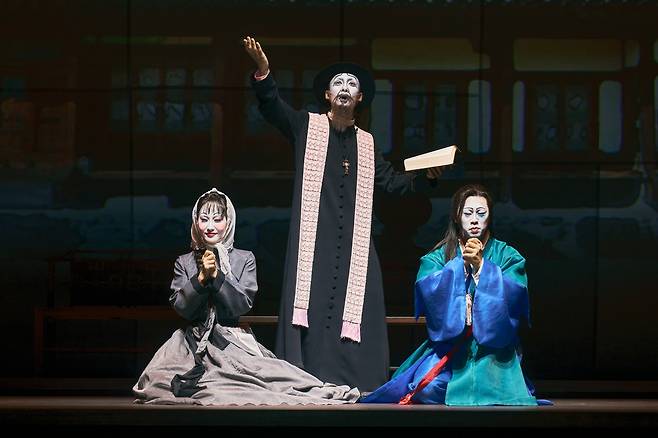
Love stories perhaps thrill us most when they survive a maze of missteps and misunderstandings. Shakespeare’s “Twelfth Night” is the quintessential romantic comedy, built on a playful tangle of disguise, mistaken identity and a love triangle that somehow finds its way to a perfectly happy ending.
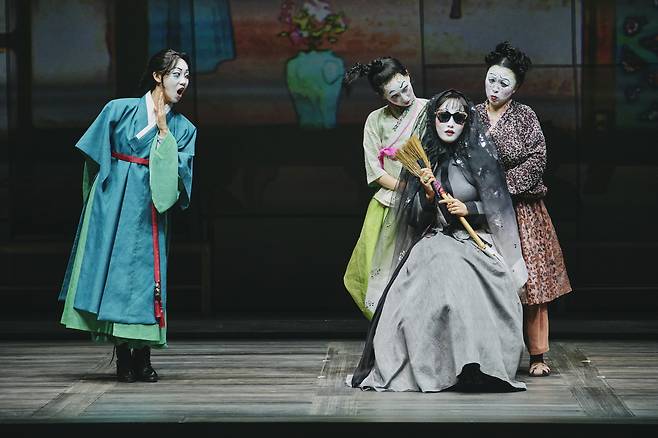
The National Theater Company of Korea’s recent adaptation relocates the play to Nongmeori, a coastal village that corresponds to today’s Sammok Ferry Terminal area in Incheon, during the Joseon era (1392-1910).
The production premiered last year in Daejeon and returned to Seoul in this summer. In October, it was invited as the closing performance of the Beijing Fringe Festival, where its two-night run sold out, marking the company’s first appearance in China in nine years. It is now set to head to the Hong Kong Shakespeare Festival early next year.
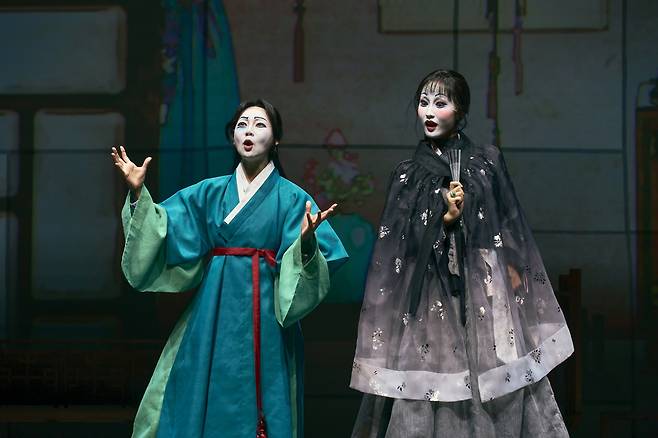
For director Im Do-wan, the shift to a Korean setting was essential from the start.
“We wanted this piece to carry a distinctly Korean sensibility, and the company asked for that, too,” he recalled in an interview with The Korea Herald. “So we placed it in a Joseon-era village, but I thought we could avoid anything too old-fashioned by mixing in contemporary elements.”
The plot remains faithful to Shakespeare. Twin siblings Shin-ae and Mi-eon are separated in a shipwreck, each believing the other dead. Shin-ae disguises herself as a young man named Man-deuk, entering the service of Oh Sa-ryong, a young nobleman preoccupied with courting Seo-rin, a noblewoman from the village. Man-deuk quietly admires her master, but when Man-deuk delivers Oh’s heartfelt message, Seo-rin unexpectedly falls for the disguised Shin-ae. Meanwhile, Mi-eon also arrives in the village, setting off a cascade of confusion and comic mishaps as the villagers mistake the twins for one another.
Onstage, the old and new coexist with an almost mischievous freedom. Pansori interludes collide with rap. Performers wear hanbok layered over tracksuits.
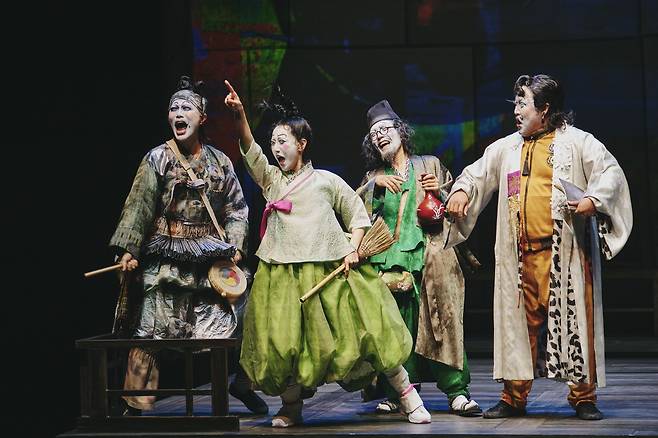
“We tried every strange idea. If I’d done this in my school days, people would’ve said I was crazy. But now? It’s trendy. Audiences are already familiar with this kind of mash-up,” the director explained.
A familiar Im trademark returns as well: the masklike, white-painted faces with brows and lips sharply accentuated. He employs the technique, he said, to accentuate personality traits, sharpening contours to bring each character into sharper relief.
For all its playfulness, the adaptation rests on Im’s meticulous research, from authentic period names to the surprise appearance of a Catholic priest, a nod to French missionaries who began arriving in Korea in the 1840s.
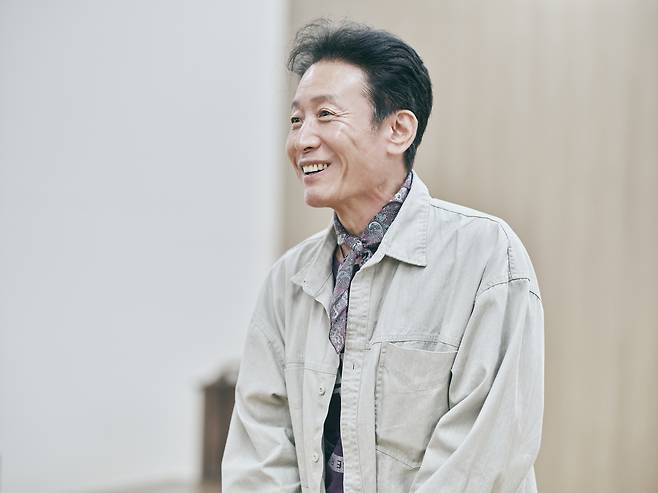
This is not Im’s first success abroad. His dance-theater production of “Woyzeck,” created with the Sadari Movement Laboratory, has toured 25 countries since 2005. As the head of the movement-driven troupe, Im builds his theater from the body outward rather than from the text.
“My first question is always: How does the character move? Even something as simple as a walk determines everything from the character’s status and temperament. Many actors think with their heads first, but for me, once you adjust the walk, the entire picture changes.”
He offered a simple example: A servant leans forward, body pitched toward the next task, ready to sprint at a master’s call. Someone who leans back, by contrast, signals distance, or higher status, without saying a word.
His sensitivity to physical language is especially potent in comedy, where he believes precision matters far more than force.
“Comedy is the hardest thing in acting and directing. You can’t push for laughs. And you must never ‘beg’ for them,” he said. “The moment an actor tries to be funny, the audience sees it. And it ruins the show.”
Comedy may be more demanding, but the genre carries a unique restorative power.
“Comedy has a kind of resilience. We’ve been through a great deal of turmoil, and I simply hope audiences can relax a little and leave with more laughter on their faces.”
Copyright © 코리아헤럴드. 무단전재 및 재배포 금지.