Can the past save the present?
When Han Kang delivered her Nobel Prize lecture last year, her question, “Can the past save the present?” reverberated far beyond the hall in Stockholm. Her meditation on memory against violence resonated deeply in Korea, resurfacing debates about military dictatorship and the enduring wounds of state power.
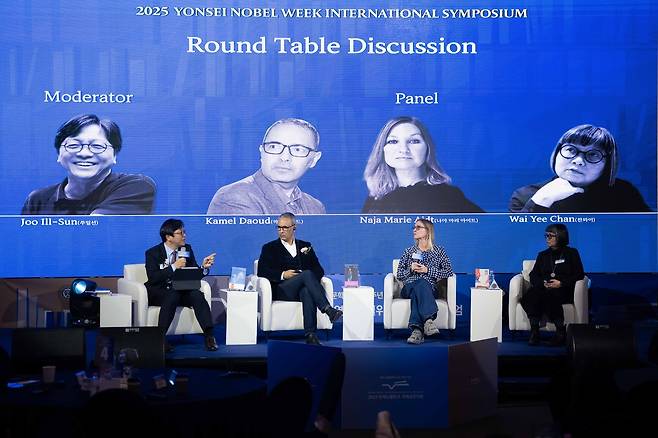
One year on, Yonsei University, Han’s alma mater, has inaugurated Yonsei Nobel Week, a symposium devoted to revisiting that question and exploring how literature can confront trauma, surface suppressed histories and chart paths toward understanding.
The program on Thursday convened three writers whose work embodies the force of testimony: Algerian-born French novelist Kamel Daoud, Danish writer Naja Marie Aidt and Hong Kong writer Wai Yee Chan. Each has written from the fault lines of violence, crafting narratives that resist erasure and bear witness to what histories often silence.
Writing against forgetting
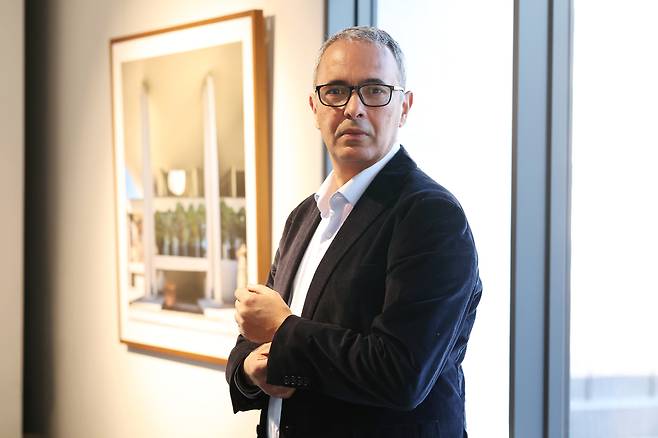
There is a country where “remembering” is forbidden by law, according to the Algerian-born French novelist and journalist Kamel Daoud. His 2024 novel “Houris,” which won the Goncourt Prize last year, is prohibited in Algeria. For writing about the tragedy of the Algerian Civil War (1991-2002), a subject the Algerian constitution bars from public mention, he faced two arrest warrants and mounting threats to his safety. He left Algeria two years ago and has since continued writing from France.
“I doubt any other country in the world has a law that forbids the act of remembering,” Daoud said at a press conference at the French Embassy in Seoul on Dec. 3, ahead of a symposium.
“The only way to resist institutionalized forgetting is through writing and testimony, by refusing to abandon those who suffered. The most painful kind of death is to be erased from memory, and writing is the only means of ensuring the victims of the past are not lost.”
Set in 2018, “Houris” bears witness through a young girl who survived a massacre committed during clashes between the Algerian military and Islamist forces. Marked by a scar that cuts across her face, she has lost her voice after damage to her larynx and vocal cords; the novel opens as she speaks silently to the daughter she carries.
“But I want to be clear,” he added. “I am not in conflict with my country. I am in conflict with the regime that has stolen my country.”
A former journalist who covered the Algerian Civil War, Daoud turned to fiction because it allowed him to ask questions. “You write novels when there is no answer. A novel is an act of inquiry following characters as they confront contradictions in reality and search for ways to endure.”
“I write in order to live in the present,” he said, “because life exists after pain, after death -- life continues.”
Loss becomes language, language becomes connection
When her son died, the Danish writer Aidt felt her language slip away. The shock was so traumatizing that she could no longer recognize herself — neither as a person nor as a writer. For a long time, it was impossible to write coherently.
What followed was a terrifying sense of dissolution. “Suddenly time was no longer continuous. The past disappeared with the deceased, and there was no future either,” she said.
Aidt likened the traumatic process to radiation, something “that lingers in muscle and bone, causing chromosomes to mutate, cells to turn cancerous, life attacking itself. Even if the victim dies, even if the body is cremated, that substance cannot be obliterated.”
Nevertheless, she eventually found a way back through literature. She began writing nine months later, assembling a collage of poems, diary entries, fragments and quotations charting the first year after the death of her 25-year-old son in a tragic accident. In 2017, Aidt published “When Death Takes Something from You, Give It Back: Carl’s Book.”
To find her way back to language, she leaned on the voices of others because her own voice wasn’t strong enough. She sought refuge in the writings of Stephane Mallarme, who wrote after losing his 8-year-old son in 1879, and in the words of Denise Riley, Walt Whitman, Anne Carson, Emily Dickinson and many more.
“Literature reaches out. No matter one’s circumstances, it is possible to find mirrors and answers in books. By sharing our stories across cultures and borders, we bind ourselves to one another,” she said.
Compassion, she believes, grows through reading. “When we read about cultures other than our own, about different societies and life circumstances, we understand, not just intellectually, but with our senses, in our bodies.”
Because stories forge solidarity
For writer and screenwriter Chan, the act of remembering ultimately led her away from her hometown, yet she continues to mourn the past through writing.
Born in Hong Kong, Chan built her career during the city’s Golden Age of Cinema. She was among the first 10 public supporters of the 2014 pro-democracy protests known as the Umbrella Movement, which demanded universal suffrage in the election of Hong Kong’s chief executive. “It was a big trauma,” she recalled, “one that transformed our lives and the very fabric of our society.” In the months that followed, she felt the city split in two.
As political pressure mounted, Chan accepted a university post in Taiwan in 2018 — a decision she described as “the beginning of a prolonged farewell.” After the National Security Law was passed in 2020, she realized she could never return home. Out of that rupture came her 2022 award-winning novel "Brother," which follows two siblings through Hong Kong’s turbulent years from the 1997 handover to the 2019 protests.
Confronting reality felt petrifying. "Like Perseus holding up a mirror so he wouldn’t face Medusa, I created a mirrored Hong Kong to keep writing.”
In Taiwan, she said, people often ask, "Are you okay?" — a question that expects only one polite answer: I’m fine, thank you. “But all I want to say is: I’m not okay. It’s not okay. I don’t want to be okay. I will never be okay. A part of me shattered, and I need to remember the temperature, the sound, the speed, the rage of that shattering.”
Still, she believes in the solidarity that reading can forge. Literature, she said, allows people to step into one another’s histories. “I did not experience the Gwangju Uprising, but by reading Han's 'Human Acts,' I can understand it. Stories help us connect.”
Copyright © 코리아헤럴드. 무단전재 및 재배포 금지.