Trump OKs Nvidia chip exports to China, lifting Samsung, SK hynix outlooks
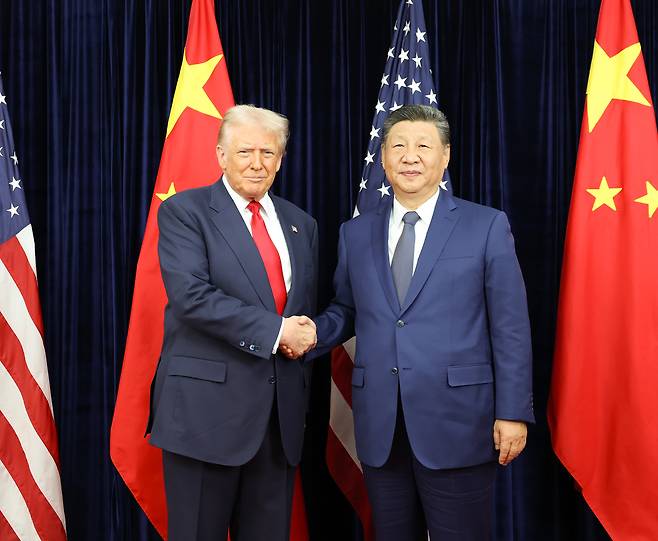
US President Donald Trump has approved exports of Nvidia’s high-performance H200 artificial intelligence chips to China — a move expected to give fresh momentum to South Korea’s semiconductor industry, particularly for Samsung Electronics and SK hynix.
Trump disclosed the decision Monday on Truth Social, saying he informed Chinese President Xi Jinping directly and agreed to allow shipments under a framework that “safeguards US national security.” He also said 25 percent of H200 sales revenue from China will go to the US government, presenting the policy as a way to support American jobs and generate tax revenue.
The H200 is based on Nvidia’s Hopper architecture and delivers far stronger performance than the downgraded H20 chips currently sold in the Chinese market. Although it does not match the latest Blackwell graphics processing units — nor the upcoming Rubin lineup — it remains one of the most powerful AI accelerators available globally. Trump stressed that Blackwell and Rubin chips remain excluded from export approval.
Industry observers say the resumption of higher-end AI chip exports could drive an immediate jump in demand for high-bandwidth memory, or HBM, a critical component that Samsung and SK hynix dominate. Each H200 uses six fifth-generation HBM3E modules, and the two Korean chipmakers jointly control nearly 80 percent of the global HBM supply.
“With Chinese tech companies signaling strong pent-up demand, renewed Nvidia exports are likely to feed directly into higher HBM shipments for Samsung and SK hynix,” an industry official said.
Analysts expect the policy shift to ripple across Nvidia’s entire supply chain, benefiting Korean memory leaders through increased order volumes, stronger pricing power and clearer business visibility into 2025.
Some market watchers view the move as a calculated response to China’s accelerating domestic semiconductor efforts. US export restrictions imposed in 2022 under the prior Joe Biden administration spurred aggressive investment into homegrown AI chips and supporting infrastructure. Firms such as ChangXin Memory Technologies have advanced faster than many in Washington anticipated.
Allowing access to the H200 may help prevent China’s market from shifting too far toward domestic alternatives — while still withholding Nvidia’s highest-end technologies.
Even so, uncertainties remain. China continues to pursue semiconductor self-reliance as a national priority. In September, Beijing banned public agencies and state-owned firms from purchasing certain Nvidia chips, reinforcing its push to reduce dependence on US technology. Analysts expect a hybrid approach: Chinese companies deploying domestic GPUs where they can, alongside imported solutions where AI workloads demand peak performance.
Longer-term gains for Korea may expand if Nvidia broadens the list of export-eligible products. Samsung has already been designated as a key supplier for Nvidia’s HBM3E and next-generation HBM4 products and SK hynix continues to lead in mass HBM production capacity and advanced packaging.
However, the approval remains a limited easing of US export restrictions. The measure is expected to draw scrutiny from US lawmakers and a future shift in administration or congressional stance could retighten controls. Trump framed the decision as a commercial win for the US, but national security officials may push back if China’s AI capabilities accelerate too rapidly.
“Whether this is a tactical, temporary concession or the beginning of a broader policy reset is still unclear,” another senior industry source said. “But as China scales up its AI infrastructure, Korean memory suppliers are positioned to remain at the center of advanced systems — from data-center computing to high-end cloud and AI servers.”
Copyright © 코리아헤럴드. 무단전재 및 재배포 금지.