Samsung Elec, SK hynix to post record earnings in Q4 on strong chip demand
전체 맥락을 이해하기 위해서는 본문 보기를 권장합니다.
"Major customers such as PC and server makers are alleviating their memory cost burdens through product price hikes, which increases the potential for further memory price gains," said Park Yu-ak, an analyst at Kiwoom Securities. "The upward price elasticity for NAND is also strengthening, raising the possibility that NAND contract prices in the first quarter of next year could far exceed expectations."
Citi Global Markets, meanwhile, said in a report published last week that "the memory semiconductor industry is seeing unprecedented levels of order requests," adding that "SK hynix is likely to struggle to fully meet customer demand for memory semiconductors even through 2027."
이 글자크기로 변경됩니다.
(예시) 가장 빠른 뉴스가 있고 다양한 정보, 쌍방향 소통이 숨쉬는 다음뉴스를 만나보세요. 다음뉴스는 국내외 주요이슈와 실시간 속보, 문화생활 및 다양한 분야의 뉴스를 입체적으로 전달하고 있습니다.
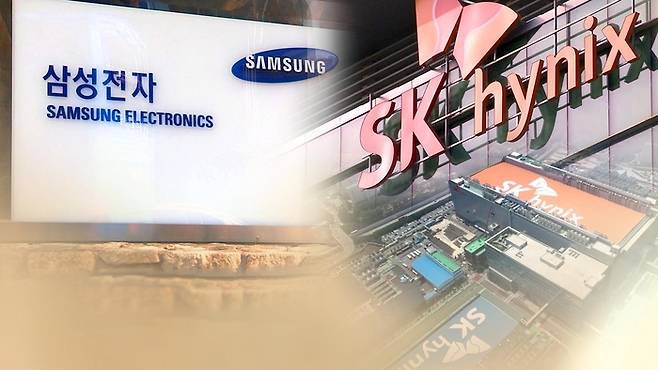
According to Kiwoom Securities Co. on Monday, SK hynix is expected to achieve an operating profit of 16.2 trillion won ($11.02 billion) in the fourth quarter, exceeding the market consensus of 14.6 trillion won.
By business segment, the DRAM division, led by high-bandwidth memory (HBM), is projected to post 15.3 trillion won, up 39 percent from the previous quarter and the NAND division 900 billion won, up 170 percent.
These forecasts exceed the outlook for Samsung Electronics’ semiconductor division.
Samsung Electronics’ Device Solutions (DS) division is projected to post an operating profit of about 15.1 trillion won in the fourth quarter.
Analysts note that demand for HBM has surged rapidly as global big tech companies such as Nvidia Corp. and Google LLC have intensified their competition in developing AI accelerators.
They also said that SK hynix, which has secured leadership in the HBM market, has reaped significant benefits.
The two companies are expected to set a record for the largest quarterly operating profit in Korean corporate history as they stand at the center of the semiconductor super cycle.
The previous record was set by Samsung Electronics in the third quarter of 2018, when it posted 17.57 trillion won in operating profit. Its DS division contributed 13.65 trillion won.
Some observers point to the seasonally slow period for Samsung Electronics’ smartphone and consumer device businesses as a potential variable, but most expect DS profitability to drive overall earnings.
Industry analysts also widely anticipate Samsung Electronics and SK hynix to sustain their strong earnings momentum next year.
With supply shortages in the memory semiconductor market – including general-purpose DRAM – prices continue to soar.
As cloud service companies aggressively build AI data centers and secure memory supplies, rising demand is pushing up prices not only for HBM but for DRAM and NAND across the board.
“Major customers such as PC and server makers are alleviating their memory cost burdens through product price hikes, which increases the potential for further memory price gains,” said Park Yu-ak, an analyst at Kiwoom Securities. “The upward price elasticity for NAND is also strengthening, raising the possibility that NAND contract prices in the first quarter of next year could far exceed expectations.”
“Operating profit for the first quarter of next year is also expected to reach 17.9 trillion won, substantially exceeding market forecasts,” he added.
The expansion of the global semiconductor market is also cited as a foundation for the Korean companies to continue their strong performance.
The World Semiconductor Trade Statistics (WSTS) organization projected in its Autumn 2025 forecast that the global semiconductor market will grow by more than 25 percent next year and reach $1 trillion for the first time.
This brings forward by 4 years its original projection that the market would surpass $1 trillion in 2030.
WSTS also expected this year’s semiconductor market to grow 22 percent from last year to about $772 billion.
Citi Global Markets, meanwhile, said in a report published last week that “the memory semiconductor industry is seeing unprecedented levels of order requests,” adding that “SK hynix is likely to struggle to fully meet customer demand for memory semiconductors even through 2027.”
“Customers are approaching SK hynix to secure volumes,” said Lee Se-chul, head of Global Tech at Citi. “Discussions are underway regarding advance payment terms for three-year long-term supply contracts and even five-year contracts.”
As general-purpose DRAM prices rise, analysts also suggest that the Korean companies will gain leverage in HBM price negotiations.
With HBM appearing relatively inexpensive by comparison, rising DRAM prices – which effectively represent the cost base of HBM – are becoming a key factor pushing HBM prices higher.
Copyright © 매일경제 & mk.co.kr. 무단 전재, 재배포 및 AI학습 이용 금지
- “일진에 끌려다닌 학폭 피해자”...조진웅 후배 증언 나왔다 - 매일경제
- 중국은 거른다더니 월 1000대씩 팔렸다…中전기차 재고떨이 공포 - 매일경제
- “값싼 중국산 배터리 써봤더니”…벤츠가 LG엔솔과 2조 계약 맺은 이유 - 매일경제
- “한달조정 견딘 분만 웃으세요”…58만닉스 만든 ADR 대체 뭐길래 - 매일경제
- 40억 투자했는데 700억 됐다… 유한양행이 대박 터뜨린 ‘이 회사’는 - 매일경제
- “코스닥 좋았는데 이러기야?”…대장은 이사가고, 좀비만 집지키네 - 매일경제
- 반도체 투톱 '30조 영업익' 신기록 예고…칩 품귀에 호황 더 간다 - 매일경제
- [단독] 신용산 조합장 실종사건…가족에 입주권 뿌렸다가 구속돼 사업 발목 - 매일경제
- “졸업해도 백수 신세”…대학생 10명 중 6명 ‘소극적 구직’ - 매일경제
- 이정후, 결국은 포지션 이동? 샌프란시스코 GG 출신 중견수에 관심 - MK스포츠