Judiciary, legal circles warn ruling party's special tribunal would threaten judicial independence
Legal and judicial circles expressed growing concern Friday over the ruling party’s push for judicial reform that would launch a special tribunal for insurrection, calling the proposal an unprecedented move that could undermine constitutional safeguards for judicial independence.
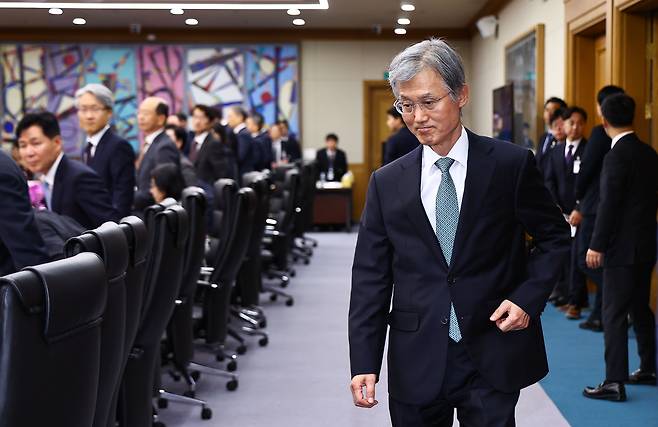
Heads of courts convened Friday to discuss the bill, with Supreme Court Chief Justice Jo Hee-de cautioning that “if the (judicial) institution is amended in a wrong way, it could result in direct and lasting damage to the Korean people.”
“Reform of the judicial institution should occur on the basis of thorough discussion, public debate and evaluation by an expert who is both adept in theoretics and field experience,” Jo said. He had conveyed similar concerns directly to President Lee Jae Myung during a luncheon Wednesday.
The meeting adjourned after six hours. The heads of courts determined unanimously that the new bill would be unconstitutional and undermine the judiciary's ability to deliberate cases.
"The new bill is unconstitutional because it damages the neutrality of court and the trust people place in it — ultimately infringing on their right to a free trial," the top judges said in a statement following the meeting.
Their sentiment was echoed by others within the judiciary.
Cheon Dae-yeop, minister of the National Court Administration, also voiced alarm during a committee hearing Monday, saying, “(If the bill passes) the independence of the judicial branch could become a thing of the past.”
“(The establishment of a special tribunal) itself can be an infringement on the independence of the judiciary,” the National Court Administration added in a written statement.
The much-disputed bill was advanced by the National Assembly’s Legislation and Judiciary Committee on Thursday, providing legal grounds to establish a special tribunal dedicated exclusively to cases stemming from former President Yoon Suk Yeol’s December 2024 martial law decree. The bill, propelled by the ruling Democratic Party of Korea, which holds a majority in both the plenary and the committee, now awaits a floor vote, with the main opposition People Power Party threatening to boycott.
The proposal drew immediate pushback from senior figures in the legal community. Nine former presidents of the Korea Bar Association and four former presidents of the Korea Women Lawyers Association issued a rare joint statement urging the ruling party to scrap the bill.
“The Constitution contains no basis upon which to create a special tribunal outside the (military) court martial,” the former bar leaders wrote. “The Constitution … guarantees the judicial branch’s power over personnel appointment to ensure the independence, fairness and trust of rulings.”
They added that the legislation “goes against the Constitution by allowing others to intervene in the appointment of judges,” warning that a tribunal established through political design could become vulnerable to “legislative power.”
The Democratic Party first floated the idea of a dedicated tribunal in August as an extension of a broader judicial reform package that includes increasing the number of Supreme Court justices, abolishing the National Court Administration and introducing a new offense targeting distortion of legal proceedings.
The party has defended the special tribunal for insurrection as a necessary safeguard to ensure impartiality in adjudicating the former president’s martial law decree. The Democratic Party has said that a dedicated tribunal would prevent institutional self-review, promote transparency and restore public trust in a judiciary they argue has “lost credibility” due to its handling of the crisis.
Since then, additional voices from academia and the bar have raised red flags.
Cha Seong-an, a professor of law at the University of Seoul, cautioned Friday that the appointment process of special justices could be considered unconstitutional. The Democratic Party’s bill stipulates that special judges would be appointed by the chief Supreme Court justice upon recommendations from judicial and executive agencies.
Other academics have expressed even greater concerns.
“If it fundamentally violates judicial independence by unconstitutionally dictating judges’ qualifications or artificially engineering the composition of the judiciary — the composition of the bench itself — to create, so to speak, a Nazi-style special tribunal, that is plainly unconstitutional,” said Cha Jin-a, a professor of law at Korea University, during a September interview with local broadcaster KBS. “This is something only a totalitarian state would do.”
A group of senior attorneys who enrolled in Seoul National University's Law School in 1976 also issued a separate statement in September warning that “the Democratic Party’s bill which states that special judges will be appointed based on recommendations by politicians and lawyers is unconstitutional.”
“(The bill) cannot be permitted because it allows external actors to infringe on the court’s exclusive authority over internal task allocation and case assignment,” according to the group.
“A law establishing a special tribunal that applies only to defendants in insurrection cases is a classic example of an individual-case law,” the statement read. “Because laws must be general in nature and apply to an unspecified number of people, the Constitutional Court has held that individual-case laws are, in principle, strongly suspect of being unconstitutional — a precedent we cannot ignore.”
Twenty-one prominent attorneys signed the statement, including those who had formerly served as lawmakers, presidential aides and in other public offices.
Not all legal groups oppose the bill, however. Progressive civic group Lawyers for a Democratic Society publicly endorsed the creation of the tribunal, arguing the judiciary had lost its trust.
“A judiciary that calls for judicial independence without any self-reflection cannot persuade anyone,” the group said. “In this sense, the calls for an independent and impartial trial through legislation to establish a dedicated tribunal are fully understandable.”
However, the group cautioned that the bill could backfire and stall tribunals, as court hearings could be halted if former President Yoon and his aides file for the Constitutional Court to deliberate on whether the special tribunal for insurrection is constitutional.
Supporters say the tribunal would enable a more specialized, transparent review of the martial law decree and ensure accountability for what they consider an attempted insurrection.
Faced with backlash, the Democratic Party has said it will hold a party general assembly of lawmakers to discuss the bill. It is rare for a bill that has already passed a committee vote to be discussed again internally.
Some unnamed Democratic Party lawmakers have told local media that the bill being referred back for internal discussion showed it was “a legislative mishap born out of rushing ahead and skipping the party’s internal deliberation process.”
Copyright © 코리아헤럴드. 무단전재 및 재배포 금지.