SoftBank CEO meets Lee, warns AI could soon outsmart humans
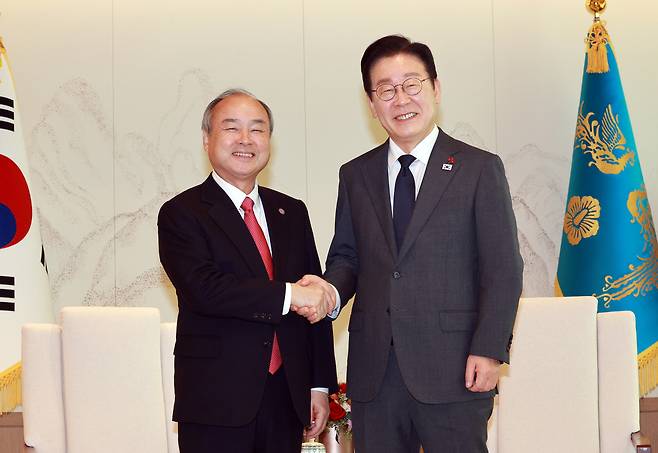
Japanese business magnate Masayoshi Son, founder and CEO of SoftBank Group, on Friday urged South Korea to prepare for an era of artificial intelligence that will outperform human intelligence during a meeting with President Lee Jae Myung on Friday.
The meeting, which took place at the presidential office in central Seoul, came as South Korea deepens cooperation with global players investing in and shaping the AI industry, including BlackRock, OpenAI and Nvidia. Lee also met with OpenAI CEO Sam Altman on Oct. 1.
During the meeting, Lee asked Son to continue offering ideas and advice, noting that Son’s recommendations to former presidents Kim Dae-jung in 1998 and Moon Jae-in in 2019 helped shape Korea’s push for high-speed internet and AI development. Lee is the third Korean president Son has met in person.
Lee said his administration was committed to establishing AI as a part of the nation's basic infrastructure — equivalent to water systems and road networks — so that every citizen may benefit from its capabilities.
While concerns persist regarding overvaluation and safety risks, he added, Korea will focus on responsible and inclusive use.
“I believe AI’s incredible capabilities should be accessible to all people and all nations as a fundamental infrastructure,” Lee said. “We will build a society where every group can utilize AI at a basic level.”
Lee also asked Son to serve as a bridge between South Korea and Japan, citing the need for bilateral cooperation in the AI sector.
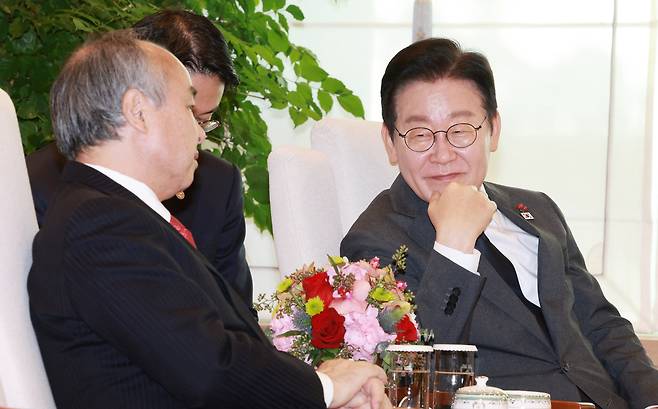
In response, Son highlighted artificial superintelligence, or ASI.
He explained that while ongoing discussions center on artificial general intelligence, or AGI, which he argued aims to achieve human-level reasoning, it was time to focus on AI that will surpass human capabilities.
“ChatGPT 5.1 has already reached a level capable of passing doctoral-level examinations in various fields including mathematics, physics and medicine,” Son said. “ASI will emerge, and it will undoubtedly be smarter than the human brain.”
Son added that it was essential to prepare for when ASI will arrive — and how much smarter it will become.
“If ASI were only 10 or 100 times smarter than the human brain, I would not call that superintelligence,” he said. “What I define as ASI is intelligence that is 10,000 times superior to the human brain.”
He compared the future relationship between humans and ASI to that of a human and a goldfish, stressing ASI’s hardware superiority including neural networks and synapses.
“No matter how much you train or educate a goldfish, it remains a goldfish,” he said. “Its hardware — the number of neurons and synapses — is fundamentally different.”
Son added that humanity must think less about controlling AI and more about how to coexist harmoniously.
“In the ASI era, AI will be smart enough to treat humans kindly and make them happier,” he said. “Just as we do not kill our dogs or eat our cats, I believe we can live peacefully with AI.”
Son also said “yes” when Lee asked whether AI might one day win the Nobel Prize in Literature, a field still considered to rely heavily on human creativity.
Friday’s meeting, which began around 10:30 a.m., ran longer than scheduled, lasting more than an hour, with the latter portion held behind closed doors.
After the meeting, Kim Yong-beom, the chief presidential policy aide, briefed reporters, saying Son stressed that energy, semiconductors, data and education are the four essential resources for an ASI strategy.
For Korea, Son higlighted expanding data centers and ensuring adequate energy to power them, saying the country still appears insufficient in both areas.
At the same time, Son highly assessed Korea’s chip-making capabilities, saying they will elevate Korea into a more significant role alongside the United States — further strengthening what he called a “memory alliance.”
Son also called on the president to maintain strong commitment to AI education, calling it a sector with the highest return on investment. Both sides agreed that access to AI should be recognized as a fundamental right, according to the presidential office.
The meeting was arranged after Son first requested talks during and before the APEC summit in late October, the presidential office said.
Attendees included Rene Haas, CEO of Arm, a SoftBank-backed chip designer; Mun Kyu-hak, head of SoftBank Vision Fund; and South Korean officials including Deputy Prime Minister and Science Minister Bae Kyung-hoon; Industry Minister Kim Jung-kwan; and Presidential Secretary for National AI Policy Kim Woo-chang.
As part of the meeting, the Ministry of Trade, Industry and Resources signed a memorandum of understanding with Arm to strengthen Korea’s AI semiconductor sector.
The two sides will form a working group to discuss establishing a tentatively named “Arm School,” a specialized semiconductor design institute that aims to train around 1,400 top-level global design experts.
Copyright © 코리아헤럴드. 무단전재 및 재배포 금지.