SeMA explores how art becomes knowledge through research-based practice
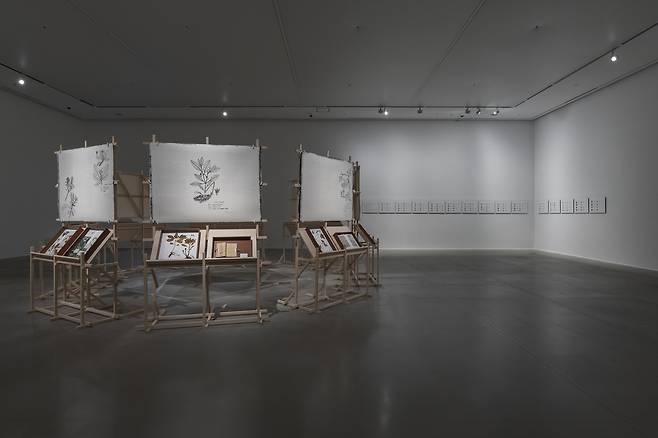
Buk-Seoul Museum of Art in northern Seoul spotlights how art can generate new knowledge, presenting two exhibitions by Korean artist Lee So-yo and British artist Anna Ridler that fuse scientific research with artistic imagination.
Lee’s exhibition “Unfinished Flora ― Soyo Lee” centers on “Illustrations of Joseon Plants: A Selection of Toxic Plants,” a botanical volume written in 1948 by Korean botanical researchers Toh Pong-shyup and Shim Hak-chin, who documented Korean flora through direct observation and collection.
Her presentation unfolds like an expanded research archive — text drawings, preserved plant specimens, diagrams and reference materials function as visual annotations added to the book’s incomplete botanical record.
Lee transforms the plants she has collected and the materials she has studied into installations combining preserved specimens and drawings, adding visual notes to the original text. Through this blend of archival research and fieldwork, Lee reveals a meticulous inquiry into how knowledge is produced and shared.
“Research undertaken by artists is not merely preparatory work but can become a new mode of knowledge production,” said Choi Eun-ju, director of SeMA. “Through the artists’ experiments that traverse art history, natural history, biology, geography and AI, we hope audiences will reflect on what questions art can pose about how we understand the world today.”
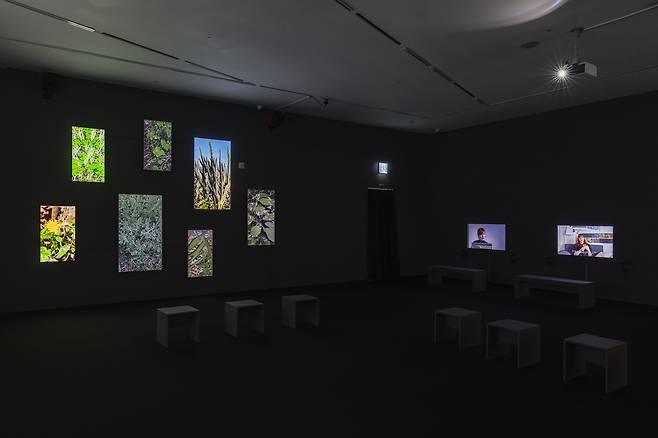
Ridler delves into the intersection of technology, nature, and art, where critical reflection meets sensorial beauty.
The London-based artist is known for using artificial intelligence as an artistic tool. Ridler transforms datasets she collects and studies herself into visual forms using GAN (Generative Adversarial Network) machine learning models.
Ridler draws on 18th-century naturalist Carl Linnaeus’s idea of the “flower clock,” which notes that different flowers open and close at specific times of day. Instead of using human-made measures like hours and minutes, she visualizes time through these natural rhythms, showing how flowers follow their own biological schedule.
The exhibitions opened Thursday and run through March 22, 2026.
Copyright © 코리아헤럴드. 무단전재 및 재배포 금지.