LG, LS pitch all-in-one AI data center infrastructure to Microsoft
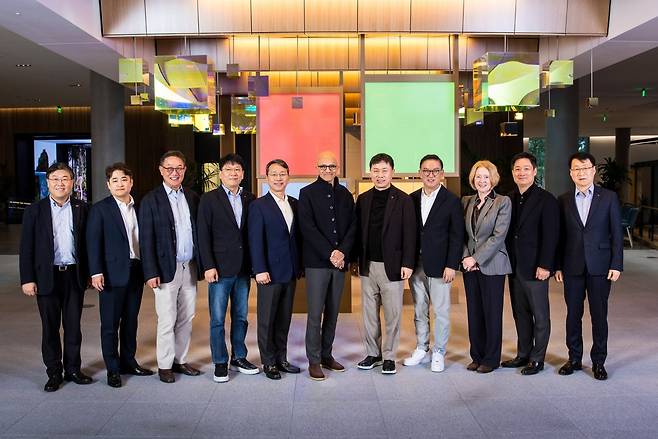
Top executives from South Korea’s LG and LS Groups traveled to Microsoft’s headquarters in the US to pitch a comprehensive, next-generation infrastructure package for artificial intelligence data centers, in a rare show of C-suite coordination targeting one of the world’s most ambitious AI investors.
On Monday, executives from eight affiliates, including LG Electronics, LG Energy Solution, LG CNS and LS Electric, traveled to Microsoft’s campus in Redmond, Washington, for the AIDC Tech Show, a closed-door showcase of technologies supporting AI data center infrastructure.
Microsoft CEO Satya Nadella was among the attendees.
Rather than pitching individual products, the Korean delegation introduced a full-stack infrastructure concept aimed at solving two of the biggest pain points in modern AI data centers: extreme heat and massive power draw.
Today’s AI clusters, built around high-performance graphics processing units like Nvidia's H100, can consume more than 100 kilowatts per rack, which is an order of magnitude higher than conventional cloud servers. That energy demand generates enormous heat, which must be removed quickly and efficiently to maintain system performance.
To address heat concerns, LG showcased advanced thermal management solutions such as direct-to-chip liquid cooling, immersion cooling and magnetic bearing centrifugal chillers, all aimed at improving power usage effectiveness, or PUE.
PUE is a key industry metric that measures how efficiently a data center uses energy. A PUE close to 1.0 indicates near-perfect efficiency, something Microsoft and other hyperscale operators increasingly demand.
LS Group, meanwhile, tackled the other side of the infrastructure equation: power delivery.
LS Cable & System highlighted its bus duct technology, which replaces bulky cables to save space and reduce heat in high-density environments. LS Electric presented ultrahigh-voltage transformers and grid interface systems that safely deliver stable electricity to energy-intensive AI workloads. The alliance also included battery energy storage systems for peak shaving, which is a method of reducing sudden spikes in power use to avoid straining local grids.
Though Korea Economic Daily initially reported that a large-scale supply deal had been signed, LG Electronics and three other group affiliates issued a formal disclosure on Friday stating that “no specific confirmed contract” with Microsoft had been finalized.
They clarified that “overall business cooperation is under discussion.”
Still, the presence of top leadership from across both conglomerates signals an advanced stage of talks and a serious effort by South Korea to position itself as a global infrastructure partner for AI. Rather than sourcing cooling, power and control systems separately from multinationals like Vertiv or Schneider Electric, which are currently experiencing long delivery lead times, Microsoft is being offered a bundled, vertically integrated supply path.
According to market research firm MarketsandMarkets, the global AIDC infrastructure market is forecast to grow from $236.4 billion this year to $933.7 billion by 2030. The specialized heating, ventilation and air conditioning market is expected to more than double by 2032.
Copyright © 코리아헤럴드. 무단전재 및 재배포 금지.