Hyundai’s hydrogen obsession shows no signs of slowing, even as rivals walk away
![Hyundai Motor Group Vice Chairman Chang Jae-hoon speaks about the company's vision in hydrogen at the World Hydrogen Expo 2025, which kicked off on Thursday at Kintex in Goyang, Gyeonggi, on Dec. 4. [HYUNDAI MOTOR]](https://img3.daumcdn.net/thumb/R658x0.q70/?fname=https://t1.daumcdn.net/news/202512/04/koreajoongangdaily/20251204182449892hptm.jpg)
GOYANG, Gyeonggi — Hyundai’s fixation on hydrogen borders on the unprecedented, as the company presses ahead despite mounting costs even while rivals retreat from the technology over shaky profitability.
Having introduced the world’s first mass-produced hydrogen vehicle in 2013, the Korean automaker recently unveiled a fully redesigned Nexo SUV, extending nearly three decades of relentless investment in an energy source that many still regard as fraught with uncertainty.
That resolve was once again on full display at the World Hydrogen Expo 2025, which kicked off on Thursday at Kintex in Gyeonggi, following Hyundai Motor Group Vice Chairman Chang Jae-hoon’s completion of the three-day Hydrogen Council CEO Summit, held in Korea for the first time and bringing together government officials from 21 countries and 1,700 CEOs from global energy firms.
Hydrogen, a zero-carbon and abundantly available resource, has long been cast as a potential antidote to the world’s energy imbalance. It is more thermally efficient than petroleum or batteries, and advocates argue that a mature hydrogen ecosystem could ultimately supplant oil, coal and gas altogether.
Yet hydrogen-powered vehicles remain far from mainstream. They are roughly twice as expensive as battery electrics, saddled with higher refueling costs, and constrained by inadequate station networks.
![Hyundai's booth at the World Hydrogen Expo 2025, which kicked off on Thursday at Kintex in Goyang, Gyeonggi, on Dec. 4. [HYUNDAI MOTOR]](https://img1.daumcdn.net/thumb/R658x0.q70/?fname=https://t1.daumcdn.net/news/202512/04/koreajoongangdaily/20251204182452662kkai.jpg)
New technologies push limits
Hyundai Motor and its six affiliates opened the event’s largest pavilion, showcasing the group’s hydrogen brand and business platform, HTWO, and presenting technologies spanning the entire hydrogen value chain — with the explicit goal of pushing past today’s technical frontiers.
A 700-bar mobile hydrogen charging station, an all-in-one system on a truck or large trailer that integrates a hydrogen compressor, storage tanks, and dispensers. Designed for deployment in regions where refueling infrastructure remains sparse, it offers a practical means of cultivating early demand while overcoming space constraints.
Hyundai further introduced its Polymer Electrolyte Membrane (PEM) water electrolysis technology, which produces high-purity clean hydrogen by electrolyzing water through the reverse reaction of fuel cells.
![Hyundai Motor Group Vice Chairman Chang Jae-hoon, third from left in the front row, and Minister of Climate, Energy and Environment Kim Sung-hwan, fourth from left in the front row, tour Hyundai's booth at the World Hydrogen Expo 2025, which kicked off on Thursday at Kintex in Goyang, Gyeonggi, on Dec. 4. [HYUNDAI MOTOR]](https://img3.daumcdn.net/thumb/R658x0.q70/?fname=https://t1.daumcdn.net/news/202512/04/koreajoongangdaily/20251204182454032diyp.jpg)
An automatic charging robot was also on display, an apparatus built on vision AI and high-precision control technology that precisely identifies the positions of both the vehicle and the charging inlet, allowing the connector to attach securely and operate autonomously around the clock.
The robot is designed to address the lack of refueling infrastructure, one of hydrogen’s most persistent drawbacks. In Korea alone, about 38,000 hydrogen vehicles share just 386 stations, effectively one station for every hundred drivers.
"Hydrogen is an essential part for the future, so we approach it with strong determination and a sense of mission,” Hyundai’s Chang said. “We are committed to making it happen. The most important thing is unwavering consistency."
![From left, Ivana Jemelkova, CEO of the Hydrogen Council, Hyundai Motor Group Vice Chairman Chang Jae-hoon, who chairs the Hydrogen Council, Air Liquide CEO Francois Jackow, co-chair of the council, speak during a press conference on the sidelines of the World Hydrogen Expo 2025, which kicked off on Thursday at Kintex in Goyang, Gyeonggi, on Dec. 4. [HYUNDAI MOTOR]](https://img4.daumcdn.net/thumb/R658x0.q70/?fname=https://t1.daumcdn.net/news/202512/04/koreajoongangdaily/20251204182455335qcgf.jpg)
For the next generation What makes Hyundai’s commitment to hydrogen so unusual is its persistence at a time when many global automakers have walked away. As Hyundai chief Euisun Chung stated, the commitment is “less about believing hydrogen technology will yield profit, and more about using every technological avenue available to safeguard the future,” with the company bearing short-term losses to secure the future for coming generations.
General Motors announced last month that it would halt development of its next-generation Hydrotec hydrogen fuel cells, despite having invested $3 billion in them since 1996.
Stellantis also said in July that it would suspend its hydrogen program, with its Europe COO, Philippe Imparato, arguing that “the hydrogen market remains a niche segment with no prospects of medium-term economic viability.”
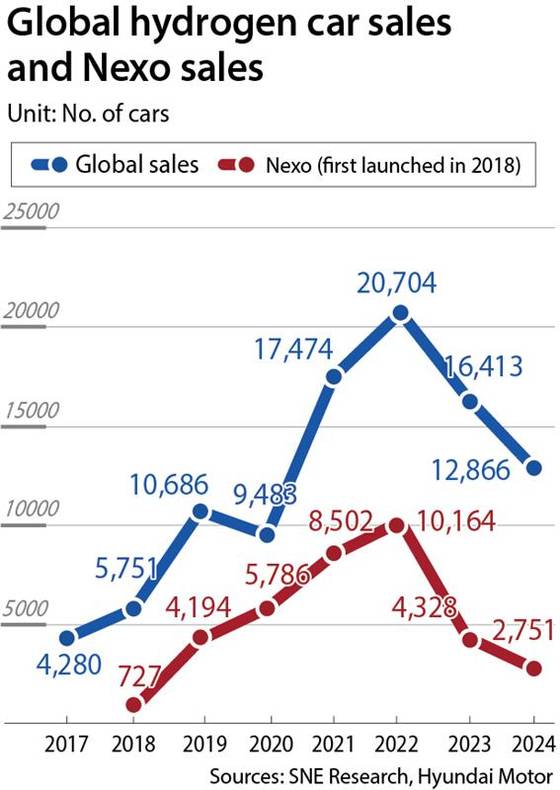
Demand is also slipping, with global hydrogen car sales falling 40 percent from 20,704 units in 2022 to just 12,866 last year. Hyundai’s own Nexo plunged 73 percent from 10,164 to 2,751 units over the same period.
“Korea is becoming a playbook for hydrogen mobility for the world, and it's a unique combination of constant and consistent public support, industrial commitment, innovation and market acceptance," said François Jackow, the chairman of Air Liquide, who co-chairs the Hydrogen Council.
BY SARAH CHEA [chea.sarah@joongang.co.kr]
Copyright © 코리아중앙데일리. 무단전재 및 재배포 금지.
- Netflix's 'Physical: Asia' to return with spinoff
- Court rules against husband who filed for divorce over wife's refusal to donate part of liver
- Lovelorn ginkgo tree enjoys birthday party: Villagers, officials mark occasion as plant pines for North Korean wife
- Samsung is sending Snapdragon S26s to the U.S. Why has that roiled Korea and Europe?
- Police investigate deadly motel stabbing involving four middle school students in Changwon
- Top court finalizes 5-year prison sentence for driver in deadly City Hall crash
- Seoul snowfall expected Thursday afternoon as cold snap continues
- Police disclose identity of man accused of murder in North Chungcheong
- Bigger 2026 budget for 'K-culture' and programs as gov't focuses on turning content into strategic industry
- Park Na-rae's ex-managers allege entertainer bullied them and forced them to cover expenses