Even in our own languages, we can understand one another
이 글자크기로 변경됩니다.
(예시) 가장 빠른 뉴스가 있고 다양한 정보, 쌍방향 소통이 숨쉬는 다음뉴스를 만나보세요. 다음뉴스는 국내외 주요이슈와 실시간 속보, 문화생활 및 다양한 분야의 뉴스를 입체적으로 전달하고 있습니다.
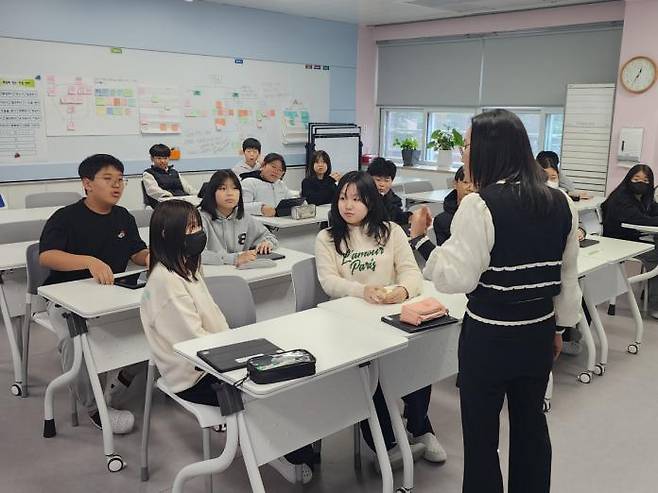
On the afternoon of the 21st last month at Samho Elementary School in Yeongam County, South Jeolla Province. The question “How should we live for the Earth's environment and a sustainable future?” appeared on the large electronic whiteboard in the 6th-grade classroom. Sarbina (13) raised her hand first.
Sarvina, an Uzbek national who arrived in Korea early last year, is still learning Korean. When she said in Uzbek, “We need to reduce environmental pollution,” her words were instantly translated into Korean subtitles on the board.
The students nodded as they read the subtitles. A student beside her agreed, saying, “That's right,” and added, “We need to stop actions like destroying forests and polluting the oceans.” On one side of the blackboard, keywords like ‘Let's plant trees,’ suggested by the students, began to pile up one by one. It was the moment when the children's thoughts, previously blocked by the language barrier, connected through an artificial intelligence (AI) translator.
This classroom is the ‘2030 Language Free Classroom,’ established by the Jeonnam Office of Education as a future-oriented teaching model. Rather than conducting lessons based on a specific language, this model uses AI simultaneous interpretation and visual aids to enable students to participate in discussions centered on ‘concepts.’ The goal itself is the process of exploring the same topic together despite language differences and creating generalized sentences. It runs for about 10 hours weekly across all grades.
This teaching method aligns with local characteristics. Yeongam County, adjacent to Hyundai Heavy Industries and the Daebul National Industrial Complex, sees a high influx of foreign worker households. According to Jeonnam Office of Education statistics (as of April 1), there are 12,374 multicultural students in the province. Among them, 582 students (4.7 percent of all multicultural students) have both parents who are foreigners. A significant 184 students, representing 31.6 percent of foreign-family students, are concentrated in Yeongam.
The classrooms reflect this trend. Out of the school's approximately 300 students, about 100 (roughly 30 percent) are from foreign households. The nationalities of enrolled students alone span 12 countries. Students from Central Asian nations like Uzbekistan, Kazakhstan, and Kyrgyzstan are the most numerous, followed by those from Vietnam, Mongolia, China, and Russia.
Newly arrived students who are not yet fluent in Korean had previously struggled to keep up with lessons. To reduce language-based learning gaps, the school, with support from the Jeollanam-do Office of Education, established a dedicated inquiry space last August that is 1.5 times the size of a normal classroom. Each classroom is equipped with AI real-time translation devices and large electronic boards, enabling students to participate in class immediately in their native languages.
The changes were quickly noticeable. During breaks, students no longer clustered only with those speaking the same language. During lessons, they naturally collaborated while looking at the same screens. Even hesitant students began to fully express their ideas when it was their turn to present. A parent of a Vietnamese student recently called the school, saying, “My child has become noticeably brighter and more confident. Thank you.”
Kim Hyun-mi, the lead teacher for the program, said, “I wanted to create a classroom where no student is excluded from learning due to language. This approach allows students to derive universal concepts from personal experiences and take responsibility as global citizens. This is the essence of the learning transformation we aim for.”
Based on the Samho Seo Elementary example, the Jeollanam-do Office of Education plans to gradually expand the program to other participating schools. A local education official said, “This classroom symbolizes how diversity can be an asset rather than a barrier. We will strengthen support so that no student is left behind due to language differences.”
※This article was translated by an AI tool and edited by a professional translator.
Copyright © 경향신문. 무단전재 및 재배포 금지.
- [속보]“집 못 지어서 미쳤나 소리 듣게 지어라”···남양주 덕소농장·경기광주·염창공원 등 23
- [속보]내년 1월부터 ‘비거주 1주택자’ 전세대출 제한···갭투자 차단 조치[8·13 부동산대책]
- 1년 만에 방한한 빌 게이츠, 내일 한성숙 총리·정기선 회장 등 만난다
- “정원오 잘하기는 하나 봅니다”···칭찬 글 올린 이재명 대통령, 공직선거법 위반 고발 사건
- ‘길거리 음식의 최강자’ 동남아가 아니었다···예상 확 깨버린 ‘반전의 1위 도시’ 어디길래
- [단독]경찰 조사받던 피의자 유치장서 식사 도중 자해…병원 이송, 상처 깊어
- ‘구독자 100만 인플루언서’로 돌아온 김혜수 “유튜브 처음으로 많이 봐…‘대박 콘텐츠’ 연
- “뭐? 한우가 반값이라고?” 홈플러스 재개장 첫날 문전성시…부활 신호탄일까
- “초딩 때 시작했는데 애엄마” “마음의 고향 이젠 안녕”···25년 국민게임 ‘크레이지 아케
- 게슈타포 부활? 독일, 80년 원칙 깨고 정보기관에 작전권 부여···“어두운 역사 잊었나” 목소