The rise of far-right Christianity: Anti-impeachment and authoritarian roots
이 글자크기로 변경됩니다.
(예시) 가장 빠른 뉴스가 있고 다양한 정보, 쌍방향 소통이 숨쉬는 다음뉴스를 만나보세요. 다음뉴스는 국내외 주요이슈와 실시간 속보, 문화생활 및 다양한 분야의 뉴스를 입체적으로 전달하고 있습니다.
“Martial law is an opportunity given by God.”
“‘Yoon Again’ is the order God is restoring.”
“Let us wage a spiritual war against Satan who opposes this.”
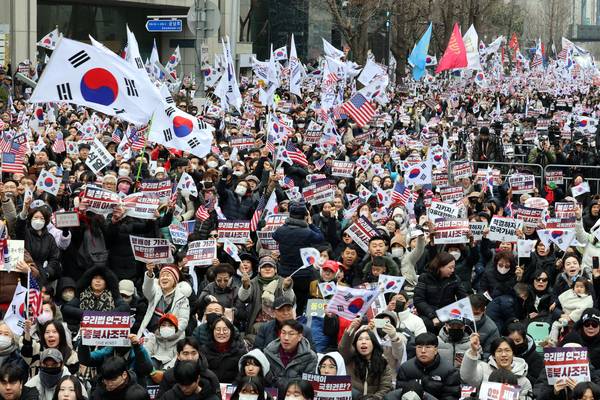
Since the illegal martial law declared on December 3, 2024, the slogans that fluttered across the streets for the following year were deeply rooted in the language of a particular religious community. The long-latent specter of far-right politics awakened and spread through the illegal martial law episode, and at the center of it stood conservative Protestant groups. In issue 151 of Critical Review of Modern Korean History, Professor Cheon Jeong-hwan of Sungkyunkwan University referred to this phenomenon as “the Easter of the Korean far-right,” linking the illegal martial law and far-right Protestantism.
Of course, not all Protestants are far-right. According to an August survey by the Christian Institute for the Study of Justice and Society of 10,000 adults nationwide, the proportion of far-right tendencies among the general population and among Protestants was similar, at about 21percent each.
Even so, why is it that so many far-right demonstrators in the streets are Protestants? Within Protestantism, reform-minded theologians have long engaged in analysis and discussion to dissect and overcome this phenomenon. On November 27, ahead of the first anniversary of the December 3 martial law, a seminar titled “How Should We Overcome Far-Right Christianity?” was held, hosted by the National Council of Churches in Korea (NCCK) and the Korea Church and Public Forum. Floods of analysis were presented on why Protestantism has become a focal point of far-right forces.
■ Churches that support the far-right
Theologians point to the structural environment of Protestant churches. They argue that authoritarian church structures, anti-intellectualism, and an exclusivist worldview rooted in Christian doctrine carry structural responsibility. Protestant churches commonly exhibit strong support for hierarchical authority and the absolute leadership of senior pastors. A culture of literalist biblical interpretation and of treating doubt or questioning as unbelief reveals a pronounced anti-intellectual tendency. As a result, democratic debate gives way to hierarchical obedience within church structures.
Professor Song Jin-soon of Ewha Womans University said, “When the authority-oriented structure within Protestantism converges with political authoritarianism, faith loses the language of critique and resistance. As far-right rhetoric and religious sentiment are reproduced within Protestant culture and structure, far-right Christianity becomes not merely a supporter of far-right politics but a structural partner that morally legitimizes far-right discourse.”
■ Widespread worship of capital, exclusion, and hatred
Far-right Protestants show low inclusivity and strong exclusionary attitudes toward minorities. They have opposed not only presidential impeachment but also the enactment of anti-discrimination laws. Yet this tendency cannot be said to apply only to far-right Protestants.
In an analysis by Professor Shin Ik-sang of the Anglican Theological Institute, which examined Protestant attitudes through the lens of late-capitalist fascism, far-right Protestants expressed significantly higher support than non-far-right Protestants for religious nationalism, the belief that Korea has been given a special divine mission, and authoritarianism, such as the belief that an elected leader may temporarily streamline parliamentary procedures in times of crisis.
Notably, widespread support across Korean Protestants was found for the worship of capital and market absolutism and for the belief that sexual minorities and immigrants threaten traditional values and cultural purity. This characteristic cannot be separated from the parallel rise of Korean society and the rapid expansion of Korean churches during decades of growth-first economics.
■ False divine chosenness and the idea of building a Christian nation
According to Oh Se-jo, chair of the NCCK Committee on Ecumenical Theology and Education, “Far-right Protestants believe that Korea, like the United States, was originally founded as a Christian nation, and that Koreans, like Israel, are a chosen people of God.”
Their theological justification traces back to the U.S. military government after liberation and the subsequent Syngman Rhee administration, which appointed large numbers of Protestants. Indeed, far-right Protestants regard Syngman Rhee as the “father of Christian nation-building.” The presence of American and Israeli flags at far-right rallies is also tied to this sense of chosenness. Oh emphasized, “The ideological foundation of a ‘Christian nation’ is a secular ideology unrelated to Christianity. They mistakenly equate the divisive idea of a Christian nation with the biblical concept of the Kingdom of God.”
■ The majority of Protestants must reflect
Professor Kim Hye-ryeong of Ewha Womans University argued, “Korean Protestantism has reached a catastrophic state that cannot be repaired simply by criticizing the far-right. This is because everyday exclusion, hatred, and capitalist affinity are present across nearly all Protestants.” She added that believers must “thoroughly learn that the absolute worship of capital, and the extreme competition it produces, fundamentally contradict the spirit of the gospel.”
Professor Kim continued, “Unless the majority of Protestants seriously reflect on issues such as real-estate profiteering enabled by urban development, hereditary pastoral succession, opaque church finances, patriarchal church structures, meritocratic views of economic freedom, ignorance and repression of labor rights, the Korean church cannot escape its current crisis.”
※This article was translated by an AI tool and edited by a professional translator.
Copyright © 경향신문. 무단전재 및 재배포 금지.
- “동료라 하기도 부끄러워”···민주당, ‘5·18 토론회 강행’ 이진숙 제명 촉구 결의안 제출
- 정성호 법무장관, ‘이화영 재판 집단 퇴정’ 수원지검 검사 2명 징계 청구
- 전 연인 둔기로 폭행하고 달아난 30대 검거···경찰, 살인미수 적용
- 종합특검, ‘내란 가담’ 강호필 전 지작사령관 기소
- 이 대통령 “이원집정제·내각제 바람직하지도, 가능하지도 않아···4년 중임 또는 연임제 개헌
- ‘골프 회동’ 대통령 개헌 발언 전해지자 청와대 “‘4년 중임제’ 국민 수용성 높다는 입장··
- “대통령과 안 싸우고 골프 친 의원들도 징계할 건가”···조경태, 당협위원장 교체 예고 장동
- 한국 프로야구 유일 ‘4할 타자’ 백인천 전 감독, 뇌경색으로 위독
- [단독]텔레그램방에 20대 여성 노출 사진에 학생증·민증까지 유포…2차 범죄 우려
- 딸 유치원에 협박 전화까지···30대 싱글맘 죽음 내몬 사채업자, 2심서 감형돼 ‘징역 3년 6개월