Local governments looking to boost populations look to overseas Koreans
전체 맥락을 이해하기 위해서는 본문 보기를 권장합니다.
"I've always had this longing to spend the rest of my life in my hometown," Kim said. "Getting a dental implant in Australia can cost more than 3 million won [$2,050], so Korea's health care infrastructure is another big advantage. I hear that many Koreans in Australia are considering returning home."
South Chungcheong is taking a more proactive approach. While running its own "One Month in Chungnam" program, the province also held a promotional session this May in Los Angeles — home to a large Korean population — under the slogan "The Perfect Destination for a Comfortable Life."
이 글자크기로 변경됩니다.
(예시) 가장 빠른 뉴스가 있고 다양한 정보, 쌍방향 소통이 숨쉬는 다음뉴스를 만나보세요. 다음뉴스는 국내외 주요이슈와 실시간 속보, 문화생활 및 다양한 분야의 뉴스를 입체적으로 전달하고 있습니다.
![Overseas Koreans from Australia take a picture while hiking at Mount Sogeum Grand Valley in Wonju [SANGJI UNIVERSITY]](https://img1.daumcdn.net/thumb/R658x0.q70/?fname=https://t1.daumcdn.net/news/202511/28/koreajoongangdaily/20251128133042710eskl.jpg)
Amid a rising trend of older Korean emigrants returning to their motherland, local governments are launching programs and incentives to attract “reverse immigrants” as a way to counter population decline.
Thirty years after moving to Australia to study, a 66-year-old Korean national surnamed Kim is planning to return to their hometown of Chuncheon, Gangwon.
Kim recently closed their food service business in downtown Queensland and reclaimed their Korean citizenship earlier this year. Under Korean law, overseas Koreans over 65 are eligible for dual citizenship and can still receive Australian senior pensions after returning to Korea.
“I’ve always had this longing to spend the rest of my life in my hometown,” Kim said. “Getting a dental implant in Australia can cost more than 3 million won [$2,050], so Korea’s health care infrastructure is another big advantage. I hear that many Koreans in Australia are considering returning home.”
In fact, a recent program in Wonju, Gangwon, invited overseas Koreans living in Australia to experience life in Korea. Hosted by the city and Sangji University, the “Two Weeks in Wonju” event brought 20 participants to explore wellness tourism spots such as Mount Sogeum Grand Valley and attend lectures on health in aging, financial planning and how to apply for repatriation.
“I dropped everything to take a flight back home, and I’m glad I did,” said another overseas Korean from Australia, a 77-year-old surnamed Won. “I want to spend my final years in Wonju, where I was born.”
As shrinking populations put some local governments at risk of extinction, municipal officials are increasingly turning to overseas Koreans in hopes of luring returnees.
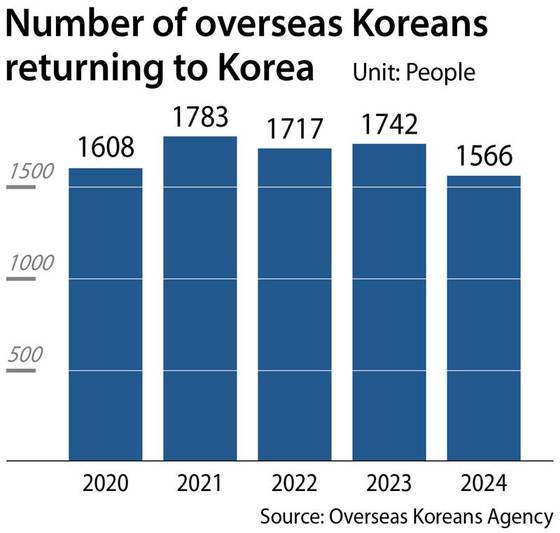
A total of 1,566 Koreans returned permanently to Korea last year, according to the Overseas Koreans Agency (OKA). Over the past five years, an average of 1,683 overseas Koreans have returned annually. Of those who returned last year, 881 were aged 60 or older — more than 56 percent of the total.
Some regional governments are now competing to attract these returnees with extended stay tourism programs and plans for senior housing communities.
South Gyeongsang is among the most active. Through its “One Month Travel” program, the province gives priority to overseas Koreans among applicants across its 18 municipalities. The idea is to give returnees a glimpse of everyday life in Korea and lower the barrier to resettlement.
As of the end of September, 41 overseas Koreans from the United States, China, Japan and Canada had participated. The province covers lodging, airport pickup and even travel insurance costs. For a 30-day stay, participants can receive over 2 million won in support in exchange for daily social media posts about their experience.
“A lot of overseas Koreans have a nostalgic longing for their hometown,” said a South Gyeongsang official. “We’re seeing a growing number of returnees who choose to settle here after taking part in the program.”
![A view of the Namhae German Village in Namhae, South Gyeongsang [JOONGANG ILBO]](https://img2.daumcdn.net/thumb/R658x0.q70/?fname=https://t1.daumcdn.net/news/202511/28/koreajoongangdaily/20251128133045668jbsc.jpg)
South Chungcheong is taking a more proactive approach. While running its own “One Month in Chungnam” program, the province also held a promotional session this May in Los Angeles — home to a large Korean population — under the slogan “The Perfect Destination for a Comfortable Life.”
The province, in cooperation with the Chungnam Development Corporation, is pursuing a plan to supply unsold housing in new towns to overseas Koreans. The long-term goal is to create a senior town for reverse immigrants.
Experts say tailored policies are essential.
“The example of the Namhae German Village, which helped Korean miners and nurses who had worked in Germany resettle, shows that beyond simply offering housing, what’s really needed is a town or community that also includes health care and reemployment infrastructure,” said Yun Kap-sik, a professor of urban engineering at Dong-A University, said.
“But while this kind of model fits well in areas with limited infrastructure like rural counties, in major cities like Busan, it would be more appropriate to enhance access to existing residential, medical, employment and cultural resources, rather than building separate communities,” added Yun.
This article was originally written in Korean and translated by a bilingual reporter with the help of generative AI tools. It was then edited by a native English-speaking editor. All AI-assisted translations are reviewed and refined by our newsroom. BY KIM MIN-WOOK, PARK JIN-HO, KIM BANG-HYUN, AN DAE-HUN [lim.jeongwon@joongang.co.kr]
Copyright © 코리아중앙데일리. 무단전재 및 재배포 금지.
- Gov't official gets suspended sentence for booking, canceling first class airline tickets for lounge access
- Marathoner says coach offered no apology for ‘forceful’ finish-line grab; coach denies wrongdoing
- Multibillionaire Mukesh Ambani arrives in Korea for meeting with Samsung chief Lee Jae-yong
- 'Submarine war' with Germany heats up in race for Canadian contract
- 2025 MAMA Awards to continue as scheduled
- Man caught stealing hundreds of bottles of alcohol from Daegu restaurant
- Lee calls for bipartisan support to get largest-ever budget approved by deadline
- From the stadium to the studio: Retired Korean athletes bag gold in variety TV
- As K-pop dominates domestic scene, Korea's indie musicians look abroad to find audiences
- Commuter chaos awaits as Seoul subway unions vote to strike in December