Korean retailers brace for cost surge as won–dollar rate jumps
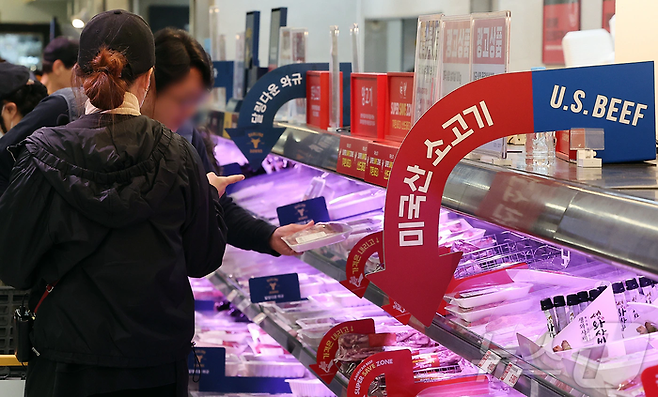
Since a rising exchange rate can push up production costs and ultimately consumer prices, large discount stores that rely heavily on imported agricultural and livestock products as well as food manufacturers using imported ingredients are scrambling to defend prices.
According to multiple industry sources on Thursday, major discount stores are increasing advance stockpiling to build inventory and reduce logistics expenses.
E-mart Inc. is securing five to six months of frozen meat in advance and plans to expand purchases further as currency volatility persists. It also maintains annual procurement contracts for almonds, frozen fruit and olive oil to secure stable supply and pricing.
The company has sharply increased squid imports, boosting supplies of frozen squid caught near Argentina by about 50 percent from a year earlier.
If the high exchange-rate trend continues, the cost of imported food ingredients for large retailers will rise, feeding into higher consumer prices. Retailers are moving early to stabilize supply chains in an effort to contain price increases.
U.S. frozen short ribs were selling for 4,435 won ($3.03) per 100 grams as of October, up 19.3 percent from the average year-round price of 3,718 won.
“Slaughter volumes have dropped, and the weaker won has pushed prices even higher,” an industry insider said. “If the high exchange rate persists, prices could rise further.”
Companies are also widening sourcing channels.
E-mart is considering adding Irish beef to its current range from the U.S. and Australia. Imported shrimp, once sourced largely from Vietnam, now includes new supplies from Saudi Arabia.
Frozen peeled shrimp from India and Vietnam has been supplemented with Peruvian shrimp introduced in July and August at roughly 20 percent lower cost. For apparel, production is shifting to Bangladesh, where labor costs are lower than in China and Vietnam.
Lotte Mart is also expanding stockpiles of frozen meat and seafood. In light of higher U.S. beef prices driven by the weaker won, the company has increased its sourcing of Australian beef.
Through advance contracts in July, Lotte Mart raised its volume of Australian beef by about 20 percent from last year.
With imported mackerel prices expected to rise, the retailer plans to expand its stock of domestic mackerel by about 50 percent year-on-year.
It has also designated Spanish mackerel, used similarly for grilling or braising, as an alternative and plans to increase supply by about 40 percent.
To secure high-quality supply, Lotte Mart is also relying on long-term contracts with overseas producers.
Since July, it has operated a dedicated salmon farm in Chile, the first of its kind in Korea’s retail sector, under a pre-contract model that reduces exposure to currency swings. The company has secured about 1,000 tons of salmon through these contracts, allowing it to import at prices up to 15 percent below global market levels.
Fashion companies face similar challenges.
LF Corp., Handsome Corp. and Shinsegae International Inc. are diversifying suppliers for premium materials such as cashmere and wool across domestic and overseas markets, and staggering purchase schedules.
Companies are also developing currency-hedging strategies. When importing products, they are adjusting cost negotiations and purchase volumes with brand headquarters and using forward contracts to offset the impact of a stronger dollar.
Copyright © 매일경제 & mk.co.kr. 무단 전재, 재배포 및 AI학습 이용 금지
- “생후 6개월 데뷔했는데”…자택서 숨진채 발견된 아역 출신 배우 ‘충격’ - 매일경제
- “배달이요” 퇴직한 부장, 현관서 마주쳤다…월수익 듣고 ‘경악’ - 매일경제
- “치욕스러워, 왜 이렇게까지”…‘초코파이 절도’ 항소심 무죄 받은 직원 심경 - 매일경제
- [단독] 230억 주한미군 공사따낸 건설사, 사기꾼이었다…한미 공조수사중 - 매일경제
- 우리집 49층인데 불나면 어디로 가요?…소방청 대피 매뉴얼 보니 - 매일경제
- “매달 통장에 318만원 꽂힙니다”…국민연금 최대 수령 비결 들어보니 - 매일경제
- 국힘 초선 “장동혁 대표 사과 안하면 20여명 집단행동할 것” - 매일경제
- 아직도 AI 못 다루는 부장님…58년생부턴 무조건 배워야 삽니다 - 매일경제
- “아파트에 월급도 준다”…두 딸 있는데도 새 딸 구하는 할머니 속사정 - 매일경제
- ‘빅리그 도전’ 송성문, 샌디에이고행 전망 떴다! “멀티 포지션 능력 갖췄다” - MK스포츠