‘I hope Hanran sparks interest in the April 3 Incident,’ says Kim Hyang-gi at the premiere
이 글자크기로 변경됩니다.
(예시) 가장 빠른 뉴스가 있고 다양한 정보, 쌍방향 소통이 숨쉬는 다음뉴스를 만나보세요. 다음뉴스는 국내외 주요이슈와 실시간 속보, 문화생활 및 다양한 분야의 뉴스를 입체적으로 전달하고 있습니다.
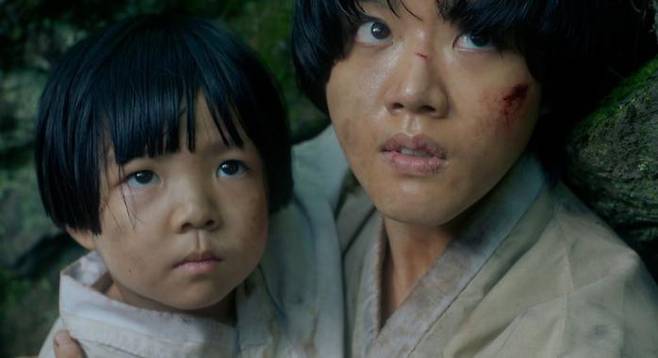
If you and I forget this incredible tragedy, who will remember it?
The film ‘Hanran,’ set against the backdrop of the Jeju April 3 Incident, opened on November 26. The film depicts the story of Jeju citizens facing threats to their survival amidst the conflict between the ‘Mountain Brigade’ of the Northwest Youth Association, opposing the establishment of a separate South Korean government in 1948, and the military-police ‘Punitive Expeditionary Force’ seeking to suppress them. The movie drew particular attention for actress Kim Hyang-gi (25), who plays Go A-jin, a 26-year-old mother raising her six-year-old daughter.
At the center of the film are A-jin and her six-year-old daughter, Haeseong (played by Kim Min-chae). A-jin, a former haenyeo (female diver), hears that the punitive force is approaching and joins the villagers fleeing into the mountains in search of her husband, who has gone into hiding. Believing a rumor that soldiers would spare young children, she leaves her daughter and mother-in-law behind. Soon afterward, she hears that the entire village has been burned down. Miraculously, Haeseong survives as the sole survivor of the massacre. Learning from a shaman that her daughter is alive, A-jin heads back to the village to find her.
The film depicts the harrowing era through the mother-daughter duo and the villagers' collective portrait. It also vividly portrays the human landscape within the punitive expedition and guerrilla forces. The narrative interweaves the story of a sergeant within the punitive force who indiscriminately killed civilians and a corporal who simply couldn't bring himself to kill innocent civilians.
Kim Hyang-gi, whom we met in Samcheong-dong, Jongno-gu, Seoul, in an interview on November 18, stated, “I chose this project because I loved the script, which not only tells the mother-daughter story but also vividly portrays the lives of diverse people.” She added, “Hanran is a story about human beings trying to move forward despite hardship. I’m glad the film captures the lives of Jeju residents so well.”
Regarding taking on a mother’s role at a relatively young age, she said, “Women my age at that time were mothers, so it didn’t feel unnatural.” She added, “Watching A-jin draw superhuman strength from her love for Haeseong made me think deeply about what maternal love really is. While watching animal documentaries, I also thought that the eyes and behaviors animals show when expressing maternal instincts share surprising similarities with humans.”
Most of the dialogue in ‘Hanran’ was written in the Jeju dialect of the 1940s. While some words like ‘samchun,’ ‘musa,’ and ‘poksak sokdda’ are widely known, most are difficult for standard Korean speakers to understand due to the thorough historical accuracy. Therefore, standard Korean subtitles are displayed throughout the film.
Kim Hyang-gi also expressed concerns about speaking the Jeju dialect during filming. She explained, “I learned the Jeju dialect through one-on-one tutoring starting three months before shooting. When I approached it as a dialect, it didn't come naturally, but once I began to take it as a completely new language, the emotions began to flow out of nowhere.” Director Heo Myeong-mi stated at a press conference on the 12th, “With the help of supporting actors from Jeju, we were able to create natural Jeju dialect dialogue.”
The vast natural landscapes of Jeju captured on screen are another charm of the film. Jeju's forests, caves, and seas—its natural scenery—appear even more beautiful when contrasted with its tragic history. Kim Hyang-gi shared, "Before filming, I went on a ‘dark tour’ with the director to learn about the April 3 Incident. We explored Jeju's forests and seas to scout filming locations, and while they looked similar at first glance, each forest had its own character.” She added, “Rather than finding the forest shoots difficult, I felt more deeply healed by nature." A ‘dark tour’ refers to visiting sites of tragic history, like disasters, catastrophes, and wars, to reflect on their meaning and learn lessons from them.
Kim Hyang-gi expressed her hopes for the audience: “I hope viewers come with an open mind and experience the film as it is. If the film sparks curiosity about the April 3 Incident and leads them to learn more, that would mean the most to me.”
※This article was translated by an AI tool and edited by a professional translator.
Copyright © 경향신문. 무단전재 및 재배포 금지.
- [속보]트럼프 “다음 주까지 이란과 합의 안 되면 발전소·교량 공격”
- 민주당이 2만표 앞섰는데…‘먹튀 탈당’에 인천 연수구의회는 국힘이 ‘독식’
- 영화관 앞서 친구 가슴 찌른 40대···3시간 만에 검거
- “상추에도 기생충이?” 미국 뒤집은 집단 감염…1600명 넘게 쓰러졌다
- “다이소 선크림 10개 중 8개가 기준 미달” 유튜버 주장에 다이소 반박 ‘진실 공방’
- [단독]4년 만에 도로 ‘컬러풀 대구’?···도시브랜드 교체에 또 수억원 쓰겠다는 대구시
- [에프워드] ‘남돌’을 좋아하면서 ‘페미니스트’일 수 있을까
- ‘성과급 차별’도 서러운데 ‘밥값 차별’까지…조선소 이주노동자 노조 집단 가입
- 비만치료제 시장 경쟁 ‘2라운드’ 본격화…“투약은 편하고 효과는 더 다양하게”
- [속보]6월 취업자 6만3000명 증가···청년 고용 26개월째 뒷걸음