Policymakers weigh NPS portfolio tweaks for FX stability
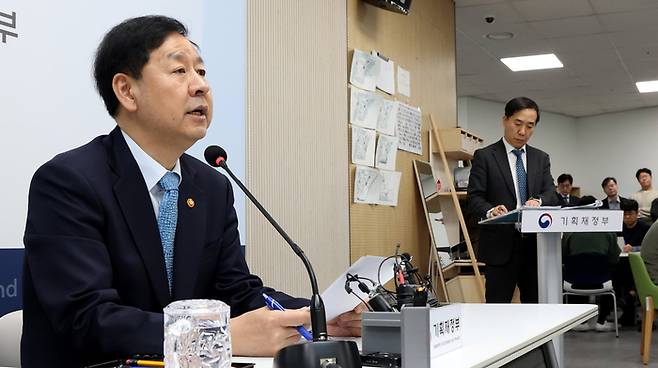
Deputy Prime Minister and Finance Minister Koo Yun-cheol on Wednesday introduced a new policy concept dubbed the “New Framework” for the NPS. “We have begun discussions to establish a new framework to balance the NPS’s profitability with FX market stability,” Koo said at a press briefing.
He warned that “if large-scale overseas investments by the pension fund are concentrated in a short period, it could negatively affect the national economy by driving inflation and reducing real income.” He added that since the NPS fund is managed in won, sharp fluctuations in FX exposure could increase market volatility and undermine returns.
As of the end of August, the NPS managed assets totaling 1,322 trillion won, with 58 percent—or about 771 trillion won—invested overseas. Under its current annual return target of 4.5 percent, the fund’s total assets are projected to reach 2,895 trillion won by 2047. If the return target is raised to 5.5 percent, the fund could grow to 3,600 trillion won by 2071.
The pension fund aims to raise its overseas investment ratio to 60 percent by 2028, implying an annual increase of 30–45 trillion won in foreign assets over the coming decades. Authorities believe this steady outflow of won—converted to dollars for foreign investment—has created structural downward pressure on the currency. Conversely, large-scale sales of overseas assets during future fund drawdowns could strengthen the won.
While some have floated the idea of reducing the NPS’s foreign investment share to curb dollar demand, analysts say this is unlikely. The NPS already invests 14.8 percent of its assets in domestic equities, while Korea’s stock market accounts for just 1–2 percent of global capitalization. Domestic bond yields also remain relatively unattractive compared with U.S. and European rates, making further onshore allocation inconsistent with both return and stability objectives.
Market participants instead expect the government to expand the fund’s FX hedging ratio as a more feasible indirect measure. The NPS currently caps its combined strategic and tactical FX hedging at 15 percent of total assets. Authorities are reportedly considering raising this limit. Earlier this year, the fund’s strategic hedging helped push the won from 1,487.6 to the 1,350 range per dollar by supplying dollars to the market.
A four-party working group comprising the Ministry of Economy and Finance, the Ministry of Health and Welfare, the Bank of Korea, and the NPS is now reviewing multiple stabilization options. Koo also said that while measures such as higher capital gains taxes on overseas stock investments are not under immediate review, “they remain possible if conditions warrant,” noting that higher taxes could redirect investment flows toward tax-exempt domestic equities.
Despite such efforts, major global investment banks remain cautious. Bloomberg reported that Wells Fargo, RBC, and Standard Chartered expect the won to trade between 1,425 and 1,470 per dollar next year — effectively establishing the mid-1,400s as the new normal for the Korean currency.
They noted that temporary appreciation could occur following Korea’s inclusion in the World Government Bond Index (WGBI) in April 2026, which is projected to bring about $56 billion in foreign inflows, along with a potential U.S. rate cut and government intervention.
However, structural factors such as continued foreign equity purchases by the National Pension Service (NPS) and individuals, as well as overseas investments by Korean exporters, are likely to keep the won weak toward the mid-1,400 range by year-end.
RBC said in a recent report that “even though the won has weakened noticeably over the past month, it cannot yet be regarded as an undervalued currency,” adding that the expansion of overseas direct investment (FDI) by Korean corporations and the growing foreign investment by individuals and institutions remain key drivers of the won’s weakness.
Copyright © 매일경제 & mk.co.kr. 무단 전재, 재배포 및 AI학습 이용 금지
- “이어지는 결혼식, 축의금 5만원으로 통일”…9월이 힘들었다는 직장인들 - 매일경제
- 차에 매달린 채 1.5km 끌려가 숨진 대리기사…경찰, 만취 차주 구속 송치 - 매일경제
- “무조건 여기부터 오른다”…월가 큰손들 줍고 있다는 ‘이 종목’은 - 매일경제
- “공급이 수요 못 따라가”…‘불닭’ 삼양식품, 자사주 전량 매각한 이유는 - 매일경제
- “삼성전자 목표가 또 올랐네”…구글 TPU 수혜 기대감 확산 [오늘 나온 보고서] - 매일경제
- 고환율·집값 들썩…한국은행, 결국 4연속 2.5% 금리 동결 - 매일경제
- “올 연말부터 국민연금 추납 잘못하면 손해”…돈 아끼려면 이 방법 ‘딱’[언제까지 직장인] -
- 거주지 무단이탈 조두순, 국민참여재판 질문에 “국민카드요?” - 매일경제
- “한국 사회 인권침해 전형적인 가해자는 ‘4050 남성 직장 상사’” - 매일경제
- “손흥민 12월 토트넘 복귀 확정”…‘레전드의 귀환’ 런던에 고별 알린다, 12월 21일 리버풀전