Ruling party submits US investment bill, locking in retroactive auto tariff cut
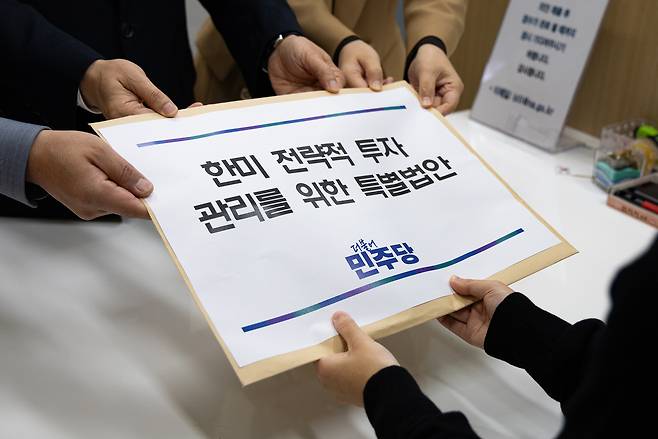
South Korea’s ruling Democratic Party of Korea on Wednesday introduced a special bill to implement its $350 billion US investment pledge, with the goal of expeditiously locking in tariff cuts for automobiles that would apply retroactively to Nov. 1.
The legislation — a central follow-up to the joint fact sheet — paves the way for Washington to reduce levies on Korean automobiles and parts to 15 percent from 25 percent.
The bill, titled “Special Act on Managing Korea-US Strategic Investments,” was submitted less than two weeks after the allies released their joint fact sheet and simultaneously signed the memorandum of understanding on strategic investment on Nov. 14, following their summit on Oct. 29 in Gyeongju, North Gyeongsang Province.
The Democratic Party sought to introduce the bill before the end of November in order to capitalize on the agreement by Seoul and Washington that the tariff reduction would be effective retroactively from the first day of the month in which the bill is submitted to the National Assembly.
South Korea’s Ministry of Trade, Industry and Energy sent a letter signed by Minister Kim Jung-kwan to US Secretary of Commerce Howard Lutnick to notify him of the bill’s introduction at the National Assembly after it was submitted Wednesday morning.
In the letter, Kim also “requested expedited publication in the Federal Register” of the tariff reduction on automobiles and parts — including its retroactive application to Nov. 1 — so that the measure can formally take effect from the start of the month.
South Korea’s Ministry of Economy and Finance said the introduction of the special bill “has eased uncertainty for Korean exporters to the US.”
Following the bill’s submission, Minister of Economy and Finance Koo Yun-cheol underscored the importance of South Korea’s investment in the US at a time when “the Korean economy is at a turning point that will determine its growth trajectory for the next several decades.”
“(Our investment) must be turned into a strategic opportunity for us to actively lead global value chains and position ourselves at the forefront of the world,” Koo said, presiding over an economic ministers’ meeting in Sejong.
The special bill includes provisions on establishing a framework and procedures for carrying out strategic investments, creating a Korea-US strategic investment fund and setting up a Korea-US strategic investment corporation on a temporary basis to manage the fund.
The special bill, which covers Korea’s pledge to invest $200 billion in US strategic sectors and $150 billion in the US shipbuilding industry, also stipulates that the safeguards for the Korean government outlined in the memorandum must be observed.
The bill requires investments to remain “within the annual remittance cap of $20 billion” out of the pledged $200 billion, and ensures that only “commercially reasonable” projects are recommended by the US, while encouraging priority for Korean vendors and personnel “to the extent possible.”
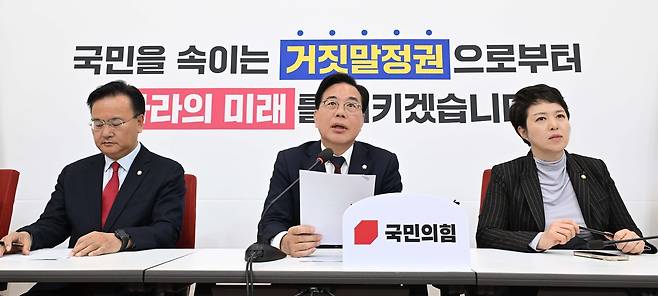
However, Rep. Kim Gunn of the People Power Party said the bill is riddled with flaws and structural weaknesses that could leave South Korea at a disadvantage and impose a financial burden on the public.
Kim raised concern, for instance, about Article 32, which states that the government must cover any losses or deficits, arguing that this structure could mean “a considerable share of the investment risk would ultimately fall on taxpayers.”
Kim also criticized the bill for adopting the term “commercially reasonable,” which the memorandum defines only as what the US Investment Committee “believes in good faith,” a standard he said is vague and ultimately places Korea at a disadvantage.
Kim further noted the bill weakens the requirement for a Korean project manager by adding the phrase “to the extent possible,” compared to the memorandum, effectively opening the door to non-Korean managers.
Rep. Huh Young of the Democratic Party said that the "party has not set a timetable for deliberation because we hope the ruling and opposition parties can work together to pass a more complete US investment bill."
The ruling party’s push came despite repeated calls from the main opposition People Power Party for the investment plan with the US to undergo Assembly ratification.
The opposition party has cited relevant constitutional provisions — including Article 60, which stipulates that the National Assembly has the right to consent to “treaties that will burden the state or the people with an important financial obligation.”
Rep. Song Eon-seog, the party’s floor leader, said, “The proper principle is to obtain the National Assembly’s ratification first and, if necessary, pursue a special law or revise existing laws accordingly.”
The Lee Jae Myung administration has said that ratifying the fact sheet could strategically backfire on South Korea by unnecessarily binding the country to unfavorable clauses in the current memorandum, such as the revenue-sharing formula between Seoul and Washington.
Experts are divided over whether the US investment arrangement requires National Assembly ratification.
On one side, Kim Yang-hee, a professor in the Department of Economics, Finance and Trade at Daegu University, argued against ratifying the memorandum, saying flexibility must be preserved because the Korea-US negotiations are “a long fight that won’t be wrapped up anytime soon,” and that “only the first round has ended."
“While the National Assembly’s role in oversight and scrutiny should be fully guaranteed, it is preferable not to seek Assembly ratification in order to preserve a degree of uncertainty,” Kim said.
Copyright © 코리아헤럴드. 무단전재 및 재배포 금지.