In a world of walls, BRIDGE Summit 2025 builds a pathway for ideas and a shared future for the global content economy
For more than a century, the global media environment has been shaped by industries that developed along separate tracks — news, film, music, gaming, advertising, education and the technologies that distribute them. Today, those boundaries are collapsing with unusual speed. A news story travels on the same channels as short-form video; a song becomes a trend through a gaming platform; a film’s success hinges as much on algorithmic discovery as on traditional marketing. What once felt like distinct creative economies are now converging into a single, intricately interdependent content ecosystem.
This convergence, while creating new opportunities, has also intensified a long-standing challenge: fragmentation. The most influential sectors in global culture are advancing rapidly, but not necessarily in conversation with one another. Innovation outpaces the forums where shared understanding can be developed, where regulatory perspectives can be compared, and where emerging audiences can be interpreted collectively rather than in isolation.
It is into this landscape that the United Arab Emirates has introduced BRIDGE, a project conceived in Abu Dhabi but designed for the world. BRIDGE does not resemble a festival, trade show or traditional cultural gathering. Instead, it functions as a long-term framework for collaboration — a structure that treats media, entertainment, content, technology, research and education not as parallel industries, but as interconnected elements of one global system.
At its core lies a simple idea: the UAE is not seeking to build the greatest physical bridge, but a bridge of ideas — one that connects people, disciplines and ways of thinking that rarely meet elsewhere.
This approach is deliberate. For more than two decades, the UAE has invested in becoming a global meeting point — a nation that convenes industries, policymakers and cultural institutions through a combination of regulatory agility, multicultural composition and infrastructure designed for exchange.
With residents from more than 200 nationalities and governance systems able to adapt quickly to emerging technologies, the UAE has cultivated an environment where disciplines that rarely meet elsewhere can engage one another with ease.
BRIDGE extends that trajectory. It emerges from the recognition that the future of political, cultural and economic influence will not be shaped by any single sector or geography, but at the intersections where those sectors meet.
The timing behind BRIDGE is not coincidental. Across global markets, media institutions are navigating pressures unprecedented in the modern era. Trust in news organizations is declining in many countries. Streaming platforms are struggling to maintain sustainable business models. Social networks and short-form video platforms have redefined how attention is captured and how communities form. Meanwhile, artificial intelligence is introducing profound questions around verification, authorship, and intellectual property.
These pressures are not experienced evenly. Significant parts of the world still lack access to reliable broadband, independent journalism or competitive digital infrastructure. Platform dominance continues to concentrate power in the hands of a small number of global companies, raising concerns about cultural homogenisation and the shrinking visibility of local content. Fragmentation, in this context, is not only a technical challenge — it is a social and political one.
BRIDGE does not claim to solve such structural inequalities. Rather, it seeks to create a venue where they can be examined collectively. It aims to bring together policymakers, creators, technologists, and investors to understand how their sectors influence one another, and where shared interventions may be possible. In a world where content economies increasingly define economic and diplomatic leverage, the project offers a space for coordinated thinking.
BRIDGE’s design reflects a long-term vision. The project functions as an ecosystem built on interconnected environments: co-production labs for testing early-stage ideas; regulatory exchanges linking governments and platforms; research partnerships connecting universities and emerging ventures; accelerators for innovation; and open collaborative spaces where creators, technologists, and cultural institutions can experiment.
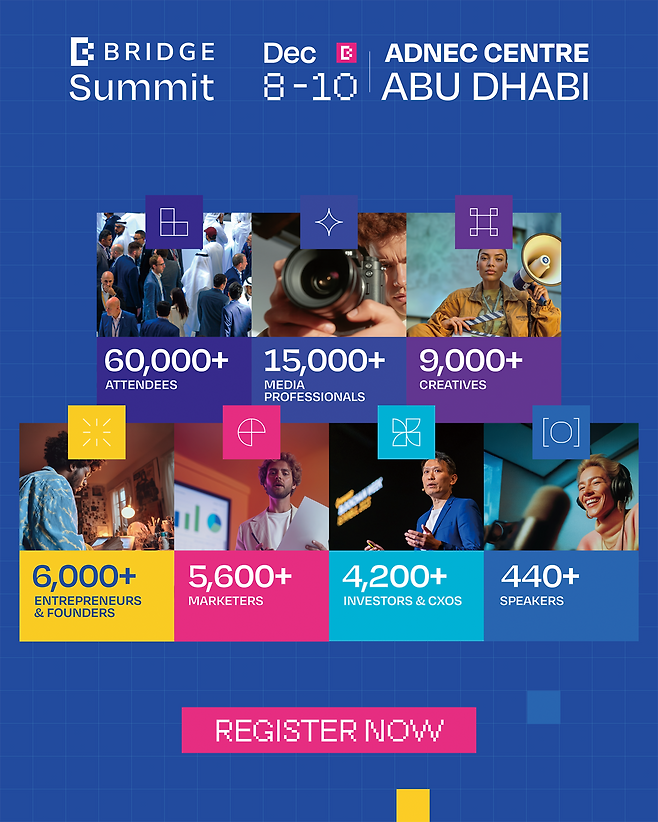
The most public expression of this ecosystem is BRIDGE Summit 2025, to be held Dec. 8–10 at the Abu Dhabi National Exhibition Center. Described as the world’s largest debut media event, the Summit reflects the scale of the forces it seeks to address.
The gathering will bring together 60,000 participants from 132 countries, including 1,200 CEOs, 260 advertising agencies, and nearly 5,000 media professionals. More than 300 sessions and activities — from workshops and executive roundtables to hands-on studios and networking programmes — will run across 1.65 million square feet of exhibition space. Selected from over 1,000 applicants, 150+ companies will exhibit alongside more than 100 startups representing advanced creative and technological frontiers.
Yet the Summit is not intended as an endpoint. It is the annual moment when the BRIDGE ecosystem becomes visible at scale — a working model of what a converging content economy looks like in practice. Its purpose is to illustrate how differently sectors operate when placed in proximity rather than isolation.
At the core of BRIDGE Summit 2025 are seven tracks that represent the sectors shaping global influence: Media, Music, Picture, Gaming, Technology, Marketing and the Creator Economy.
These tracks do not function as silos. Instead, they serve as points of connection. An AI researcher might experiment with tools that reshape journalism or documentary production. A musician may analyse how platform behaviour influences composition and audience discovery. A gaming studio might evaluate how narrative and design intersect with advertising and fan communities. Brands can examine how algorithms alter consumer expectations and the underlying infrastructure of trust. Through these intersections, BRIDGE underscores a central reality:
Content is no longer the outcome of separate industries. It is the connective tissue of the global digital economy.
The Summit’s spatial design reflects this philosophy. Newsroom labs sit beside AI studios. Creator spaces adjoin gaming pavilions. Policy discussions take place near workshops focused on immersive storytelling, machine learning, and audience intelligence.
The intention is not to flatten differences between disciplines but to illuminate their interdependence.
This is particularly significant in an era when many societies feel the effects of cultural homogenisation, or the sense that global platforms shape narratives in ways that narrow local expression. BRIDGE does not present a single answer, but it offers a venue where diverse cultural institutions, independent creators, regional media, and global tech companies can address these concerns collectively.
That BRIDGE originates in the UAE matters. The country’s regulatory agility, diplomatic networks, investment in cultural and technological sectors, and multicultural demographics have made it an increasingly neutral ground for global dialogue. Abu Dhabi and Dubai have become meeting points for industries undergoing transition — from publishing and technology to climate research, economics, and cultural diplomacy.
BRIDGE builds on that foundation, leveraging the UAE’s position to address a global need rather than a regional one.
Will one project resolve fragmentation across the global content ecosystem? No. But it can establish a reference point — a shared vocabulary for an era defined by extraordinary acceleration. BRIDGE offers a place where stakeholders can pause, compare perspectives, and understand how their sectors shape one another in real-time.
In a world where influence travels faster than regulation, where audiences shift fluidly across platforms, and where technology evolves in unpredictable cycles, coherence will not come from any single institution. It will emerge at intersections such as these — through relationships, experiments and collaborations designed with intention.
BRIDGE Summit 2025 is one of those intersections. A bridge is never the destination, but it reshapes what becomes reachable — and who can reach it together.
Further details about BRIDGE’s programs and participation are available at worldmediabridge.com.

Copyright © 코리아헤럴드. 무단전재 및 재배포 금지.