Samsung’s smart factory project transforms kimchi production in Gangwon
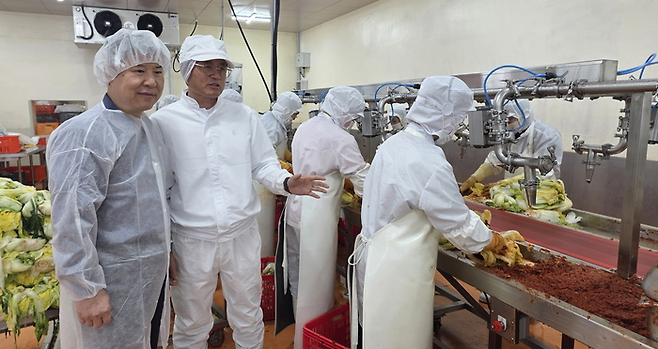
“This program was not just about changing our production line—it was an invaluable opportunity for us to grow. We will not stop here but continue to move toward a better tomorrow,” said Min Byung-chul, CEO of Pyeongchang Kkotsooni.
Pyeongchang Kkotsooni, known for using 100 percent domestic and organic ingredients, has grown rapidly over the past few years. Its flagship products—including highland dried pollack kimchi, seasoned kimchi, and diced radish kimchi—are supplied nationwide. The company’s annual revenue rose from 4.5 billion won ($3.06 million) in 2022 to 7.5 billion won last year, a nearly 67 percent increase in just three years. Its workforce doubled from 12 to 24 employees during that period and now numbers around 50. The firm expects to hit 9 billion won in sales this year.
However, this growth might not have been possible without Samsung Electronics’ Smart Factory Support Program. Despite surging demand, Pyeongchang Kkotsooni’s production line remained inefficient and heavily reliant on manual labor. Kimchi-making requires extensive handwork—from inserting seasoning into each cabbage leaf to cutting stems and packing products—placing heavy physical strain on workers’ wrists and backs while limiting output.
Before automation, even cutting the cabbage stems and packing kimchi in ice boxes had to be done by hand. Workers could not increase production beyond a certain point without risking injury or fatigue. The factory layout also caused hygiene and safety concerns: condensation dripped from ceiling coolers, air curtains were absent—allowing insects to enter—and the lack of separation between allergenic and general storage items posed contamination risks. Damaged urethane flooring also raised concerns about mold and bacterial growth.
After reading a Maeil Business report on Samsung’s Smart Factory initiative, Min applied for the program. Pyeongchang Kkotsooni first joined the basic support stage in July–August last year and completed the advanced upgrade phase this summer. The results exceeded expectations.
The installation of an automated filling machine improved product consistency and boosted productivity by 10 percent—from 566 kilograms per hour to 623 kilograms. Automatic box taping for ice-box packaging reduced repetitive manual work, increasing output by 25 percent from 180 to 225 boxes per hour. The cabbage-box washing process was also automated, cutting washing time per box by 28 percent—from 25 to 18 seconds. Upgraded X-ray inspection equipment now prevents defective products, achieving a near-zero defect rate.
Samsung also helped overhaul the facility environment. Partition walls now separate allergenic from general items, air curtains prevent insect entry, and sloped floors were leveled to improve logistics efficiency. Drain covers were added to prevent cart wheels from getting stuck, cutting movement time nearly in half—from 28 seconds to 15 seconds.
The company also introduced a Manufacturing Execution System (MES), replacing handwritten material tracking with barcode and PDA-based digital management. This improved inventory accuracy and workflow efficiency, while new temperature and humidity monitoring systems in cold storage now alert staff to any abnormalities in real time.
Min said, “The smart factory upgrade dramatically improved efficiency and sales. At first, employees were resistant to change, but after seeing the results, their professionalism and motivation grew.”
Founded in 2014 with 400 million won in capital, Min describes himself as a farmer. He personally farmed vegetables from 2009 to 2013, believing that “a CEO must understand the full production process to make a truly good product.” His wife, Jeong Yun-seo, serves as the company’s head researcher and a certified kimchi master.
Pyeongchang Kkotsooni has since earned multiple awards, including the Grand Prize at the GTI International Trade and Investment EXPO, and holds patents such as its low-sodium kimchi and automated cabbage trimming system—granted this month after a one-year application process. The company is now preparing to enter the meal-kit and U.S. export markets. It remains the only Korean kimchi maker with halal certification, achieved in 2022 to target Muslim consumers.
Copyright © 매일경제 & mk.co.kr. 무단 전재, 재배포 및 AI학습 이용 금지
- [단독] “초코파이 더 내놔” 난리난 러시아…2조 매출 오리온이 내린 결단 - 매일경제
- “아내가 회계사인데 너무 불안해요”…곳곳이 인건비 절감 생존경쟁 - 매일경제
- “국민쓰레기 됐다”…‘박명수 불화설’ 개그맨, 인성 논란 입 열었다 - 매일경제
- 하루 6시간 자고, 식사 거르고 커피 한잔…아침마다 ‘이 증상’ 힘드시죠? - 매일경제
- “한강뷰, 임대동엔 절대 못 준다”…조합장 해임까지 번진 ‘이 아파트’ - 매일경제
- [속보] 대미투자특별법 발의···“자동차 관세 11월 1일자 15% 소급” - 매일경제
- IMF “한국, 퇴직·연금개시 함께 늦춰야”…68세부터 받으라는데 - 매일경제
- 근육은 놔두고 물살만 태운다...살 빼는 약, 실험 결과 대반전 - 매일경제
- “명품백, 백화점 가서 사세요”…면세점 직원도 조용히 말 건낸다는데 - 매일경제
- ‘라건아 없는’ 위기의 대한민국 농구, 농월 예선 최약체 ‘언더독’ 평가…“이현중 중심 젊