Lee's Middle East, Africa trip underscores regional ties
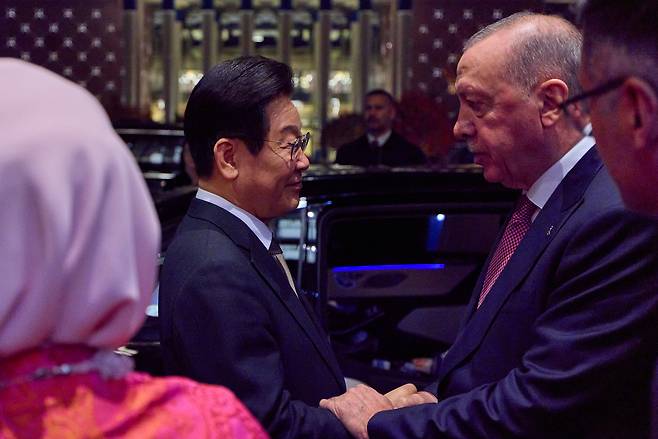
President Lee Jae Myung's 10-day trip of the Middle East and African nations was to wrap up Tuesday, with South Korea having put particular emphasis on defense and nuclear energy ties.
On the final leg of the trip in Turkey, Lee and Turkey's President Recep Tayyip Erdogan agreed to deepen the two countries' strategic partnership and bolster ties in such fields.
Lee’s meetings with leaders of the United Arab Emirates and Egypt, held before the G20 summit in Johannesburg over the weekend, had similar themes, in line with the Lee administration's push to nurture these sectors as growth drivers.
Througout his trip, Lee highlighted South Korea's model of defense cooperation, involving joint development and local production.
Following his summit with Erdogan on Monday, Lee said in a joint press conference that the two nations agreed to continue defense cooperation involving joint production, technological collaboration and personnel training exchanges, as seen in the case of Turkey's main battle tank, Altay, the initial batch of which went into production in September and uses packs made by South Korean firms.
The agreement with Turkey was the last in a series of such announcements made during the trip.
The UAE has been a key importer of South Korean arms, including the Chunmoo multiple rocket launcher and the Cheongung-II surface-to-air missile system, but a new agreement seeks to take cooperation in the industry beyond bilateral trade.
In the UAE, Lee and his Emirati counterpart Sheikh Mohammed bin Zayed Al Nahyan on Nov. 18 agreed to seek up to $15 billion worth of defense contracts in third countries through joint development, technology cooperation and local production.
Such models for joint production in the field of defense have already been in practice in the Middle East.
In Egypt, Lee on Thursday hailed the joint production of the K-9 self-propelled howitzer, during his joint press conference with Egyptian President Abdel Fattah el-Sissi. This was made possible through Egypt's introduction of other South Korean equipment, such as FA-50 light aircraft and the Cheongeom air-launched anti-tank missile.
After the Group of 20 Summit, Lee said that his push for defense cooperation with multiple partners came amid "unexpected and sudden changes" not only in the Middle East but in other countries.
"The demand for defense industries in each country is growing faster than anticipated," Lee said. "As the level of the threat (to national insecurity) intensifies, so does their interest (in national defense). I believe this will be very helpful in developing inter-country relations."
As to the Middle Eastern region's transition to nuclear energy, Lee's trip also raised hopes that South Korea could continue to build its track record in the region.
South Korea and Turkey on Monday signed a memorandum of understanding to ensure that the remaining detailed evaluation processes for Turkey’s new nuclear power plant project could proceed as planned, supported by the governments of the two countries, as South Korea's state-run Korea Electric Power Corp. is seeking to take part in Turkey's Sinop Nuclear Power Plant project on Turkey's northern shores.
This follows Korea's construction of the Barakah nuclear power plant in the UAE. The plant has provided about a quarter of the country's electricity needs since last year.
Lee and Sheikh Mohammed agreed to jointly enter third-country markets for nuclear power plant exports.
Regarding infrastructure, Lee revealed on his flight to Turkey that Egyptian leader el-Sissi during the summit had verbally offered South Korean firms' participation in Egypt's project for Cairo Airport overhaul.
While memorandums of understanding are often part of summit meetings, one expert said that they had carried increasing weight.
"Expectations for follow-up work resulting from the visit were essentially low in the past," said Eom Ki-hong, a political science professor, at Kyungpook National University. "While diplomatic negotiations in the past merely had symbolic significance, today's meetings between leaders have a greater chance of actually leading to substantive outcomes."
He added this might stem from the United States' growing reliance on its alliance to reduce its own costs and instead allow its allies like South Korea to take on some of the roles it had played.
Copyright © 코리아헤럴드. 무단전재 및 재배포 금지.