Nuri rocket transfer to kick off amid three key challenges
이 글자크기로 변경됩니다.
(예시) 가장 빠른 뉴스가 있고 다양한 정보, 쌍방향 소통이 숨쉬는 다음뉴스를 만나보세요. 다음뉴스는 국내외 주요이슈와 실시간 속보, 문화생활 및 다양한 분야의 뉴스를 입체적으로 전달하고 있습니다.
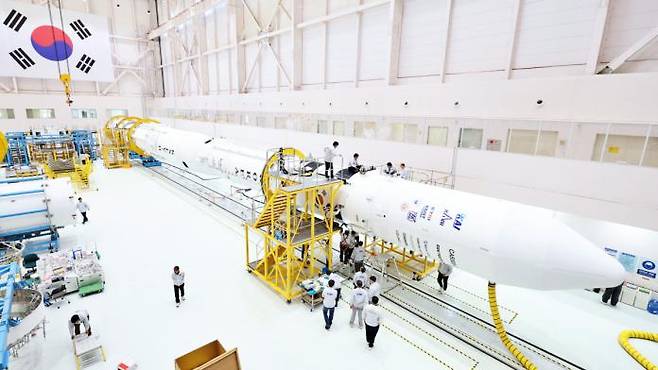
The fourth space launch of Nuri, South Korea's domestically developed launch vehicle, will finally take place on November 27. Researchers from the Korea Aerospace Research Institute (KARI) and other organizations completed the full assembly of the Nuri rocket body, consisting of three stages, by connecting them in sequence last week at the Naro Space Center in Goheung, South Jeolla Province.
The Nuri rocket, previously divided into three sections, has now become a complete, massive structure measuring 47 meters in length, equivalent to a 16-story apartment building. With all components and satellite payloads installed, the Nuri rocket now awaits its ‘D-day’ to break free from Earth's gravity and soar into space. What are the critical hurdles to stamping ‘success’ on the Nuri rocket's fourth launch?
Challenge One: Transport
The first operation requiring close attention for launching Nuri into space is its ‘transport.’ This involves moving the rocket out of the assembly building at the Naro Space Center, which resembles a large logistics warehouse, and transferring it to the launchpad. Transportation begins at 7:50 AM on November 25, two days before launch.
During transport, Nuri is loaded onto a vibration-free vehicle. This vehicle travels at 1.5 km/h, one-third the speed of a person walking leisurely. This slow pace ensures safety. Since the distance between the assembly building and the launchpad is 1.8 km, the transport takes about an hour to complete.
The problem is the weather. Weather has actually disrupted transport before. On June 14, 2022, when the Nuri rocket was scheduled to be transported for its second launch, strong winds persisted at the Naro Space Center. Winds reached speeds of approximately 10 meters per second, making it difficult for people to hold umbrellas or parasols.
After moving Nuri to the launchpad and standing it upright, researchers must personally climb the 48-meter-tall ‘umbilical tower’ erected atop the launchpad for final inspections. Encountering strong winds at such heights significantly increases the risk of safety accidents. Consequently, the Nuri transfer date was postponed by one day at that time. The launch date was consequently postponed as well. This time too, the Korea Aerospace Research Institute (KARI) team is expected to be on high alert regarding the weather conditions on the day of transfer.
Challenge 2: Separation
When it is transferred to the launchpad, the Nuri rocket undergoes procedures to load fuel (kerosene) and oxidizer (liquid oxygen) into its body starting around 9 PM on the 26th, four hours before launch. After fueling is complete, an automated countdown begins 10 minutes before launch. If no issues arise, Nuri will lift off at 12:54 a.m. on the 27th.
Once airborne, the key challenge is the separation of components. One of the most critical events is the jettisoning of the fairing, the metallic protective cover shielding the payload on the rocket’s third-stage nose. The fairing protects the satellite from atmospheric friction and heating during ascent.
After 234 seconds of flight (at an altitude of 201 km), when the atmosphere thins and protection is no longer needed, it is scheduled to split cleanly in two like a watermelon and be discarded into space.
If the fairing fails to separate, it's a major problem. This happened during the first launch of Naro, Korea's first space launch vehicle and the predecessor to Nuri (in August 2009). The added weight of the fairing prevented Naro from reaching its planned velocity, causing the satellite to miss its intended orbit. Normal fairing separation is also a critical milestone that must be achieved during Nuri's fourth launch.
The ‘stage separation,’ where the spent Nuri rocket body stages sequentially detach in space, is also critical. Separation between Nuri's first and second stages is scheduled for 125 seconds after liftoff (altitude 63 km), while separation between the second and third stages is planned for 272 seconds (altitude 257 km). Any malfunction or delay in this process jeopardizes the satellite’s insertion into its intended orbit.
Challenge 3: Satellite Deployment
807 seconds after launch, with only the third stage remaining, Nuri surges to an altitude of 600 km and finally deploys the satellite into Earth orbit.
The first to be released is the next-generation medium-size satellite No. 3, roughly the size of a large commercial refrigerator. After that, 12 CubeSats ranging in size from a few apples to a briefcase will be deployed one after another. This process is known as deployment, during which CubeSats are pushed out of the rocket through a small “ejection tube” mounted on the third stage.
This step must be monitored carefully. During the third Nuri launch in 2023, one of the four Doyosat CubeSats failed to deploy because the door of the ejection tube did not open properly due to a mechanical mishap.
The fourth Nuri mission includes the largest number of CubeSats to date, which is 12 in total, making the risk of unexpected issues higher. Until the deployment sequence finishes at 1,284 seconds after launch, the team cannot fully relax.
Nuriho project manager Park stated, “In September, we conducted a Wet Dress Rehearsal (WDR), filling and draining the rocket’s fuel and oxidizer to confirm that all components operated normally.” He added that additional lighting and nighttime work protocols were implemented to support Nuri’s first-ever night launch. “The success or failure of the fourth Nuri launch depends on a single attempt, so we are doing everything we can to prepare.”
※This article was translated by an AI tool and edited by a professional translator.
Copyright © 경향신문. 무단전재 및 재배포 금지.
- 31세 명문대 공학도, 왜 총을 들었나···트럼프 만찬장 총격 사건 용의자는 누구?
- 백악관 만찬 행사 시작 30분 만에 아수라장···긴박했던 ‘VIP’ 대피 순간
- ‘순방 복귀’ 하정우, 다가온 결단의 시간…평택을 조국 대항마는 이광재냐 김용남이냐
- [오토 차이나 2026]“봐도 봐도 끝이 없다”…축구장 50개 크기 공간서 펼쳐진 전기차 기술의 향연
- 29명 목숨 앗아간 제천 화재 참사 29억 위로금···우여곡절 끝에 지급
- 호르무즈 해협 폐쇄로 미국 기업만 웃는다···3~4월 에너지 수출 역대 최대
- 낚시·조개잡이 관광용 전락한 ‘인천공항 자기부상열차’···타는 승객도 없다
- 김병민 정무부시장 등 오세훈 참모들 서울시 떠난다···“본격적인 선거운동 돌입”
- “나랑 애인해도 되겠어” 20대 여성 등산객 얼어붙게 만든 노인
- “1분기 순이익 1조원” 증권사, 코스피 불장에 ‘만년 조연’ 탈피···실적 전망 금융지주도 넘