AmCham, KCCI lay out strategies for Korean firms entering US market
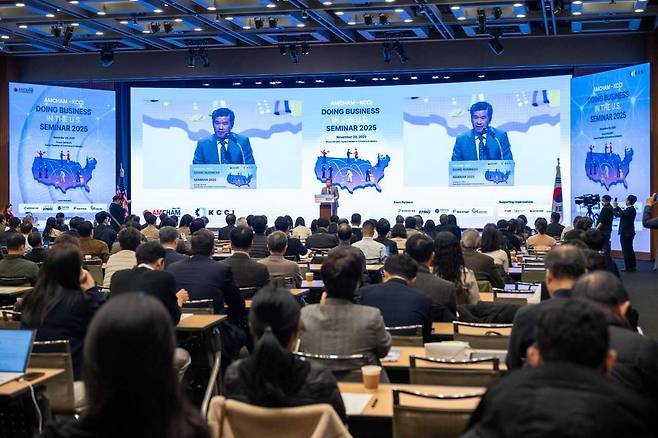
South Korean companies face a fast-changing landscape in the United States as reciprocal tariffs, regulatory scrutiny and evolving industrial policies reshape conditions for market entry, speakers said Thursday at Doing Business in the US Seminar 2025 in Seoul.
Co-hosted by the American Chamber of Commerce in Korea and the Korea Chamber of Commerce and Industry, the annual seminar — now in its seventh year — has grown into one of the country’s top platforms for firms seeking to expand or establish operations in the US. The event drew senior executives, legal and tax experts, state officials and government representatives, all offering guidance on navigating what participants described as the most complex US policy environment in years.
AmCham Chair and CEO James Kim opened the seminar by urging Korean businesses to build on the renewed bilateral momentum following the recent summit between President Lee Jae Myung and US President Donald Trump and the joint fact sheet outlining cooperation in strategic sectors.
“Korea’s leadership at the APEC summit demonstrated what our two countries can achieve when we work together,” Kim said. “A core mission of AmCham is to ensure that Korean businesses have a confident and well-supported pathway to success in the United States.”
KCCI Executive Vice President Park Dong-min echoed the sentiment, saying the joint fact sheet underscores both countries’ intentions to deepen cooperation in shipbuilding, semiconductors, space and AI. But he warned that global uncertainty continues to grow as protectionism spreads and supply chains realign.
“In this environment, today’s seminar is especially valuable because it provides practical guidance in areas where companies face the greatest challenges,” Park said.
In the first session, Kim Jong-duk, executive director at the Korea Institute for International Economic Policy, said the conclusion of US-Korea negotiations during the Asia-Pacific Economic Cooperation summit had eased some uncertainty. Still, he cautioned that the US policy direction will remain anchored in structural issues such as weakened manufacturing competitiveness and strategic rivalry with China. Companies, he said, must closely monitor political developments, major-country negotiations and financial market conditions when planning their US strategies.
Kim Seon-hyung of Deloitte Anjin outlined the implications of the new 15 percent reciprocal tariff regime, calling it a “fundamental challenge” that requires Korean companies to reassess their cost structures and competitive positioning. Midsized firms, he noted, face increasingly interconnected hurdles related to tariffs, transfer pricing and regulatory compliance.
The seminar’s second session offered corporate mentoring across visas, finance, mergers and acquisitions, taxation, customs and workforce strategy. Speakers stressed the importance of carefully selecting visa categories for personnel deployment, preparing early for Committee on Foreign Investment in the United States reviews in M&A and tailoring strategies to fast-growing US markets such as Texas.
Kim Tae-joo of KPMG said companies must proactively plan around evolving tariff policies, rules of origin and transfer pricing structures, while Bank of Hope Senior Executive Vice President Kim Kyu-seong highlighted the importance of choosing banking partners capable of handling complex cross-border needs.
The final session focused on workforce development, with KCCI’s Park So-youn introducing a new platform connecting Korean companies with US Forces Korea veterans — a talent pool seen as increasingly valuable for firms seeking to expand US operations.
Organizers said the seminar offered Korean companies timely insights and practical tools as they position the United States as their next major growth market.
Copyright © 코리아헤럴드. 무단전재 및 재배포 금지.