Late-life love in Jongno: Inside Seoul's 'I’m Solo’ for seniors
전체 맥락을 이해하기 위해서는 본문 보기를 권장합니다.
Studies show that seniors who remain socially active are healthier and more satisfied with life. Yet only 34.2 percent of older people living alone describe themselves as "healthy," while nearly 1 in 3 say they "feel isolated due to having no one to talk to."
Some participants were bolder. Memory, 82, admitted he had his eye on three women and couldn't decide. Others knew exactly what they wanted. "My children live abroad," said one man. "When I had the flu last time, no one brought me water. If I meet someone nice, I'd love to live together."
이 글자크기로 변경됩니다.
(예시) 가장 빠른 뉴스가 있고 다양한 정보, 쌍방향 소통이 숨쉬는 다음뉴스를 만나보세요. 다음뉴스는 국내외 주요이슈와 실시간 속보, 문화생활 및 다양한 분야의 뉴스를 입체적으로 전달하고 있습니다.
Under a soft October sun, laughter and music filled the courtyard of Seoul Donhwamun Traditional Theater in central Seoul. Thirty-six seniors aged 65 and older gathered for the third annual “Jongno Good Life Challenge,” an event organized by Jongno-gu Office to help older residents build new friendships, and perhaps even find love.
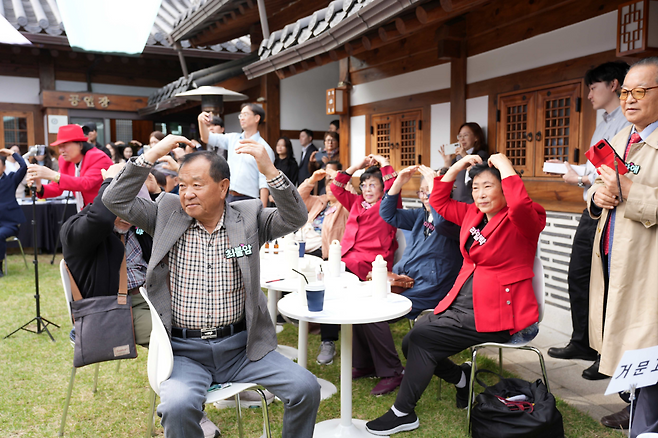
Some call it the senior version of “I’m Solo” after the hit dating reality show "I'm Solo," where single men and women live together to find partners.
As in the show, participants, unmarried or widowed residents of Jongno, introduced themselves using playful nicknames such as Lilac, Squirrel, Victory and Magnolia.
The opening performance was presented by Uluolu Ukulele, a ukulele performance club based at the Jongno Senior Welfare Center’s Muak branch, composed of members aged 60 and older. The highlight of the day was a “DIY essential oil” session, where participants created their own scents and gifted them to a “Secret Santa.”
Though initially shy, the warm aromas and conversations quickly filled the theater courtyard. Participants chatted about everyday life: “My children live in the countryside,” “I attend temple,” “I stay active for my health.” They were given 20 minutes each for one-on-one conversations.
By the end of the afternoon, the participants had formed 10 pairs -- both romantic and platonic -- promising to meet again over coffee or dinner. “I never thought I’d make a new friend at this age,” one woman said, smiling.
Behind the lighthearted mood lies a deeper concern: isolation among the elderly.
According to national data, 1 in 5 Koreans is now aged 65 or older. The number of single-person households among those aged 65 and above reached 2.29 million in 2024, up from 1.67 million in 2020, marking a roughly 36 percent increase. By 2052, seniors are expected to make up 51.6 percent of all single-person households.
Studies show that seniors who remain socially active are healthier and more satisfied with life. Yet only 34.2 percent of older people living alone describe themselves as “healthy,” while nearly 1 in 3 say they “feel isolated due to having no one to talk to.”
Recognizing this, local governments are shifting their focus from economic welfare to rebuilding social connections, increasingly treating loneliness as a public health issue.
Jongno’s matchmaking event is part of this broader movement. Across the country, municipalities are launching creative projects to help seniors reconnect.
In Gangneung, Gangwon Province, local residents are paired with seniors to share meals and check in regularly. In Jincheon County, North Chungcheong Province, programs like “A Fence of Happiness” offer gardening and cooking activities to promote mental well-being. In Chilgok County, North Gyeongsang Province, a group of rapping grandmothers known as “Suni and the Seven Princesses” began through a local social club and went on to release music of their own.
“The key is not one-time support but lasting relationships,” said Kim Jin-young, sociology professor at Korea University in Seoul. “Cooking classes, cultural events and wellness programs can form sustainable networks. In the long run, restoring social ties reduces care costs and improves quality of life.”
At Donhwamun that day, courage and curiosity mixed freely with nervous laughter. Lilac, a 72-year-old woman who had never married, said the event made her feel “like a queen.” Daffodil, 81, added, “It would be nice to have a friend to share meals or trips with.”
Some participants were bolder. Memory, 82, admitted he had his eye on three women and couldn’t decide. Others knew exactly what they wanted. “My children live abroad,” said one man. “When I had the flu last time, no one brought me water. If I meet someone nice, I’d love to live together.”
Even in their later years, humor and taste still mattered. “He’s so polite and charming. If only he were a bit taller,” one woman laughed after pairing with her new friend.
And as always, the oldest trick in the book worked: “Let me treat you to something delicious.” Promises of steak and barbecue dates floated through the courtyard as couples slipped away toward nearby restaurants.
For Jongno District, the event is as much about community as companionship. “In an age when living to 100 is common, what matters is not just longevity but living joyfully,” said Jongno Mayor Jeong Moon-heon. “Our seniors’ hearts are still young. We’ll continue creating opportunities for vibrant, connected lives.”
Building on the event’s popularity, the district plans to expand participation across Seoul next year and make it a quarterly program.
The smiles and conversations that lingered in the Donhwamun courtyard that autumn afternoon hinted at something more enduring than a dating show moment. Late-life romance, the participants proved, isn’t about grand gestures or perfect matches, it’s about having someone to laugh with, share a meal with, or simply hand you a glass of water when you need it most.
Copyright © 코리아헤럴드. 무단전재 및 재배포 금지.