What kind of wheat becomes the Eucharist in catholic mass?
이 글자크기로 변경됩니다.
(예시) 가장 빠른 뉴스가 있고 다양한 정보, 쌍방향 소통이 숨쉬는 다음뉴스를 만나보세요. 다음뉴스는 국내외 주요이슈와 실시간 속보, 문화생활 및 다양한 분야의 뉴스를 입체적으로 전달하고 있습니다.
During the solemn moments of Mass, even non-Catholics may have seen worshippers carefully receive and consume a small, white, round wafer offered by the priest. This white object is called the host, literally, a sacrificial bread. Made simply by mixing flour and water and baking it into a thin, plain wafer, it becomes the Eucharist, the body of Christ, through the priest’s consecration. For this reason, it cannot be made arbitrarily or with just any ingredients.
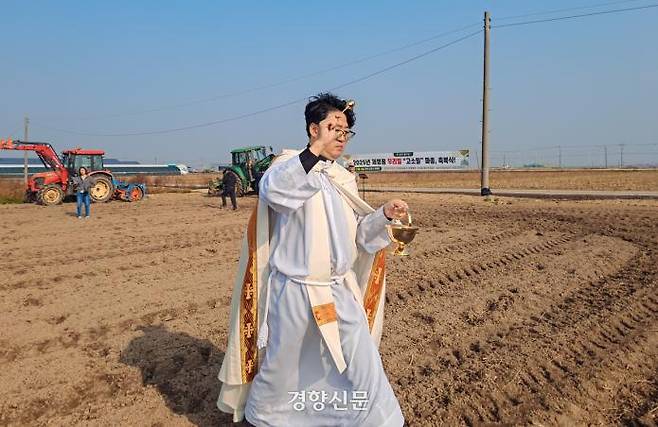
In Buryang-myeon, Gimje, North Jeolla Province, one of Korea’s largest grain-producing regions, a distinctive ceremony took place on November 13. The “Blessing of the Wheat Field,” marking the sowing of wheat that will be used exclusively to make hosts. About a dozen people, including Jang Soo-yong, head of the Hanmaeum Farming Cooperative, which grows the wheat, and Sim Sang-joon, head of the Our Rural Village Network, which handles milling and processing, gathered for the occasion.
Father Yoo Jeong-hyun (Andrea Daegun), who oversees rural pastoral ministry for the Diocese of Jeonju and wore a white vestment called a cappa, presided over the ceremony, calling it “a precious moment when we plant the grains that will become the body of Jesus Christ.” Following prayers and blessings, he walked through the ash-colored field where the wheat had just been sown, sprinkling holy water as he went. After the Lord’s Prayer and the final blessing, the ceremony ended, and a tractor immediately began smoothing the ridges. The brief, 20-minute ritual held in the vast fields under a clear blue sky evoked the feeling of a scene from a surreal film. As the solemn atmosphere lifted, someone joked, “If the crop doesn’t grow well, it’s the priest’s fault, right?” Laughter broke out.
The 30,000-pyeon area in Buryang-myeon is a dedicated farm for wheat exclusively used to make hosts. The first harvest was made this June after the dedicated cultivation site was established last year. The planted variety is Gosomill, a soft wheat typically used for baking cookies. Once harvested next June, the wheat will be milled and processed, then delivered to seven Carmelite monasteries nationwide, where the sisters will bake the hosts. These Carmelite monasteries are enclosed contemplative orders with minimal contact with the outside world, and they are responsible for producing the hosts used in Catholic Masses across Korea.
The hosts used in the Korean Catholic Church are closely tied to the “Korean Wheat Revival Movement.” After the movement launched in 1991, the Church also joined the effort. It was proposed that hosts for Mass be made from domestic wheat, a plan strongly supported by the late Cardinal Kim Sou-hwan.
However, the Korean wheat varieties then available, such as Geumgang and Baekgang, were mostly strong-flour types unsuitable for host making. Their high gluten content caused the dough to stick to the molds, making it difficult to produce proper shapes. Only about 20 percent of the flour used became usable hosts. Imported wheat, which was easier to process and cheaper, would have been far more convenient, but the Church held fast to its principles. Its commitment stemmed from the belief that “using domestic wheat instead of imported wheat reduces carbon emissions, protects the environment, and helps us appreciate and preserve the natural world God created.”
The situation improved in 2010 when the Rural Development Administration developed the Gosomill wheat variety. “Before that, the sisters making the hosts had many difficulties, but once we provided flour milled from Gosomill, the results improved significantly,” Sim explained. This led to calls for a dedicated farm for Gosomill wheat, and a full-scale cultivation site was established last year. The farm produces about 50 tons of wheat annually, though the nationwide annual requirement is around 200 tons, meaning further expansion is likely.
Hosts used in Mass must contain nothing except flour and water. They are closer in texture to a dry, hard cracker. Because no leavening is used, the dough cannot rise and remains flat, a practice rooted in the interpretation that the Last Supper was a Passover meal. In Judaism, Passover customs require eating unleavened bread made without yeast. In contrast, the Eastern Orthodox Church interprets the Last Supper as having included leavened bread and uses leavened bread for the Eucharist. Protestant denominations generally place less theological emphasis on whether the bread is leavened or unleavened.
※This article was translated by an AI tool and edited by a professional translator.
Copyright © 경향신문. 무단전재 및 재배포 금지.
- 31세 명문대 공학도, 왜 총을 들었나···트럼프 만찬장 총격범 용의자는 누구?
- ‘이재명의 남자’ 대 현역 단체장…윤곽 드러난 광역단체장 대진표
- ‘순방 복귀’ 하정우, 다가온 결단의 시간…평택을 조국 대항마는 이광재냐 김용남이냐
- “1분기 순이익 1조원” 증권사, 코스피 불장에 ‘만년 조연’ 탈피···실적 전망 금융지주도 넘
- [오토 차이나 2026]“봐도 봐도 끝이 없다”…축구장 50개 크기 공간서 펼쳐진 전기차 기술의 향연
- 29명 목숨 앗아간 제천 화재 참사 29억 위로금···우여곡절 끝에 지급
- 박민식 “온 힘 쏟겠다” 한동훈 “더 전재수같이 하겠다”…어색하게 조우한 부산 북갑 범야권
- 낚시·조개잡이 관광용 전락한 ‘인천공항 자기부상열차’···타는 승객도 없다
- “나랑 애인해도 되겠어” 20대 여성 등산객 얼어붙게 만든 노인
- “현재 경제 지속 땐 식량 훔치기 시작할 것”…전쟁 속 물가 급등 이란, 식용유 사러 튀르키예