[Thailand Forum] Thailand seeks ‘third wave’ of Korean investment
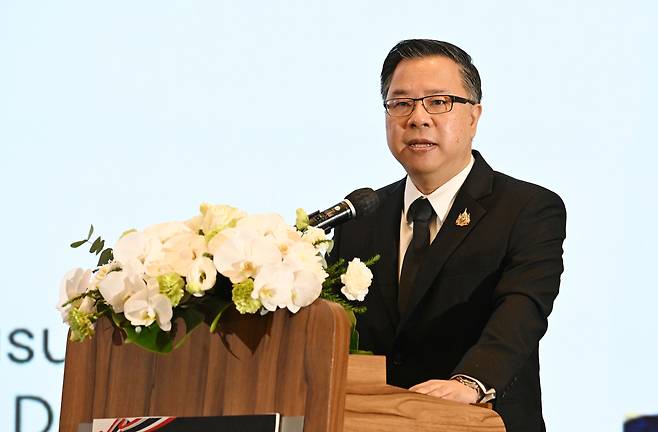
BANGKOK — Thailand is courting a new era of Korean investment in advanced industries with a coordinated package that spans national tax incentives, special economic zones and turnkey factory sites, officials from investment agencies said at the Ignite Thailand–Korea Business Forum in Bangkok on Monday.
Narit Therdsteerasukdi, secretary general of the Thailand Board of Investment, opened the session by urging Korean firms to look beyond the country’s traditional manufacturing strengths.
“For over 40 years, Korean firms have invested in Thailand’s industrial base,” he said. “Now we want to work with Korea on the ‘third wave,’ spanning semiconductors, EVs, batteries, smart appliances and digital-AI industries.”
Narit described the BOI as Thailand’s “single-window authority for investment” under the Prime Minister’s office, tasked with offering tax, non-tax and financial incentives and streamlining approvals across ministries.
He said Thailand’s next investment priorities lie in BCG (Bio-Circular-Green) industries, next-generation autos and semiconductors, areas where Korean companies have long held global leadership. “We aim to produce more ‘Made in Thailand’ chips,” he said, encouraging Korean firms to consider wafer fabrication and PCB projects.
Data centers and cloud infrastructure are emerging as another pillar, he added, with AWS, Google and Microsoft expanding their presence in the country.
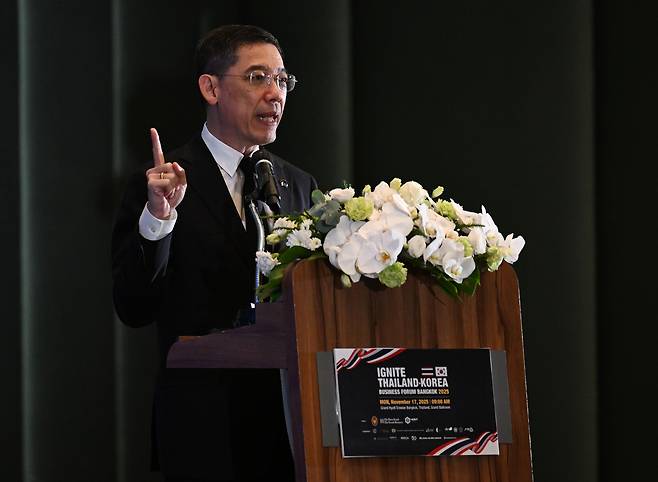
If BOI sets the national strategy, the Eastern Economic Corridor turns it into a place-based policy. Spanning Eastern Seaboard areas of Chon Buri, Rayong and Chachoengsao provinces, the EEC has become Thailand’s test bed for high-tech manufacturing.
Korkij Danchaivichit, deputy secretary general of the EEC Office, said the agency is “a full-fledged area development authority, covering everything from land-use planning and master plans to permits,” with legal authority to issue visas, work permits and more than 100 types of approvals.
The EEC’s strength lies in flexibility, Korkij noted. “Our system is truly tailor-made. We design incentives around each project,” he said, pointing to its authority to set detailed customs and tax rules. He added that the EEC is also preparing to operate its own free-trade areas as early as next year.
Its priority industries — medical and health, EVs, BCG, high-value services and digital technology — are concentrated across more than 30 estates and clusters. A distinctive feature, he added, is cross-zone foreign-currency settlement, which eliminates exchange and conversion costs.
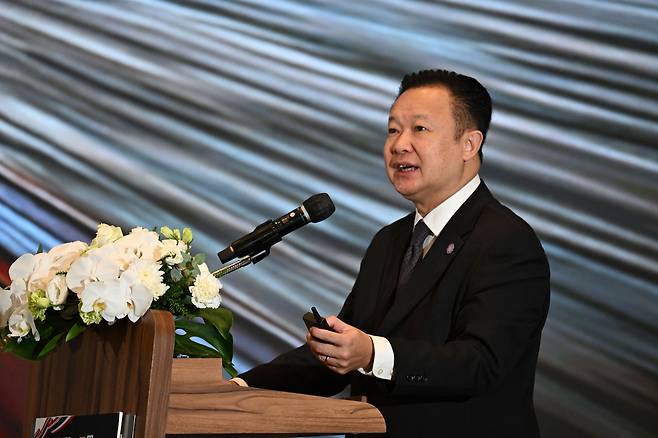
Providing the physical platform for these ambitions is the Industrial Estate Authority of Thailand. “We are a facilitator, not a regulator,” the agency's Chair Yuthasak Supasorn said, adding its estates now host more than 5,500 factories nationwide.
“Industrial estates bring together everything industry needs — water, roads, power and logistics — creating a stable investment environment and a future-ready production base,” he said.
Administrative procedures are streamlined, Yuthasak said, with land-use approvals issued within a day and factory licenses in about three — a sharp cut from the weeks or even months typically required outside the estates.
Despite working at different layers of Thailand’s investment architecture, the three agencies delivered a unified message to Korean firms: Thailand is positioning itself as a platform for sustainable growth.
“In a time of elevated geopolitical risk and uncertainty, choosing where to anchor your investment is a critical decision — and Thailand is a destination that can support your business model, growth strategy and long-term vision,” Yuthasak said.
Copyright © 코리아헤럴드. 무단전재 및 재배포 금지.