Joan Miro’s hidden Korean connection revealed through ceramics
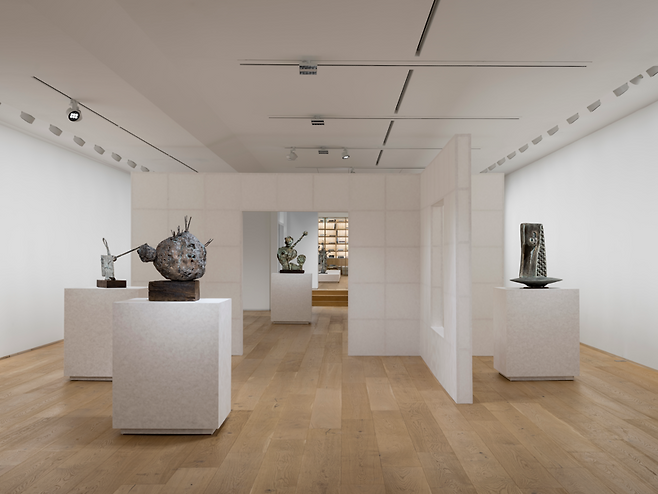
Joan Miro, the Spanish modern artist often associated with Surrealism, is not widely known to have any direct ties with Korea. But his ceramic practice, working in the middle of a forest about 64 kilometers north of Barcelona, reveals an unexpected connection.
“He never used electric or gas kilns, because the most important thing is the flame, ashes and smoke that make the patina (surface color and texture finish on ceramics) so special," said Miro’s grandson Joan Punyet Miro, who works for Successio Miro, the estate that administers the rights of the late artist's works.
When creating ceramics, Miro used to collaborate with Josep Llorens i Artigas, a renowned Catalan ceramist who visited Japan and knew how to build Korean and Japanese kilns, like the ones still being used in the studio today. Miro, himself, unfortunately, never had the chance to visit Korea, the grandson said.
“My grandfather worked with two wooden fire kilns, one Korean and one Japanese, rebuilt in Spain with the original measurements and materials,” he said, showing the late artist’s 13 bronze works at the "Joan Miro: Sculptures" exhibition at Thaddaeus Ropac in Seoul.
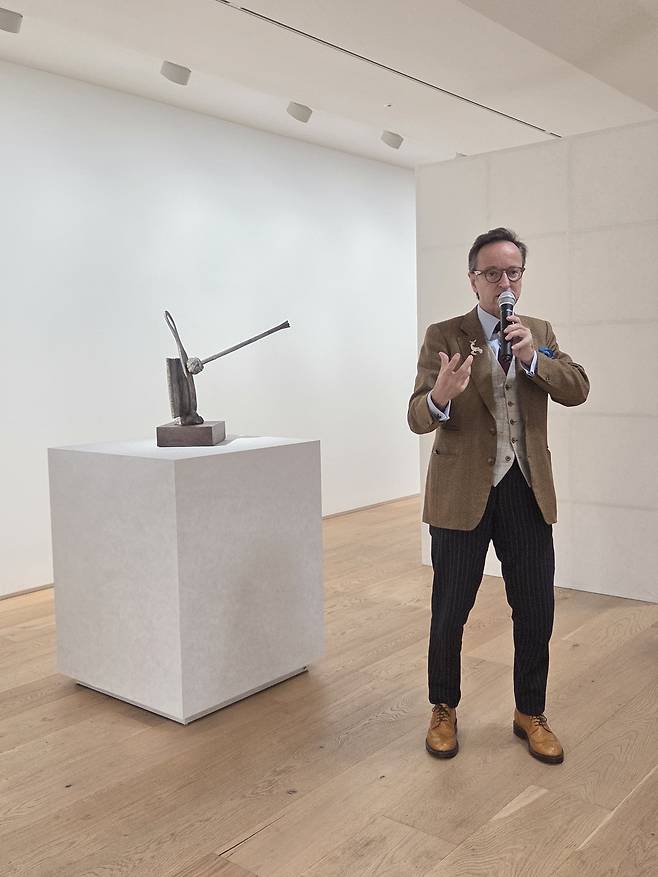
Miro emerged at a time when Surrealism was reshaping European art with its fascination for dreams and the unconscious; the master soon departed from its conventions to develop a distinctly personal language of signs and poetic abstraction.
While his paintings received more attention, the bronze works that Miro began exploring after his 40s are relatively overlooked, despite the master fully embracing the medium much later in his career.
“From 1965, he made a big production of bronze sculptures, and he was already 70 years old,” Joan said.
When asked about his memory of his grandfather, Joan Punyet Miro recalled the moment when he walked into the studio.
“There was a big circle of seashells, rocks and branches, stones and roots. He would let them talk to each other because he believed every single element of Mother Nature was sacred. He understood the spiritual forces of all the elements of nature,” the grandson said.
Instead of depicting reality, Miro reduced the world into simple signs — stars, eyes, birds, roots and soft, organic shapes — arranging them almost like lines of a poem. His sculptures follow the same approach, turning natural objects into three-dimensional forms in his own intuitive and playful way.
Miro interacted with other masters of the time, such as Alberto Giacometti, Pablo Picasso and Henry Moore, according to Joan.
Miro's grandson also talked about an unexpected connection with Ahn Eak-tai, the composer who wrote the Korean national anthem. After the Korean War (1950-1953), Ahn settled in Europe, married a woman from Mallorca, and later founded the Philharmonic Orchestra of the Balearic Islands, becoming Miro’s neighbor and a close friend.
“It is a very interesting relationship. I know (Ahn's) two daughters, still living in Mallorca; they are very good friends of mine," he told The Korea Herald.
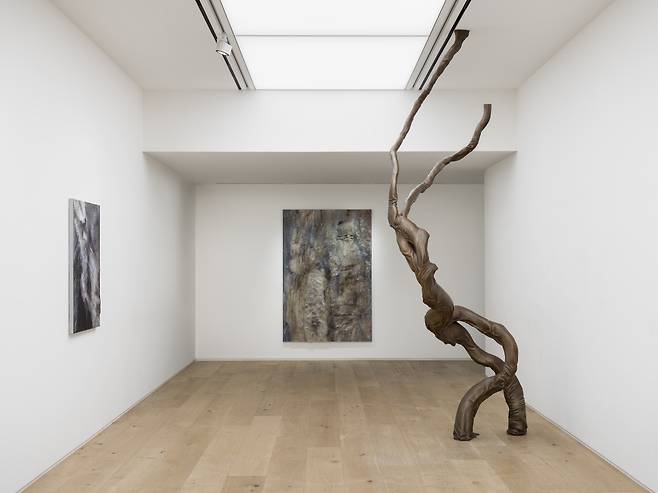
Along with Miro’s exhibition, the Thaddeus Ropac gallery in Seoul is presenting another show of fast-emerging Korean artist Chung Hee-min. In dialogue with Miro’s works, the exhibition brings together new paintings and bronze sculptures that are inspired by the natural world.
Retrieved from online databases and manipulated using 3D digital modelling software, these motifs are transferred directly onto canvas or transparent sheets of gel medium.
Both exhibitions run through Dec. 7.
Copyright © 코리아헤럴드. 무단전재 및 재배포 금지.