Hyundai Elevator to build rooftop vertiport for urban air taxis
전체 맥락을 이해하기 위해서는 본문 보기를 권장합니다.
"The flat-surface vertiport model is difficult to install in densely populated cities," an industry official said. "Vertical structures could be the breakthrough solution."
Hyundai Elevator plans to expand the business into airport-connected, urban-transfer, and smart-building-type vertiports once the current demonstration is completed. "The key to opening the skies lies in urban infrastructure," a company official said. "We aim to set the standard for future city mobility."
이 글자크기로 변경됩니다.
(예시) 가장 빠른 뉴스가 있고 다양한 정보, 쌍방향 소통이 숨쉬는 다음뉴스를 만나보세요. 다음뉴스는 국내외 주요이슈와 실시간 속보, 문화생활 및 다양한 분야의 뉴스를 입체적으로 전달하고 있습니다.
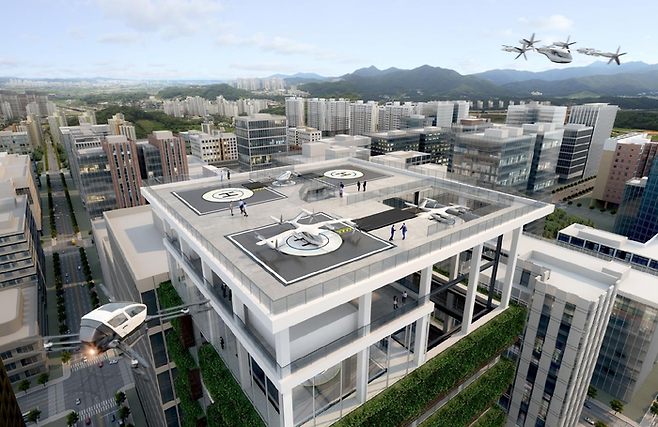
According to industry sources Wednesday, Hyundai Elevator broke ground this month on a three-story vertical-parking-style vertiport testbed, dubbed “H-PORT,” at its headquarters site in Chungju, North Chungcheong Province. The facility is scheduled for completion by June next year.
The H-PORT will serve as an integrated structure featuring an automated hangar parking system, drone parking and charging zones, and passenger boarding management facilities.
Unlike conventional flat-surface heliport-style vertiports, which require large open areas, Hyundai’s model adopts a stacked design — with the takeoff and landing pad on the upper level, maintenance and charging on the middle level, and passenger lounges on the lower level. This configuration essentially places an airport atop a city building, offering a potential solution to space constraints in high-density urban areas like Seoul and Busan.
“The flat-surface vertiport model is difficult to install in densely populated cities,” an industry official said. “Vertical structures could be the breakthrough solution.”
The H-PORT project, led by Hyundai Elevator, has been designated a national strategic technology initiative by the Korean government. As the lead institution for the “Vertiport and Ground Support System R&D” project, Hyundai is overseeing core tasks such as modular design, site selection standards, and monitoring and control technologies.
Partners including Lotte E&C, POSCO, and Korea National University of Transportation are participating in standardization and verification testing.
Hyundai Elevator plans to expand the business into airport-connected, urban-transfer, and smart-building-type vertiports once the current demonstration is completed. “The key to opening the skies lies in urban infrastructure,” a company official said. “We aim to set the standard for future city mobility.”
The project also aligns with the Ministry of Land, Infrastructure and Transport’s K-UAM Grand Challenge roadmap, which recently conducted the second phase of urban flight demonstrations along the Incheon Ara Waterway. Participants including Korean Air, Hyundai Motor, and KT tested low-altitude flight stability, route management, and communication resilience.
However, industry observers note that the absence of UAM-specific regulations and the slow pace of aircraft development remain key challenges. The government has already postponed the target commercialization timeline from 2025 to 2028.
“Government-level support such as regulatory sandboxes will be essential to accelerate commercialization,” another industry source said.
Copyright © 매일경제 & mk.co.kr. 무단 전재, 재배포 및 AI학습 이용 금지
- 오늘의 운세 2025년 11월 13일 木(음력 9월 24일) - 매일경제
- 상속세 완화 확정적…배우자·일괄공제 합쳐 17~18억 유력 - 매일경제
- 펩트론, 일라이릴리와 ‘오토인젝터’까지 공동 연구…추가 계약 내달 분수령[바이오UP&DOWN] - 매
- 윤석열 “나는 끄떡없다…무너진 법치 바로세우는 게 제가 할 투쟁” - 매일경제
- 하루 간병비 12만원인데 보험금 20만원?…팔수록 손해나도 출혈경쟁 [금융 라운지] - 매일경제
- 13조 R&D 투자 뜯어봤더니 전기차 배터리 ‘몰빵’ - 매일경제
- 가뜩이나 비싼데... 강남 3구 아파트 가격이 더 가파르게 상승하는 이유는 - 매일경제
- 영수와 최종 커플 됐는데…혼전임신 28기 정숙, ‘나솔이 아빠’ 대반전 - 매일경제
- 청년 회계사들 금융위 앞 집회…“수습기관 못 찾아 앞길 막막” - 매일경제
- 켈리 이후 주춤한 KBO 역수출 선수들, 문제가 뭘까? ‘역수출 신화’ 설계자에게 물었다 [MK인터뷰