China’s envoy calls for deeper Seoul-Beijing ties with long-term vision
전체 맥락을 이해하기 위해서는 본문 보기를 권장합니다.
In an apparent message aimed at the US, Dai went on to say, "China-Korea relations are not directed at any third party, nor controlled by any third party."
Shen Weizhong, vice president of the Global Governance Institution, said Seoul and Beijing should "turn their frozen relationship into a warmer one by expanding cultural and tourism exchanges."
이 글자크기로 변경됩니다.
(예시) 가장 빠른 뉴스가 있고 다양한 정보, 쌍방향 소통이 숨쉬는 다음뉴스를 만나보세요. 다음뉴스는 국내외 주요이슈와 실시간 속보, 문화생활 및 다양한 분야의 뉴스를 입체적으로 전달하고 있습니다.
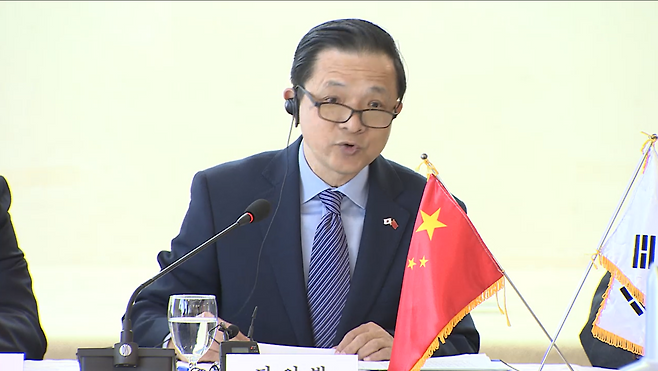
Seoul and Beijing should strengthen their relations with a long-term vision to sustain the momentum from the first summit between the two countries' leaders, rather than viewing ties through a short-term lens, China’s ambassador to South Korea said Tuesday.
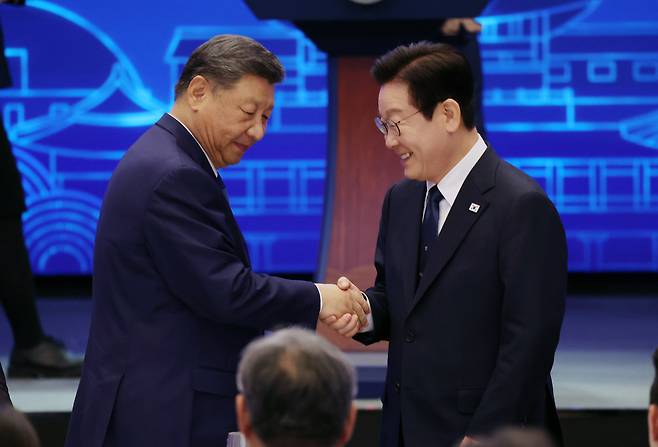
Ambassador Dai Bing highlighted the significance of Chinese President Xi Jinping’s state visit to South Korea — his first since 2014 — on the occasion of the APEC summit from Oct. 31 to Nov. 1, as well as his first in-person summit with South Korean President Lee Jae Myung.
Dai said the summit earlier this month played an "irreplaceable strategic guiding role in the development of bilateral relations” during a seminar hosted by the Institute for Global Strategy and Cooperation in Seoul.
At a critical juncture, the ambassador underscored that South Korea and China should strive to sustain the momentum for improving ties created during the Lee-Xi summit, following years of twists and turns in their relationship.
“In today’s world of intertwined changes and turbulence, strengthening China-Korea friendship and cooperation is more important than ever,” Dai said in his Chinese-language speech.
“Both sides should strengthen strategic communication, view each other objectively and comprehensively, deepen mutual trust and take a long-term perspective on bilateral relations — keeping the right direction and avoiding being swayed by temporary changes or short-term incidents," he added.
In an apparent message aimed at the US, Dai went on to say, "China-Korea relations are not directed at any third party, nor controlled by any third party."
Dai also underscored the importance of enhancing people-to-people exchanges across the board, especially among the youth.
At the same time, the ambassador reiterated his call for the Lee administration to address the issue of the anti-China political faction in South Korea.
“The anti-China rumors fabricated and demonstrations organized by extreme right-wing forces in Korea not only damage the China-Korea friendship but also harm Korea’s national image,” Dai told participants. “We hope the Korean side will take practical measures to resolve this problem at a fundamental level.”
During the seminar, experts acknowledged the urgency of easing rising anti-China sentiment in South Korea as a key task for advancing Seoul-Beijing relations in the long term and ensuring a more stable footing.
Shen Weizhong, vice president of the Global Governance Institution, said Seoul and Beijing should “turn their frozen relationship into a warmer one by expanding cultural and tourism exchanges.”
To that end, Shen called for continuously streamlining visa procedures and reviving the vitality of tourism, while encouraging youth exchanges and increasing the number of students between South Korea and China.
Underscoring the need to boost cultural exchanges, Shen also proposed "easing two-way restrictions on cultural content — including films, music and games — to narrow the psychological distance between young people in both countries."
Furthermore, Seoul and Beijing need to "encourage joint film production, animation planning and game development between Korean and Chinese companies," according to Shen.
China has imposed a ban on Korean content following South Korea's 2016 deployment of the US THAAD missile defense system. However, Beijing has consistently dismissed the existence of any such restrictions.
However, Lee Moon-ki, a professor in the department of major of chinese trade and commerce at Sejong University, believes that “China needs to fundamentally reexamine the policy and overall direction of China’s public diplomacy toward South Korea.”
Lee said the Chinese government’s public diplomacy efforts have continued for decades with the input of enormous resources, but the "results are producing reverse effects in reality — the opposite outcome of what was intended."
"Public opinion shows that a backlash is emerging, and thereby China itself should diagnose this problem internally."
According to the results of a survey published in July by the Pew Research Center, the share of adults in South Korea with a favorable view of China decreased from 25 percent in 2024 to 19 percent in 2025. South Korea was the only country surveyed where this share has dropped significantly since last year among the 25 countries surveyed.
Lee Wang-hwi, a professor in the Department of Political Science at Ajou University, also said that China has played a role in the rise of anti-China sentiment.
“South Korea is making great efforts to safeguard its strategic autonomy from the US,” he said. “However, Beijing always shows its discomfort openly in one way or another whenever the South Korea-US relationship strengthens. Sometimes, it even imposes a sanction."
For instance, China in October imposed sanctions against five US-linked subsidiaries of South Korean shipbuilder Hanwha Ocean before its one-year suspension announced on Monday.
“Thus, every time China openly expresses its discomfort in that manner, it produces a counterproductive effect, as favorable sentiment toward China continues to decline,” said Lee Wang-hwi.
Copyright © 코리아헤럴드. 무단전재 및 재배포 금지.