Korea relatively vulnerable to global trade disputes: KEF
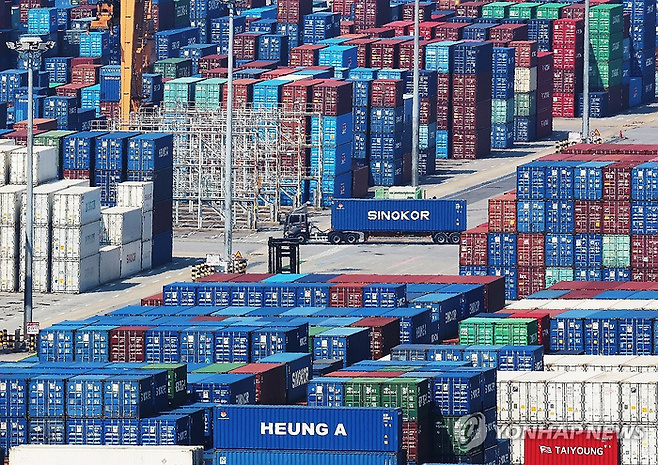
According to a report released by the Korea Enterprises Federation (KEF), intermediate goods accounted for 67.6 percent of Korea’s entire exports last year.
The figure is significantly higher than those of major countries such as the United Kingdom (57.1 percent), the United States (53.6 percent), Japan (53.5 percent), and Germany (48.5 percent).
The share of intermediate goods in Korea’s total imports was also high at 50.5 percent, compared with the 41 to 48 percent range seen in other advanced economies.
Intermediate goods refer to items such as primary steel products or basic chemical substances that are used as inputs in the production process.
Korea’s exceptionally high proportion of intermediate goods trade stems from its industrial structure, which specializes in importing raw materials and components, processing them into intermediate goods such as semiconductors, secondary batteries, and petroleum products, and then exporting them.
Korea’s top three export items - memory chips ($72 billion), processors and controllers ($35.9 billion), and petroleum products ($34.7 billion) - are all classified as intermediate goods.
“Our report suggests that our country is highly dependent on trade, and particularly more on intermediate goods trade than on final goods trade,” said Ha Sang-woo, head of economic research at the KEF. “This means we face a greater risk of production disruptions than other major economies if key materials or components are subject to export controls by other nations or if trade disputes arise between third countries.”
The report also found that Korea’s concentration of intermediate goods trade by trading partner was the second highest among G7 countries after Canada, indicating a heavy reliance on a limited number of partners.
Korea’s major export destinations for intermediate goods were China (23.7 percent), the United States (14.2 percent), Vietnam (8.9 percent), and Hong Kong (6.8 percent), while its top import sources were China (27.7 percent), Japan (10.1 percent), the United States (9.7 percent), and Taiwan (8.6 percent).
“Given the growing influence of factors such as U.S. tariff policies, the spread of protectionism, and intensifying U.S.-China tensions, we must actively pursue strategies to diversify our export markets and import sources while strengthening our domestic production bases to enhance our resilience,” Ha said.
Copyright © 매일경제 & mk.co.kr. 무단 전재, 재배포 및 AI학습 이용 금지
- 오늘의 운세 2025년 11월 10일 月(음력 9월 21일) - 매일경제
- [단독] 고려대서도 ‘집단 커닝’ 발각됐다…원격 부정행위 방지 시스템 ‘무용지물’ - 매일경
- "내 사망보험금 내가 타 쓰겠다" 연금화 일주일만에 신청 500건 - 매일경제
- 초등생, 40분 동안 손들기 벌세우자…분노한 학부모에 교사가 한 말? - 매일경제
- [속보] 정성호 “구형보다 높은형 선고…항소 안해도 문제없다 판단” - 매일경제
- “1111·1004 가질 수 있는 찬스”…SKT, 골드번호 1만개 푼다 - 매일경제
- “무덤 같다” “낮에도 무서워서 못 다녀”…부산 예술공원에 무슨 일이? - 매일경제
- “코인 라방 송출, 황망한 마음”…한혜진 ‘86만’ 유튜브 해킹 당했다 - 매일경제
- “이재명 지지자 성폭행 당하고, 중국에 팔려가라”…전한길 막말 논란 - 매일경제
- 2025년 최악의 수비수는 누구? ‘돌든글러브’ 시상식 - MK스포츠