Extending retirement age to 65 may cost 30 tn won, experts say
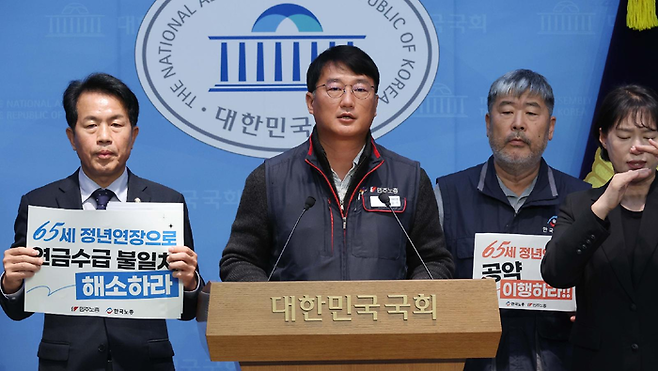
In 2013, the government extended the retirement age to 60 as a preemptive response to rapid aging, phasing in the policy from 2016. Now, with the nation officially entering a super-aged society last year — as people aged 65 and older exceeded 20 percent of the population — the issue has resurfaced amid growing concerns over longer income gaps before pension eligibility, which will rise to age 65 by 2033.
According to political sources on Sunday, the ruling Democratic Party’s Special Committee on Retirement Extension will begin full-scale discussions this week. A committee official said that while the goal of a 65-year retirement age remains, “all other aspects are subject to review,” hinting at a gradual and flexible approach. The committee is expected to deliberate on various reemployment models and the timing of the final phase-in.
While there is broad consensus on the need to find a solution for an aging workforce, experts warn that a uniform extension could hurt youth employment and place an unsustainable burden on businesses. Many now advocate for a “multi-track” model, similar to Japan’s approach, allowing multiple employment options rather than a one-size-fits-all mandate.
A report commissioned by the Federation of Korean Industries estimated that raising the statutory retirement age to 65 would cost roughly 30.2 trillion won ($22 billion) annually, including 27.3 trillion won in direct labor and insurance costs and 2.9 trillion won in indirect costs.
“Applying the same retirement rule across all industries would have an enormous shock effect,” said Kim Hyun-sok, a labor economist at Pusan National University, who authored the study.
Park Ji-soon, a professor at Korea University’s Graduate School of Labor Studies, also cautioned against a rigid legislative approach.
“Each company and sector faces very different realities. Forcing a uniform system is an outdated mindset,” he said, adding that “a pragmatic, ‘black cat–white cat’ approach like Japan’s is needed.”
Japan, which entered a super-aged society ahead of Korea, introduced a flexible framework in 2013 that allows companies to choose among extending the retirement age, abolishing it, or rehiring older workers — a model Korean experts say may be the most sustainable path forward.
Copyright © 매일경제 & mk.co.kr. 무단 전재, 재배포 및 AI학습 이용 금지
- 오늘의 운세 2025년 11월 10일 月(음력 9월 21일) - 매일경제
- [단독] 고려대서도 ‘집단 커닝’ 발각됐다…원격 부정행위 방지 시스템 ‘무용지물’ - 매일경
- "내 사망보험금 내가 타 쓰겠다" 연금화 일주일만에 신청 500건 - 매일경제
- 초등생, 40분 동안 손들기 벌세우자…분노한 학부모에 교사가 한 말? - 매일경제
- [속보] 정성호 “구형보다 높은형 선고…항소 안해도 문제없다 판단” - 매일경제
- “1111·1004 가질 수 있는 찬스”…SKT, 골드번호 1만개 푼다 - 매일경제
- “무덤 같다” “낮에도 무서워서 못 다녀”…부산 예술공원에 무슨 일이? - 매일경제
- “코인 라방 송출, 황망한 마음”…한혜진 ‘86만’ 유튜브 해킹 당했다 - 매일경제
- “이재명 지지자 성폭행 당하고, 중국에 팔려가라”…전한길 막말 논란 - 매일경제
- 2025년 최악의 수비수는 누구? ‘돌든글러브’ 시상식 - MK스포츠