Culture minister, heritage administrator denounce Seoul’s high-rise plan near Jongmyo
전체 맥락을 이해하기 위해서는 본문 보기를 권장합니다.
"This is absurd. A grotesque thing to happen," he declared. "Our precious cultural heritage has already been violated, treated like someone's private living room. And now the city believes it can do whatever it wants? That is the same reckless mindset of the 1960s and '70s era of unbridled development."
Korea Heritage Service Administrator Huh Min emphasized that Jongmyo, the first Korean site inscribed on the UNESCO World Heritage List in 1995, remains "a living heritage where the royal ancestral rites and music continue to this day."
이 글자크기로 변경됩니다.
(예시) 가장 빠른 뉴스가 있고 다양한 정보, 쌍방향 소통이 숨쉬는 다음뉴스를 만나보세요. 다음뉴스는 국내외 주요이슈와 실시간 속보, 문화생활 및 다양한 분야의 뉴스를 입체적으로 전달하고 있습니다.
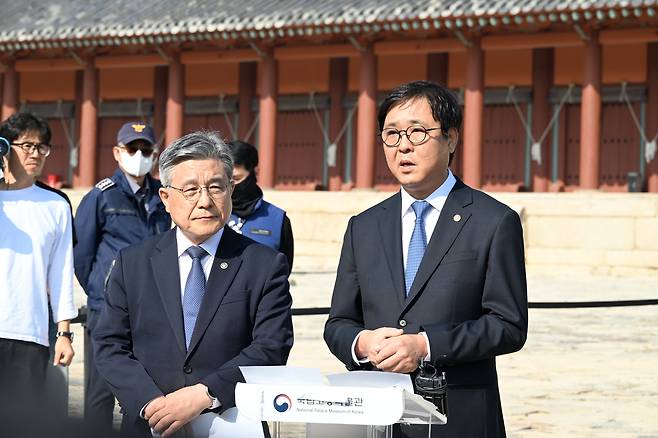
South Korea’s Culture Minister Chae Hwi-young and Korea Heritage Service Administrator Huh Min on Friday denounced Seoul’s plan to ease height restrictions around Jongmyo, a UNESCO World Heritage site, warning that the development could jeopardize its global status.
The announcement made at Jongmyo came less than a week after Seoul City approved a plan for the Sewoon District No. 4 redevelopment zone, raising the maximum building height from 71.9 meters to 141.9 meters on the Cheonggyecheon side. The decision followed a Supreme Court ruling on Wednesday that dismissed the Culture Ministry’s lawsuit against Seoul, heightening concern that the shrine’s historic skyline could be compromised.
The court upheld the legality of the Seoul Metropolitan Council’s 2023 revision to the city's ordinance on the protection of cultural assets, which deleted a clause requiring heritage-impact reviews for construction beyond a 100-meter preservation zone. The ministry had argued the change violated the national Cultural Heritage Protection Act, but the court found the law does not obligate local governments to seek consultation outside those zones.
The ruling, final under the Supreme Court’s single-instance procedure for local ordinances, effectively grants cities greater discretion over development near heritage sites. The Sewoon District No. 4 redevelopment zone is located about 180 meters from Jongmyo Shrine, meaning the decision carries immediate implications for the project.
At the site, Minister Chae condemned the city’s move in sharp terms.
“This is absurd. A grotesque thing to happen,” he declared. “Our precious cultural heritage has already been violated, treated like someone’s private living room. And now the city believes it can do whatever it wants? That is the same reckless mindset of the 1960s and ’70s era of unbridled development.”
His remark alluded to a controversy involving former First Lady Kim Keon Hee, who allegedly held a private tea meeting inside Jongmyo’s Mangmyoru Pavilion in September last year when the site was closed to the public. The case is now under investigation for potential misuse of the heritage site.
Describing Jongmyo as “a sacred legacy housing the ancestral tablets of Joseon kings and queens,” Chae vowed to “use every available measure, including revising or enacting laws, to safeguard our heritage.”
Korea Heritage Service Administrator Huh Min emphasized that Jongmyo, the first Korean site inscribed on the UNESCO World Heritage List in 1995, remains “a living heritage where the royal ancestral rites and music continue to this day.”
“But this irreplaceable legacy is now under grave threat,” Huh warned. “Skyscrapers the height of Jongno Tower would directly imperil the historic landscape that has defined Seoul’s royal heritage for centuries. It is shocking that the capital itself — the very guardian of these treasures — is leading this risk.”
He added that the agency will explore “all possible avenues, including amendments to the World Heritage Conservation Act,” to protect Jongmyo’s standing and ensure its transmission to future generations.
“This is not simply a matter of shade or height,” Huh said. “Imagine a ring of high-rises towering over the shrine, looking down upon it. The question is whether we will bequeath a world heritage to future generations — or a wall of concrete towers.”
Some residents from the Sewoon District No. 4 redevelopment zone confronted the officials at the scene, arguing that the heritage restrictions unfairly curtail their property rights. “While nearby zones can build over 200 meters high, only ours is capped at 50 meters. This violates proportionality and has cost us about 350 billion won over five years,” a community representative said.
Huh promised to hear their grievances in the near future before leaving the area.
UNESCO’s advisory body ICOMOS cautioned in October 1994, when Jongmyo was first nominated for inscription, that no high-rise construction should be authorized in surrounding areas that could “adversely affect the sight-lines within the World Heritage site.”
Copyright © 코리아헤럴드. 무단전재 및 재배포 금지.