Won under pressure as Korea’s $200b US investment pledge drives dollar demand
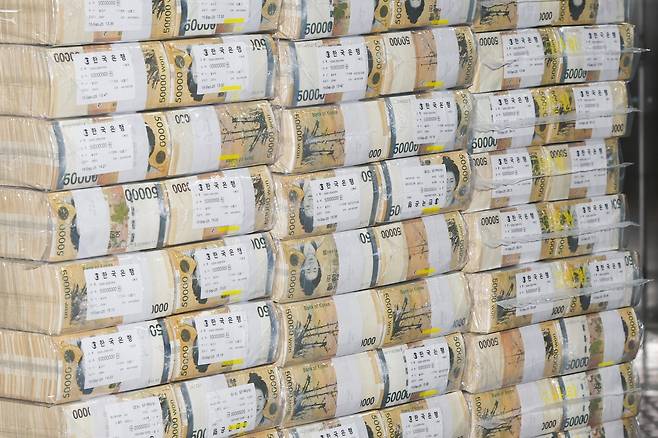
The Korean won continues to struggle to hold its value against the dollar, with some $20 billion in capital expected to flow out annually under Korea’s $200 billion investment pledge to the United States.
Despite the conclusion of the Korea-US tariff negotiations bringing more clarity to the country's economic outlook, the won has been unable to strengthen against the dollar.
Although the currency briefly strengthened into the 1,420-won range when the tariff deal was sealed on Oct. 29, it has since retreated to almost 1,440 won per dollar. On Tuesday, the won was quoted at 1,437.9 won per dollar at the close of daytime trading, weakening by 9.1 won from the previous session.
“Considering the recent surge in foreign purchases of Korean equities, the won would have strengthened against the dollar under usual circumstances. But it has not, as the market is weighed down by anticipated demand for dollars,” said Lee Hyo-seob, senior research fellow at the Korea Capital Market Institute.
“Facing heavy devaluation pressure amid the expected demand for the dollar, the won could depreciate to 1,500 won per dollar in the blink of an eye,” he added.
Under the tariff deal, Korea agreed to split a promised $350 billion investment fund into $200 billion in cash to be paid in phased installments to the United States. The installments have been capped at $20 billion per year.
Though Korea has yet to finalize how it will finance the installments, the government explained that it will be covered through investment returns generated by the nation’s roughly $420 billion in foreign reserves, without drawing down the principal.
The Bank of Korea, which manages the reserves, invests nearly 90 percent of the holdings in securities, reportedly generating a return of about $15 billion per year.
While the returns have been partly reinvested in the market until now to boost the reserves, the government now plans to redirect them to fund its investment pledge.
The financing scheme would minimize the impact on the dollar-won onshore market, limiting additional market demand for the greenback, according to the government. Finance Minister Koo Yun-cheol even stressed that the plan's impact on the forex market will be "limited" at a parliamentary audit held a day after the deal was made.
But analysts see the pressure continuing to weigh on the won as the market anticipates a steady outflow of dollars over the next decade. The installment cap roughly matches the size of the country’s total foreign direct investment in the US, which amounted to about $22 billion in 2024.
“The fact that there will be capital outflows to the United States remains a factor that weakens the won’s fundamentals,” said Ha Gun-hyung, an analyst at Shinhan Investment & Securities.
“Part of the investments that could have been directed domestically will instead take place overseas — a factor that could limit the won’s appreciation against the dollar in the mid to long term," added Lim Hye-yoon, an economist at Hanwha Investment & Securities.
The scheduled outflow also tests the strength of Korea’s foreign reserves — the world’s tenth largest as of the end of August. The country was able to boost the size of its foreign reserves partly through investment returns.
Under the plan to finance the phased installments to the United States through the returns, however, further increases in the holdings are likely to be limited for some time.
“As more central banks around the world have been striving in recent years to bolster their foreign reserves to brace against potential market volatility, Korea’s standing could eventually fall behind,” said Lee from the KCMI, adding, “It is definitely not the time to be complacent.”
Copyright © 코리아헤럴드. 무단전재 및 재배포 금지.