S. Korea to limit quake alerts to areas with strongest tremors
Starting in December, the Korea Meteorological Administration will begin sending earthquake emergency alerts accompanied by loud alarms only to areas where significant tremors expected, the administration announced Tuesday.
According to the KMA, when an earthquake with a magnitude of 3.5 to 4.9 occurs in Korea, emergency alerts will only be sent to cities and counties within a 30-kilometer radius of where the earthquake occurred and in places where the maximum forecast intensity level is 3 or higher on a scale that goes to 10.
Areas expected to experience intensity levels between 2 and 3 will instead receive a standard safety alert, without an alarm sounding.
Currently, alerts are sent to all areas forecast to experience level 2 intensity or higher — regardless of the actual level of impact — which has prompted public complaints, especially when no tremors were felt in certain places of the country.
Earthquake intensity, distinct from magnitude, measures the degree of tremors experienced on the ground, depending on how far a location is from the epicenter.
For example, level 2 intensity is typically felt only by a few people in quiet indoor environments or on higher floors, while level 3 intensity means most indoor occupants, especially in tall buildings, feel shaking, with parked cars rocking slightly. Level 4 can wake sleeping individuals and cause dishes or windows to rattle, while level 5 is strong enough to cause breakage and tip over unstable items.
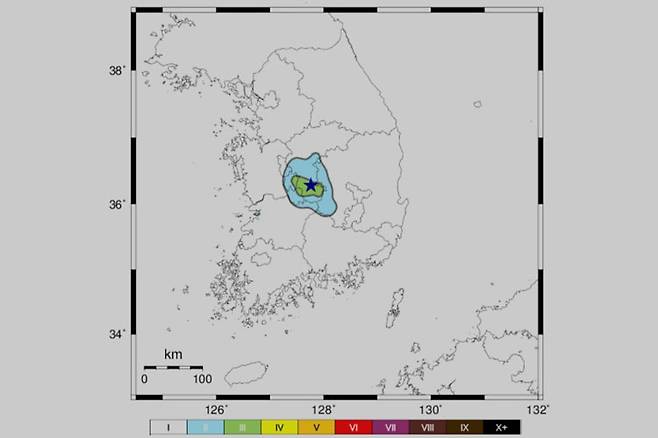
The KMA’s change in policy follows an incident on Feb. 7, when a magnitude 3.1 quake struck near Chungju, North Gyeongsang Province, in the early hours of the morning. Though the shaking was not widely felt, emergency alerts were sent to 177 administrative districts where low-level tremors were forecast, waking up and alarming the public.
To improve accuracy, the KMA added that it will also adjust its earthquake prediction systems.
“When quakes occur close to seismic stations, the system often overestimates the magnitude, as it struggles to separate the initial P-waves from later S-waves,” said KMA official Yeon Hyuck-jin during a press briefing Tuesday.
In the Chungju case earlier this year, the quake was first recorded as magnitude 4.2, which turned out to be much higher than the actual magnitude.
“To prevent similar errors, data from nearby observation stations will be used only to locate the epicenter, not to calculate the magnitude,” Yeon added.
The state weather agency added that it plans to reduce alert times for its early warnings to three to five seconds after initial detection, a significant decrease compared to the current five to 10 seconds, starting next year. While this system is currently being piloted at key infrastructure such as nuclear power plants and railways in the country, the KMA plans to expand the service nationwide.
Copyright © 코리아헤럴드. 무단전재 및 재배포 금지.