KOSPI surges amid ‘Kkanbu’ meeting and APEC, retail investors join rally
이 글자크기로 변경됩니다.
(예시) 가장 빠른 뉴스가 있고 다양한 정보, 쌍방향 소통이 숨쉬는 다음뉴스를 만나보세요. 다음뉴스는 국내외 주요이슈와 실시간 속보, 문화생활 및 다양한 분야의 뉴스를 입체적으로 전달하고 있습니다.
The benchmark KOSPI index surged more than 20 percent last month, marking its strongest monthly performance in 24 years and nine months. What had been expected to be a tense “super week,” packed with major diplomatic events such as the Korea–U.S. and Korea–China summits, instead turned into a boon for the market. Growth stocks, including semiconductor shares, rallied following NVIDIA CEO Jensen Huang’s visit to Seoul, and the upbeat mood spread to K-culture sectors as well. Retail investors, who had largely stayed on the sidelines, are now rejoining the market. However, with “big tech” companies set to release their earnings this week, analysts warn that renewed debate over an artificial intelligence (AI)-driven market bubble could emerge.
On October 31, the KOSPI closed at 4,107.50, surpassing the 4,100 mark for the first time in history. The index jumped 682.9 points in a single month, or 19.94 percent, its ninth-largest monthly gain since the KOSPI’s inception in 1983 and the highest since January 2001, when the dot-com bubble was in full swing (22.45 percent). Monthly gains of this magnitude have only been seen during the “three lows boom” period of 1987 to 88 and the volatile IMF financial crisis years of 1998 to 99, underscoring how exceptional October’s rally was.
Blue-chip stocks across sectors helped propel the index upward in October. Samsung Electronics rose 28.13 percent, Doosan Enerbility (nuclear power generation) 41.72 percent, Hyundai Motor (automotive) 34.88 percent, HYBE (entertainment) 28.2 percent, and Mirae Asset Securities (financials) 23.19 percent. Momentum spread across industries after the series of diplomatic meetings and strengthened cooperation with NVIDIA. Previously lagging sectors such as gaming, cosmetics, and entertainment also rebounded on hopes that China may soon lift its restrictions on Korean cultural exports, the so-called Hallyu ban.
Particularly notable was the impact of NVIDIA’s Jensen Huang, who strengthened partnerships with Samsung and Hyundai during his much-publicized “chimaek (chicken and beer) meeting.” His pledge to supply 260,000 GPUs to Korea boosted sentiment across semiconductor, IT, and robotics sectors. Samsung Electronics’ announcement of a formal HBM3E memory supply deal with NVIDIA led analysts to raise their price targets to as high as 140,000 to 150,000 won per share.
Market analysts say the sharp rise in domestic equities could also generate a “wealth effect,” boosting local consumption. Ryu Jin-yi, an analyst at KB Securities, said, “The bullish stock market is expected to spur a recovery in consumption in the first half of next year through the wealth effect.”
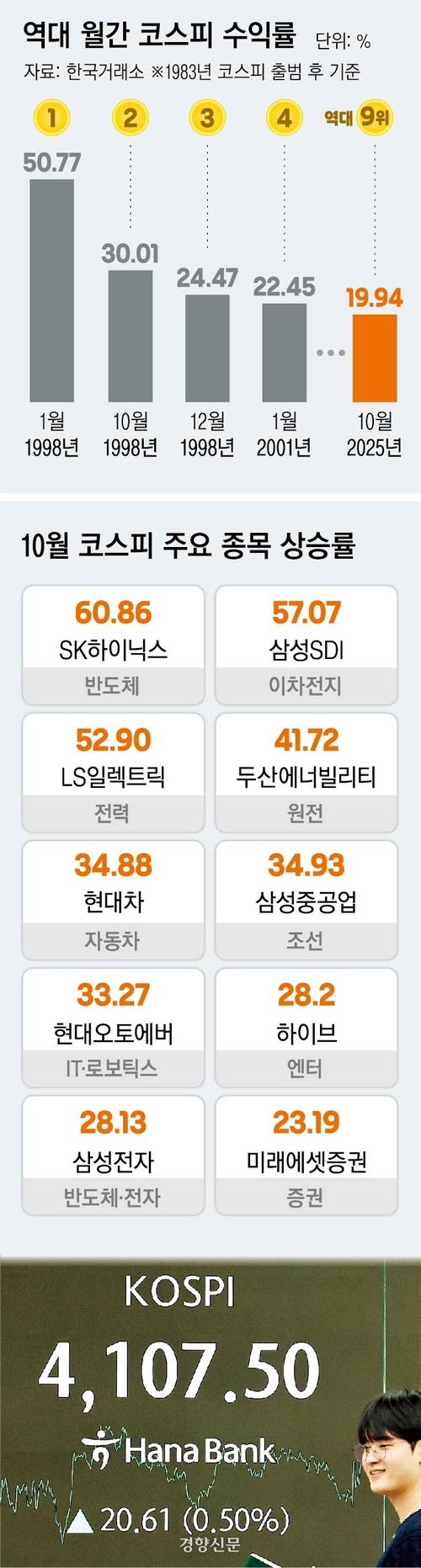
Retail investors are also smiling again. Popular stocks among individuals, such as Hyundai Motor (net buying of 1.33 trillion won) and Samsung SDI (1.28 trillion won), jumped more than 30 percent in a month. SK Hynix, which retail investors bought heavily (over 3 trillion won net in October), soared 60.86 percent during the same period.
Still, after such a rapid climb, the market could prove sensitive to negative news this week. Na Jung-hwan, an analyst at NH Investment & Securities, cautioned, “If expectations for the Fed’s rate-cut cycle or the continuation of the AI investment cycle weaken, a correction could occur.” Indeed, Meta’s stock plunged 11.33 percent on October 29 (local time) after its earnings report raised concerns over excessive AI spending, a reminder that the AI bubble debate could resurface.
Exchange rates may also become a key variable. Noh Dong-gil, analyst at Shinhan Investment & Securities, said, “The recent improvement in Korean corporate earnings has been supported by a weak won that boosted exporters’ profits. Going forward, the main source of volatility for the KOSPI may not be a stronger dollar, but a falling exchange rate.”
※This article was translated by an AI tool and edited by a professional translator.
Copyright © 경향신문. 무단전재 및 재배포 금지.
- 31세 명문대 공학도, 왜 총을 들었나···트럼프 만찬장 총격 사건 용의자는 누구?
- 백악관 만찬 행사 시작 30분 만에 아수라장···긴박했던 ‘VIP’ 대피 순간
- ‘순방 복귀’ 하정우, 다가온 결단의 시간…평택을 조국 대항마는 이광재냐 김용남이냐
- [오토 차이나 2026]“봐도 봐도 끝이 없다”…축구장 50개 크기 공간서 펼쳐진 전기차 기술의 향연
- 29명 목숨 앗아간 제천 화재 참사 29억 위로금···우여곡절 끝에 지급
- 호르무즈 해협 폐쇄로 미국 기업만 웃는다···3~4월 에너지 수출 역대 최대
- 낚시·조개잡이 관광용 전락한 ‘인천공항 자기부상열차’···타는 승객도 없다
- 김병민 정무부시장 등 오세훈 참모들 서울시 떠난다···“본격적인 선거운동 돌입”
- “나랑 애인해도 되겠어” 20대 여성 등산객 얼어붙게 만든 노인
- “1분기 순이익 1조원” 증권사, 코스피 불장에 ‘만년 조연’ 탈피···실적 전망 금융지주도 넘