Early winter chill sweeps S. Korea
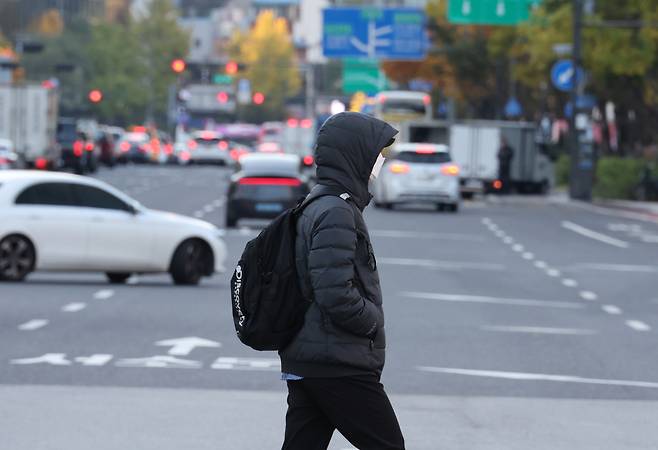
Temperatures plunged across South Korea on Monday — driving morning lows below zero in some regions — with chilly temperatures expected to continue throughout the week, according to the Korea Meteorological Administration’s weekly forecast.
The KMA attributed the drop in temperatures to a strong continental high-pressure system moving southeast from northern China. This triggered an early November cold snap and prompted cold wave advisories in several inland regions.
Monday's cold conditions were expected to continue through Tuesday, with average nationwide lows expected to range from 1 degree Celsius to 11 C, and highs estimated to sit between 14 C and 20 C.
In Seoul, morning lows are expected to reach 5 C and daytime highs are expected to average around 16 C.
Although temperatures are forecast to return to seasonal norms by Wednesday, the KMA noted that the seasonal averages are much warmer than the temperatures forecast for Tuesday, with little respite. On Wednesday, average morning lows are expected to range between 2 C and 12 C.
The KMA added that the continental high-pressure system is also bringing strong winds into the peninsula, making temperatures feel even colder. In coastal and mountainous regions, wind speeds of up to 70 kilometers per hour were recorded Monday, with heavily affected places in mountainous regions seeing wind speeds of up to 90 kph.
Though subject to change, Korea can expect a temporary relief from cold conditions from Friday, with daytime highs forecast to hover between 17 C and 19 C into the weekend. However, starting Nov. 10, temperatures are expected to drop again, with significant temperature differences expected to be recorded during the day and night.
Additionally, as the low-pressure trough descends from the north of the Korean Peninsula, the KMA added that rainfall may be observed in the western parts of the country.
As morning temperatures on Monday fell by 5 C to 10 C compared to the previous day, the KMA issued cold wave advisories that were later lifted in the afternoon for several inland regions of Korea, including parts of Seoul.
Paju, Gyeonggi Province, saw morning temperatures reach as low as minus 3.8 C, while Cheorwon, Gangwon Province, saw lows of minus 3.1 C.
Eunpyeong-gu and Nowon-gu in northern Seoul and Gwanak-gu in southern Seoul saw temperatures fall as low as minus 2.8 C, minus 2.6 C and minus 1.6 C, respectively.
Copyright © 코리아헤럴드. 무단전재 및 재배포 금지.