Brakes put on bill to halt incumbent president's trials
전체 맥락을 이해하기 위해서는 본문 보기를 권장합니다.
When asked whether the decision amounted to a full withdrawal rather than a postponement, Park replied, "Yes."
Following the announcement, presidential chief of staff Kang Hoon-sik said during a briefing, "The president requested the withdrawal, saying he wanted to focus on restoring livelihoods and the economy rather than being drawn into partisan confrontation."
이 글자크기로 변경됩니다.
(예시) 가장 빠른 뉴스가 있고 다양한 정보, 쌍방향 소통이 숨쉬는 다음뉴스를 만나보세요. 다음뉴스는 국내외 주요이슈와 실시간 속보, 문화생활 및 다양한 분야의 뉴스를 입체적으로 전달하고 있습니다.
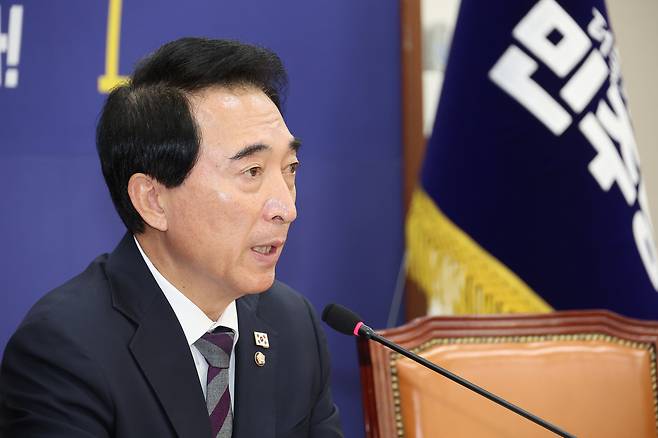
South Korea’s ruling Democratic Party of Korea on Monday stopped pursuing a bill designed to block criminal trials against a sitting president, quickly reversing its plan announced Sunday to pass the bill before the end of November.
Following the announcement, the presidential office said that President Lee Jae Myung had asked the party to remove the bill from its judicial reform agenda.
The proposal, initially dubbed the Trial Suspension Act, passed the Assembly's Legislation and Judiciary Committee in May, where the party holds half the seats, including the committee chair. But the party on Sunday unveiled its plan to rename the bill the “National Governance Stability Act” and put it to a plenary vote in November.
Rep. Park Soo-hyun, the party’s chief spokesperson, said Monday his party had withdrawn the plan to pursue other priorities.
“The party decided it would be better to focus on promoting the results of the recent South Korea-US tariff negotiations and the Asia-Pacific Economic Cooperation summits,” Park said at a press conference at the National Assembly in Seoul.
When asked whether the decision amounted to a full withdrawal rather than a postponement, Park replied, “Yes.”
He added that the decision was reached through discussions between party leadership and the president.
Following the announcement, presidential chief of staff Kang Hoon-sik said during a briefing, “The president requested the withdrawal, saying he wanted to focus on restoring livelihoods and the economy rather than being drawn into partisan confrontation.”
Kang added that there was no need to push the bill at this stage, noting that the party could still revisit it if the courts decide to resume trials against Lee.
The ruling bloc’s abrupt reversal came after a strong backlash from the main opposition People Power Party, which accused the Democratic Party of attempting to shield President Lee fromaccountability.
“If the trials resume even tomorrow, Lee Jae Myung will no longer be president but just an ordinary citizen before the year ends,” People Power Party leader Rep. Jang Dong-hyeok said during a Supreme Council meeting earlier in the day.
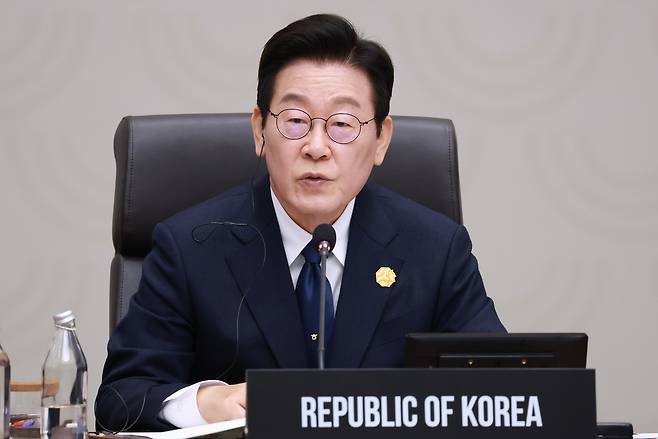
The bill has faced repeated criticism for allegedly serving to protect Lee. A similar attempt failed earlier this year amid controversy following Lee’s inauguration on June 4.
The Democratic Party had justified the bill by citing Article 84 of the Constitution, which states: “The President shall not be subject to criminal prosecution during his or her term of office, except for insurrection or treason,” arguing that this protection should extend to trials already in progress.
The People Power Party contended that ongoing trials do not fall under the definition of “prosecution” as stipulated in Article 84 of the Constitution, calling for the proceedings to continue.
Lee currently faces five separate criminal trials on charges made before he took office. All hearings have been suspended since Lee’s inauguration.
On June 9 — five days after Lee's inaguration — the Seoul High Court, which took over Lee’s election law violation case for a retrial after the Supreme Court remanded it, postponed proceedings, citing Article 84 of the Constitution.
Meanwhile, on the same day, the Democratic Party launched a task force aimed at restoring public trust in the judiciary and normalizing judicial administration.
The group will focus on reforms to improve the administrative structure of the courts, reportedly including the abolition of the Supreme Court’s Court Administration Office.
“There needs to be a democratic system to decentralize the power concentrated in the hands of a few within the Supreme Court — not only over trials, but also over budgeting, personnel and judicial administration,” said Rep. Jeon Hyun-heui, who chairs the task force, during its inaugural meeting.
The task force is part of the Democratic Party’s broader legislative reform drive, which also seeks to expand the number of Supreme Court justices, allow reviews of Supreme Court rulings, and introduce disciplinary measures for judges and prosecutors found to have deliberately misinterpreted the law.
Copyright © 코리아헤럴드. 무단전재 및 재배포 금지.