Parties split over US-Korea tariff deal
전체 맥락을 이해하기 위해서는 본문 보기를 권장합니다.
"We will make every effort to ensure the deal proceeds swiftly through parliamentary procedures."
People Power Party Chair Rep. Jang Dong-hyeok also cautioned that "while it is positive that uncertainty has been resolved, the deal marks the beginning of a new burden."
이 글자크기로 변경됩니다.
(예시) 가장 빠른 뉴스가 있고 다양한 정보, 쌍방향 소통이 숨쉬는 다음뉴스를 만나보세요. 다음뉴스는 국내외 주요이슈와 실시간 속보, 문화생활 및 다양한 분야의 뉴스를 입체적으로 전달하고 있습니다.
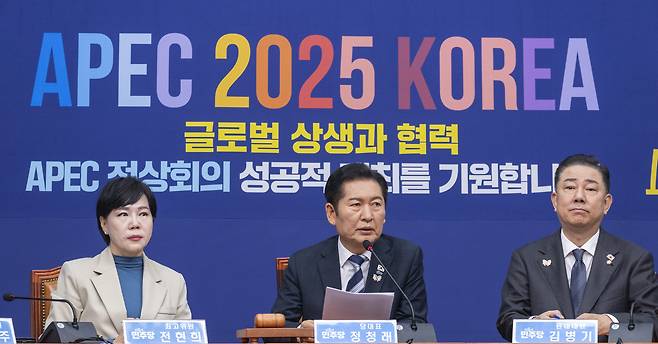
South Korea’s rival parties on Friday offered contrasting interpretations of the trade deal reached between Seoul and Washington during Wednesday’s summit between President Lee Jae Myung and US President Donald Trump in Gyeongju, North Gyeongsang Province.
The deal reportedly revised Washington’s initial demand for an upfront, $350 billion cash investment into a $200 billion installment plan to be paid over 10 years. Additionally, the remaining $150 billion would be converted into financial guarantees for a shipbuilding-related program.
The ruling Democratic Party of Korea hailed the result as a landmark achievement of the Lee administration and pledged full legislative backing to implement it.
“After the APEC summit concludes successfully, it will be the National Assembly’s turn,” the party leader Rep. Jung Chung-rae said at a Supreme Council meeting at the National Assembly in Seoul.
“We will make every effort to ensure the deal proceeds swiftly through parliamentary procedures.”
Jung also praised what he called “a bold diplomatic breakthrough,” noting that the US had agreed to let South Korea build nuclear-powered submarines — an outcome he said underscores the strength of the alliance.
Democratic Party Floor Leader Rep. Kim Byung-kee added that the government was expected to submit a special investment bill to the Assembly in November, with provisions to apply it retroactively from Nov. 1 once enacted.
The party is still reviewing whether ratification of the deal is necessary and the possibility of additional supporting legislation, according to Rep. Park Soo-hyun, chief spokesperson of the Democratic Party.
The People Power Party, meanwhile, pressed the government to disclose the full text of the deal, warning that inconsistent statements between Seoul and Washington after the summit could shake investor confidence.
Rep. Kim Do-eup, chair of the People Power Party's policy committee, said Friday that key details — including investment selection standards, fund-recovery structure and profit-sharing mechanisms — remain unclear.
“If the government focuses on publicity while withholding disadvantageous terms, it could destabilize exchange rates, interest rates and overall market sentiment,” he said.
People Power Party Chair Rep. Jang Dong-hyeok also cautioned that “while it is positive that uncertainty has been resolved, the deal marks the beginning of a new burden.”
Rep. Song Eon-seog, the People Power Party floor leader, echoed this concern, saying that despite adjustments, “the $350 billion investment commitment still imposes a heavy burden on the economy.”
The main opposition party also insisted that the deal must be ratified by the National Assembly, arguing that such a large-scale financial commitment requires parliamentary consent.
Amid the ongoing partisan divide, People Power Party officials said Jang would not attend the APEC welcome dinner in Gyeongju hosted by President Lee, in an apparent boycott.
Copyright © 코리아헤럴드. 무단전재 및 재배포 금지.