Korea, U.S. reach agreement on tariff terms
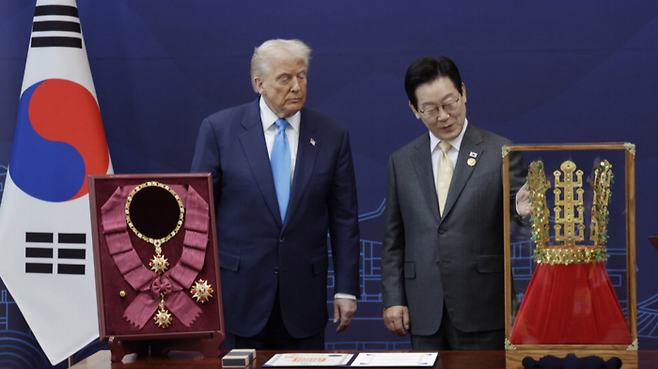
Korean President Lee Jae-myung and U.S. President Donald Trump agreed on key tariff negotiation issues during their bilateral summit and decided to sign a memorandum of understanding in the near future.
Of the $350 billion fund, the cash portion has been set at $200 billion, with an annual investment cap of $20 billion, meaning the funds will be disbursed in installments over at least 10 years.
The remaining $150 billion, which will go toward investments in the U.S. shipbuilding industry, will be composed of a mix of cash, ship financing or refund guarantees, and guarantees.
Under the agreement, profits generated from the fund will be split evenly with Korea and the U.S., each receiving 50 percent until the principal and interest are repaid.
The outcome reflects a significant degree of U.S. influence on key disputed points such as the cash ratio, decision-making structure, and profit-sharing terms.
As part of the deal, U.S. tariffs on Korean automobiles will be reduced from 25 percent to 15 percent. Semiconductor tariffs will be set at levels comparable to those applied to Taiwan, ensuring Korea is not placed at a disadvantage relative to its competitor.
“We made a deal, pretty much finalized a trade deal,“ President Trump said during a dinner hosted by President Lee in his honor. ”We had a great session (with Korea). I think we came to a conclusion on a lot of very important items.“
During a press briefing that evening at the Press Center for the Asia-Pacific Economic Cooperation (APEC) Summit taking place in Gyeongju, North Gyeongsang Province, Kim Yong-beom, Korean presidential chief of staff for policy, said: “The total $350 billion package consists of $200 billion in cash investments and $150 billion in shipbuilding cooperation.”
“We have set an annual investment cap of $20 billion for the $200 billion in cash investment.”
Kim also noted that the agreement’s impact on the domestic foreign exchange market will be limited.
The annual installment of $20 billion sits at the upper end of the annual $15 billion to $20 billion range that the Bank of Korea and the Ministry of Economy and Finance have cited as the maximum level that could be financed without destabilizing the Korean foreign exchange market.
With $200 billion in cash out of the total $350 billion, the cash ratio within the U.S. investment fund is expected to reach roughly 57 percent or higher.
The Korea-U.S. currency swap, which the government had considered essential for establishing the fund, was not included in the final deal. According to the presidential office, long-term installment payments made the swap unnecessary.
In the meantime, Trump announced on Thursday that he had approved Korea to build a nuclear powered submarine, “rather than the old fashioned, and far less nimble, diesel powered submarines that they have now.”
“South Korea will be building its nuclear powered submarine in the Philadelphia Shipyards, right here in the good ol’ U.S.A.,” Trump said on his Truth Social. “Shipbuilding in our country will soon be making a big comeback.”
The remarks come after President Lee asked his counterpart on Wednesday to allow Korea to receive fuel supplies for nuclear-powered submarines.
Copyright © 매일경제 & mk.co.kr. 무단 전재, 재배포 및 AI학습 이용 금지
- 오늘의 운세 2025년 10월 30일 木(음력 9월 10일) - 매일경제
- 트럼프 “한국 핵추진 잠수함 건조 승인...한미군사동맹 강력해” - 매일경제
- “숙소서 술 먹고 구토까지”…APEC 파견 나갔다 음주 물의 일으킨 경찰들 - 매일경제
- 관세협상 타결에 현대차그룹 “정부에 감사”…현대기아차 주가 ‘급등’ - 매일경제
- 트럼프 “한국 핵추진잠수함 승인...미 필리 조선소서 건조할 것” - 매일경제
- 미 연준, 2연속 금리인하…양적 긴축 3년만에 종료 - 매일경제
- “차라리 층간소음이라도 있으면”...윗집도 옆집도 불 꺼진 이 아파트, 왜? - 매일경제
- [단독] “4억 낮춘 강남 급매? 무조건 줍줍”…금감원장 집 바로 팔렸다 - 매일경제
- “부럽지?” 북한 김정은에게도 자랑…트럼프 따라다니는 ‘1호 괴물’ 정체 [왜몰랐을카] - 매
- 손흥민 연봉 전격 공개! 메시 다음으로 많이 받는다 - MK스포츠