At hanok cafes off Gyeongju's beaten path, modern sophistication meets tradition
![A family watches fish swim past at Twosome Place Gyeongju Gampo Port Branch. [WOO JI-WON]](https://img1.daumcdn.net/thumb/R658x0.q70/?fname=https://t1.daumcdn.net/news/202510/29/koreajoongangdaily/20251029070230312cbxt.jpg)
GYEONGJU, North Gyeongsang — It's easy to stumble upon a photogenic cafe sitting beneath giwa (traditional roof tiles) in Gyeongju — a city where even gas stations and Starbucks wear roofs in the style of hanok, or traditional Korean houses.
Then there's also Hwangridan-gil, a lively hanok village where every shop rests beneath curved tiles. But that picture-perfect street only scratches the surface of Gyeongju's vibrant cafe scene.
As Korea's second-largest city by area, Gyeongju stretches far beyond its main streets — and beyond Hwangnidan-gil lie cafes that take the city's signature hanok style to a new, creative level, as well as others that boast their own unique charm found nowhere else.
Twosome Place Gyeongju Gampo Port Branch
Few visitors venture to Gyeongju's far edges, where quiet coastal villages face the open sea. Near Gampo Port sits a truly one-of-a-kind cafe — Twosome Place Gyeongju Gampo Port Branch, where guests can sip coffee while watching fish swim past giant glass windows.
![Another section shows fishes swimming [WOO JI-WON]](https://img4.daumcdn.net/thumb/R658x0.q70/?fname=https://t1.daumcdn.net/news/202510/29/koreajoongangdaily/20251029070231842ufwd.jpg)
From the outside, it looks like a typical seaside cafe. But descend the spiral staircase to the basement, and an entirely different world unfolds. Behind huge glass panels, silver fish glide through blue water just beyond arm's reach. It may lack the colorful species of an aquarium, but that only enhances the feeling of being under the real sea.
Once a seafood restaurant, the space was transformed into a cafe this June. "It's basically a fish tank," said one employee. "The fish you see here are actually raised and later sold elsewhere."
Upstairs, the rooftop is just as appealing — a gardenlike terrace with artificial grass and a dozen tables overlooking the ocean. It's best visited at sunset, when the sea glows with a burnished golden hue. A seaside walking path right out front invites visitors for a peaceful stroll.
![A view from the roof top of Twosome Place Gyeongju Gampo Port Branch [WOO JI-WON]](https://img3.daumcdn.net/thumb/R658x0.q70/?fname=https://t1.daumcdn.net/news/202510/29/koreajoongangdaily/20251029070233329kvbv.jpg)
The cafe is at 54-3 Gampo-ro 2-gil, Gampo-eup, and open from 10 a.m. to 9 p.m. Buses 100 and 100-1 reach the area, though service is limited. A taxi or car is recommended.
Eyst 1779
In Gyochon Hanok Village, just a 15-minute drive from the Gyeongju National Museum and next to Woljeonggyo Bridge, Eyst 1779 stands out among rows of pale hanok stores with its striking redbrick exterior.
![Entrace of Eyst 1779 [WOO JI-WON]](https://img2.daumcdn.net/thumb/R658x0.q70/?fname=https://t1.daumcdn.net/news/202510/29/koreajoongangdaily/20251029070234823akwy.jpg)
Its spacious terrace — dotted with white tables and chairs — and its scenic view of Woljeonggyo draw visitors in.
Inside, sunlight through massive glass windows fills the counter. In the back, freezers are stocked with the café's signature salt monaka ice cream, priced at 4,000 won ($2.80), available in red bean, injeolmi and sweet potato flavors, with the first two most popular.
The main seating area overlooks the terrace, and leads to three adjoining rooms, each with a large window framing a unique view — the pond, the terrace or the bridge.
![A cup of Americano and a monaka ice cream sandwich placed on a sculptural work by Kwak Chulan [WOO JI-WON]](https://img3.daumcdn.net/thumb/R658x0.q70/?fname=https://t1.daumcdn.net/news/202510/29/koreajoongangdaily/20251029070236270potv.jpg)
Sculptural works by artist Kwak Chulan — whose bent irons evoke the movement of Korea’s mountains and rivers — double as tables, though they look more like pieces to be admired than surfaces to place a drink on.
"I came to Gyochon Hanok Village and found this place while looking for a cafe," said Alina Lime, a French tourist. "It's really different and gives me a new kind of experience."
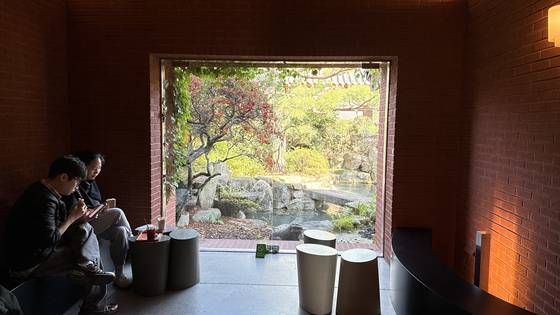
The cafe is operated by the House of Choi, rooted in Gyeongju's Choi family. Since settling in Gyo-dong (Gyochon) in 1779, the family has preserved its legacy through cultural projects like Eyst 1779. Next door stands House of Choi's Yosukgung 1779, a premium Korean dining restaurant.
Eyst 1779 is at 21 Gyochon-an-gil, and open daily from 11 a.m. to 9 p.m.
Nohkyungbocha Rapha
After a few days in Gyeongju, one might think they had had enough of hanok cafes — until stepping into Nokyeongbocharapa, a grand cafe composed of two two-story hanok buildings connected by a roofed passageway.
![Cafe Nohkyungbocha Rapha[SCREEN CAPTURE]](https://img3.daumcdn.net/thumb/R658x0.q70/?fname=https://t1.daumcdn.net/news/202510/29/koreajoongangdaily/20251029070239233mdkf.jpg)
Opened this month, it's already the talk of the town. Named after owner Noh Kyung-bo, it sits about 15 minutes from Gyeongju Station.
The L-shaped building houses shelves filled with hundreds of tea ingredients, while upstairs, broad wooden floors open to panoramic views of nearby mountains and fields.
Crossing the passageway leads to the circular main building, the more photogenic one, where raindrops fall from the tiled roof into a waterway that wraps the building. Guests can sit outside on wooden maru floors overlooking the water, or head inside to admire the grand chandelier and tranquil interior. The second floor also features low wooden tables and legless chairs, providing a serene view of the surrounding fields.
![Nohkyungbocha Rapha's L-shaped building [SCREEN CAPTURE]](https://img1.daumcdn.net/thumb/R658x0.q70/?fname=https://t1.daumcdn.net/news/202510/29/koreajoongangdaily/20251029070240728holc.jpg)
![Nohkyungbocha Rapha's circular hanok building with waterways surrounding it [WOO JI-WON]](https://img1.daumcdn.net/thumb/R658x0.q70/?fname=https://t1.daumcdn.net/news/202510/29/koreajoongangdaily/20251029070242173uugp.jpg)
At night, the roof tiles glow softly under thin, warm lights, creating another view worth seeing. The first floor is family-friendly, while the upper floor is a no-kids zone.
Located on 133-64 Mangseong 2-gil, it's open daily from 10 a.m. to 7 p.m.
BY WOO JI-WON [woo.jiwon@joongang.co.kr]
Copyright © 코리아중앙데일리. 무단전재 및 재배포 금지.
- BTS to hold 65 shows, over 30 in North America, for 2026 tour: Bloomberg
- Hospital that wouldn't perform C-section ordered to compensate family after baby born with disability
- Hegseth allegedly bristles at meeting bearded USFK soldiers
- China claims J-20 stealth fighter flew over Eastern Channel undetected, exposes Korea's outdated radars
- Chinese ships confronted Korean vessel investigating Yellow Sea structures, U.S. think tank says
- Cafe near Seoul Forest sparks controversy after banning Chinese customers
- Lee Jae Myung faces biggest diplomatic test as world leaders gather in Korea for APEC summit
- For bereaved families, painful questions remain three years after deadly Itaewon crowd crush
- No news on Kim Jong-un visit, Russia says as Trump summit speculation grows
- Seoul to sound sirens to mark 3rd anniversary of Itaewon tragedy