Gyeongju shines with timeless beauty ahead of APEC Summit
이 글자크기로 변경됩니다.
(예시) 가장 빠른 뉴스가 있고 다양한 정보, 쌍방향 소통이 숨쉬는 다음뉴스를 만나보세요. 다음뉴스는 국내외 주요이슈와 실시간 속보, 문화생활 및 다양한 분야의 뉴스를 입체적으로 전달하고 있습니다.
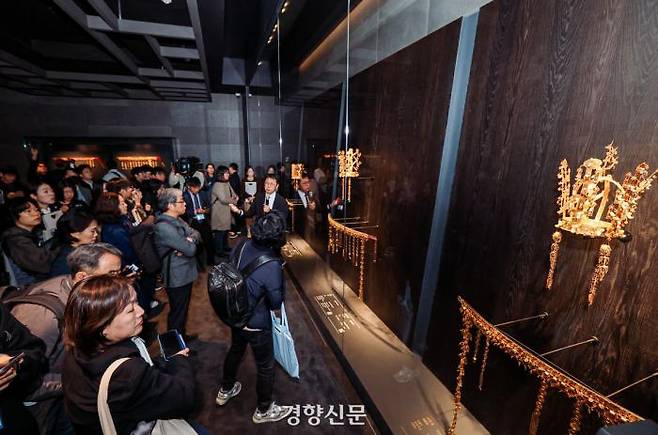
Three golden branches rising from a gleaming headband, a motif found in every surviving Silla crown. For years, visitors have marveled at the brilliance of Silla gold without noticing that each crown carries its own individuality.
The special exhibition “Silla Golden Crowns: Power and Prestige,” opening October 28 at the National Museum of Gyeongju, marks both the museum’s 80th anniversary and the upcoming APEC Summit. It is the first time that all six extant Silla crowns, discovered since the first find during the Japanese colonial period in 1921, will be displayed together.
Excluding the Gyo-dong crown, whose authenticity as a genuine Silla artifact has long been debated, the remaining five are all recognized national treasures: three designated as National Treasures (from Hwangnam daechong North Mound, Geumgwanchong, and Cheonmachong) and two as Treasures (from Seobongchong and Geumnyeongchong). Among the 20 objects on display, including belts and other regalia unearthed with the crowns, seven are National Treasures and seven are Treasures.
The exhibition opens with the Gyo-dong crown, the simplest in form among the six. It consists only of three branch-shaped uprights rising from a gold headband, without the antler-like rear ornaments or dangling pendants seen on other Silla crowns. Though smaller and less elaborate, it dates to the early 5th century and is believed to have established the prototype for all later Silla crowns. The branching motif is thought to have originated from the sodo tradition of erecting sacred trees for heaven-worship in the Samhan period. A video installation beside the crown explores this spiritual symbolism.
Next are the crowns from Geumgwanchong, Seobongchong, and Geumnyeongchong, displayed with the gold belts found alongside them. The Geumgwanchong crown is believed to have belonged to King Isaji, the Seobongchong crown to Queen Soji, and the smaller Geumnyeongchong crown to a royal youth. Each reflects how Silla’s elite expressed power and rank through regalia. Geumgwanchong’s crown features dotted wave patterns across the headband, while Seobongchong’s includes a hat-like ornament between the band and uprights, subtle variations within a shared tradition.
The crown from the North Mound of Hwangnam Daechong, often called the most beautiful of all, features three pairs of pendants hanging gracefully on either side of the headband. It faces across the gallery from the conical mogwan excavated from the South Mound. Japanese scholars once claimed the mogwan was part of the crown, but post-liberation Korean researchers concluded it was a separate headpiece used in daily life, while the gold crown was reserved for ritual ceremonies. Though Japan first unearthed Silla’s golden splendor, it was Korean scholarship that ultimately defined its cultural significance.
High-resolution touchscreen displays allow visitors to examine intricate details of each crown before viewing the originals up close. The exhibition runs through December 14.
Beyond ancient gold, contemporary art inspired by Silla’s legacy is also on view at the Bomun Tourist Complex. Solgeo Art Museum’s special exhibition “Silla Fragrance of Korea,” which opened October 22, presents large-scale ink paintings by Park Dae-sung, who reinterprets traditional sumukhwa techniques in a modern idiom. His new 5-meter-tall work Contemplative Bodhisattva (2025), rendered in ink and traditional pigments, reimagines the Treasure-listed Stone Bodhisattva from Bukji-ri, Bonghwa, of which only the lower half survives, by completing the missing upper body. Behind it, white characters printed in panbonche script on a black background evoke the shared roots of calligraphy and painting.
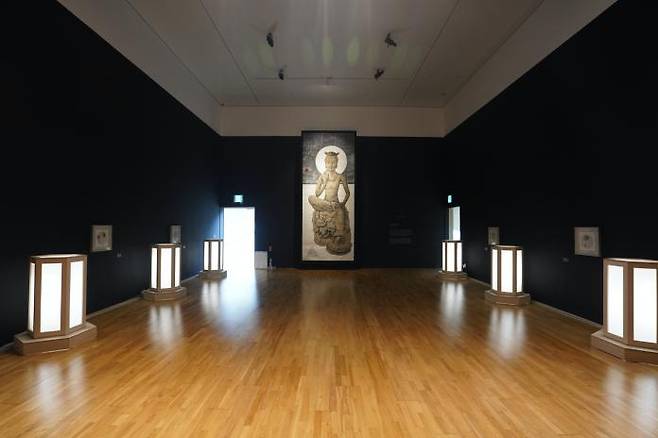
Park’s Korea Fantasy (2023), measuring 5 meters high and 15 meters wide, captures the Korean Peninsula’s vast cultural landscape, from Hallasan to Baekdusan mountains, Hunminjeongeum to Goguryeo tomb murals, and the Bangudae petroglyphs of Ulsan, rendered in sweeping ink strokes that overwhelm with scale and historical depth.
Art restorer and painter Kim Min presents luminous depictions of the Seokguram Buddha, Dabotap, and Seokgatap against a dark background, using powdered tourmaline as pigment on traditional hanji. Reflected in a large water basin before the paintings, the gold-lit pagodas evoke a tranquil sense of eternity.
Ven. Song Cheon, a monk and artist, revisits his 2023 Busan Biennale piece “Gwaneum and Maria: Truth Has Never Left Us.” The 4-meter-tall painting portrays the Virgin Mary in blue and the Bodhisattva of Compassion in red, facing each other in a dialogue that transcends religion. From Park Sun-min’s glass installations to other modern reinterpretations of Korea’s spiritual heritage, the exhibition offers diverse visions of timeless beauty. It runs through April 26, 2026.
At the Wooyang Museum of Contemporary Art, the exhibition “Nam June Paik: Humanity in the Circuits” highlights works from the 1980s and 1990s, a pivotal period in Paik’s artistic evolution. His multimedia compositions, interwoven like electronic circuits, resonate with the APEC Summit’s theme of “Connection, Innovation, and Prosperity.” The exhibition continues through November 30.
※This article was translated by an AI tool and edited by a professional translator.
Copyright © 경향신문. 무단전재 및 재배포 금지.
- 김용현 제명 안 한 육사 38기, ‘사관학교 통합 지지’ 동문은 “국가에 손해 끼쳐” 제명 추진
- [속보]“집 못 지어서 미쳤나 소리 듣게 지어라”···남양주 덕소농장·경기광주·염창공원 등 23
- [속보]내년 1월부터 ‘비거주 1주택자’ 전세대출 제한···갭투자 차단 조치[8·13 부동산대책]
- [단독]“의리 끝까지 지키겠다” 공범 편지 있었지만, 경찰 ‘위법 수집 증거’ 탓에 무죄됐다
- “정원오 잘하기는 하나 봅니다”···칭찬 글 올린 이재명 대통령, 공직선거법 위반 고발 사건
- ‘길거리 음식의 최강자’ 동남아가 아니었다···예상 확 깨버린 ‘반전의 1위 도시’ 어디길래
- [8·13 부동산대책]‘영끌 부지’에 착공 시간표에, 민간 재개발 규제완화까지··· 가용할 수 있
- [단독]특검, ‘유병호 최측근’ 최재혁 감사원 행안국장 입건···감사위원도 “속았다” 진술
- “뭐? 한우가 반값이라고?” 홈플러스 재개장 첫날 문전성시…부활 신호탄일까
- ‘항암일지’ 읽으며 시작하는 데이트···‘시한부’ 청춘들의 낯선 연프