For Korean newlyweds without homes, love comes easy yet paperwork doesn’t

Yu, a 32-year-old office worker in Seoul, tied the knot with her husband in 2021, but four years on, they are still not legally married.
The couple has been postponing their marriage registration for years in a strategic move to qualify for a government-backed loan to rent a home.
Her income alone qualifies her for a loan program offered by the state-run Housing and Urban Fund for unmarried individuals living in "jeonse" lease homes. However, when combining her income with her husband's, their total exceeds the 75 million won ($54,000) ceiling set for a separate loan program for newlyweds.
“I took out a 200 million won jeonse loan at a low interest rate of around 2 percent and used my savings to rent a 59-square-meter officetel in Incheon, where we started our newlywed life,” she told The Korea Herald. Jeonse is a Korean system in which renters give landlords a large, returnable deposit instead of paying monthly rent.
Yu is among a growing number of young Korean couples for whom legal marriage is not an automatic next step after the wedding ceremony, but a strategic decision timed to maximize economic benefits — mainly to qualify for public housing support amid soaring home prices.
Of the 222,000 marriage registrations filed last year, about 19 percent — roughly one in five couples — had delayed registering their marriage for a year after their wedding, according to data from Statistics Korea cited by Rep. Jung Il-young of the ruling Democratic Party of Korea.
The figure is nearly double the 10.9 percent recorded a decade ago.
Although couples may postpone marriage registration for various reasons, the lawmaker noted that the reduction in public housing benefits for married couples is a factor discouraging early registration.
A mortgage program under the Korea Housing Finance Corp., for instance, allows unmarried individuals earning up to 60 million won a year to borrow up to 200 million won. For newlyweds, however, the combined annual income is capped not at double the amount, but set at 85 million won, he pointed out.
On the other hand, some couples register their marriage even before holding a wedding ceremony to gain access to homes exclusively supplied to newlyweds.
Many local governments, along with public housing providers such as the Korea Land and Housing Corp., build public rental homes and offer priority access to certain groups, including engaged couples, single-parent families and young people. To take advantage of such benefits, some couples choose to register their marriage in advance.
On Naver’s wedding-planning community “Direct Wedding,” which has about 1.2 million members, there are numerous posts where users seek advice and share experiences about applying for public rental housing before their wedding by registering their marriage early.
“I’m getting married in May next year, and I want to apply for the LH public rental housing in Yongin, Gyeonggi Province. Do we need to register our marriage right now, or can we do it after we’re selected and ready to move in?” one user wrote.
Most public rental housing programs require couples to prove their relationship at the time of application with documents such as a wedding invitation or a contract with a wedding venue, and to complete their marriage registration before moving in.
In the housing subscription system as well, legally married couples are often given preferential treatment. A certain portion of apartment units is reserved for newlyweds, allowing them to face less competition compared to the general application process. Income requirements are also relaxed for this group.
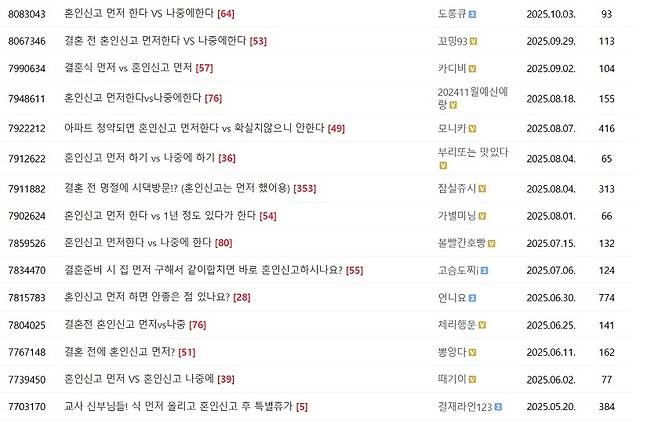
Behind the trend of marriage registration becoming a calculated strategy for many Korean couples lies not only soaring housing prices, but also a cultural perception that values a wedding ceremony, or public proclamation of their union, more than the legal procedure.
“The wedding ceremony is like a declaration to our family and friends that we’ve become a couple. But marriage registration feels like something that’s just between me and my husband. When or whether to do it is a purely personal decision, and I don’t feel pressured about it,” wrote one user, who said she tied the knot in February but has yet to register her marriage, expressing discomfort over in-laws questioning her decision.
Copyright © 코리아헤럴드. 무단전재 및 재배포 금지.