Megaplan cracks mackerel farming, aims to make fish affordable
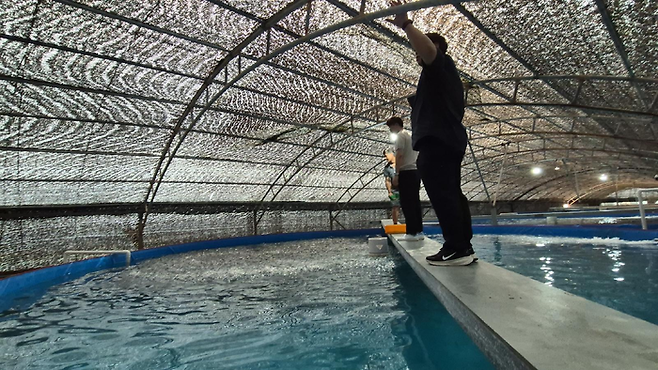
At Megaplan’s 4,000-square-meter fish farm in Pyoseon, Jeju Island, 22 tanks hold mackerel ranging from newly hatched fry to nearly market-sized fish. “Mackerel grow faster than flatfish and have higher market value, so the business potential is enormous,” said Dave Yu, CEO of Megaplan. “We plan to raise about 400,000 mackerel next year and supply restaurants at 10,000 won per fish — about one-third of the current price.”
Once known as Korea’s “national fish” for its affordability, mackerel has become a luxury item due to abnormal climate conditions and plummeting catches. A single 500-gram salted mackerel now retails for around 10,000 won, while fresh mackerel for sashimi costs between 30,000 and 60,000 won — up to three times more expensive than flatfish.
Founded in 2019, Megaplan succeeded in developing artificial fertilization and hatching technology that allows continuous breeding throughout the year. Using AI and IoT systems, the company can precisely control temperature, light, water quality, and fish health to induce spawning 365 days a year — a feat impossible in the wild, where mackerel only spawn from March to June.
Megaplan achieved its first commercial shipment of first-generation artificially spawned mackerel earlier this year and was selected for the TIPS (Tech Incubator Program for Startup) by the Ministry of SMEs and Startups. It plans to open an additional fish farm in South Gyeongsang Province, build a nationwide distribution network, and expand into markets such as Japan and Southeast Asia.
Yu, a former Samsung Heavy Industries engineer with more than a decade of experience in marine architecture and special vessel design, applied his expertise in ocean climate analysis and depth control to create the aquaculture system.
“Our goal is to make mackerel available for 1,000 won per fish,” Yu said. “We also aim to succeed in farming other species like red sea bream and flatfish, contributing to global food security and sustainability.”
Copyright © 매일경제 & mk.co.kr. 무단 전재, 재배포 및 AI학습 이용 금지
- 오늘의 운세 2025년 10월 23일 木(음력 9월 3일) - 매일경제
- [단독] 중국인이 국민연금 갉아먹는다고?…낸 돈이 받은 돈 10배 달해 - 매일경제
- “고등어 앞으로 천원에 먹게 될 것”…대기업 나와 양식장 차리더니 한 일 - 매일경제
- “갑자기 5억을 어디서 구하나”…분담금 2배 뛴 은마 소유자 날벼락 - 매일경제
- “7년 속 타다가 본전에 겨우 팔았더니”...올해 119% 오른 우량주 - 매일경제
- “조금이라도 중국 묻으면 관세폭탄”…‘국적 세탁’ 베트남에 칼 빼든 미국 - 매일경제
- “나는 어쩔 수 없었지만 국민은 안돼” 부동산 정책 입안자들의 내로남불 [핫이슈] - 매일경제
- 연봉 1억받으면 뭐해…국민연금 30년 채워도 꼴랑 150만원 받는데 [언제까지 직장인] - 매일경제
- [속보] 한국은행, 기준금리 연 2.50% ‘동결’ - 매일경제
- ‘충격’ 김서현 딜레마 빠진 한화, 시험대 오른 명장의 ‘믿음 야구’ PO5 선택은? - MK스포츠