1,600-year-old tomb of Silla general and attendant discovered in Gyeongju
이 글자크기로 변경됩니다.
(예시) 가장 빠른 뉴스가 있고 다양한 정보, 쌍방향 소통이 숨쉬는 다음뉴스를 만나보세요. 다음뉴스는 국내외 주요이슈와 실시간 속보, 문화생활 및 다양한 분야의 뉴스를 입체적으로 전달하고 있습니다.
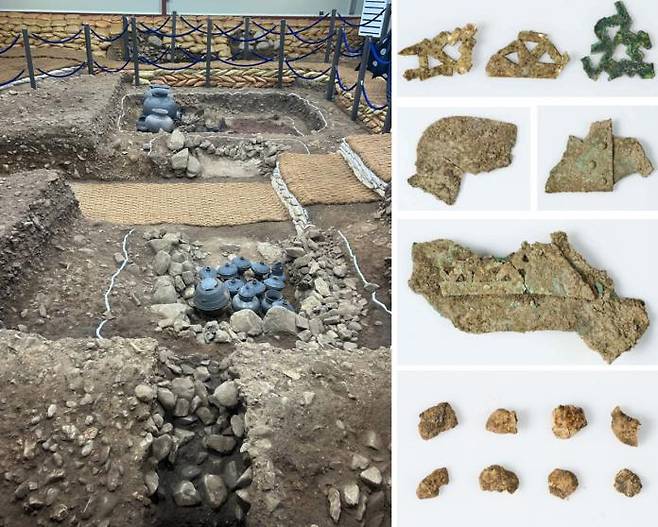
Large ancient tombs commonly seen across Gyeongju, the ancient capital of the Silla Kingdom, are mostly stone-mound wooden chamber tombs (jeokseok mokgwakbun), built by placing a wooden coffin chamber for the deceased and burial goods, then covering it with layers of stones. The earlier type, known as wooden chamber tombs (mokgwakmyo), did not include these stone layers. Now, archaeologists have discovered a tomb that clearly shows characteristics of a transitional stage between these two styles. The tomb’s owner is believed to have been a high-ranking military general in his 30s who wore a gilt-bronze crown, and skeletal remains found beside him are thought to belong to an attendant buried through human sacrifice. Experts say the find offers valuable insight into the evolution of Silla’s tomb structures and funerary practices.
The Korea Heritage Service (KHS) announced the discovery at a press briefing on October 20 at the excavation site of the Hwangnam-dong No. 1 wooden chamber tomb in Gyeongju, North Gyeongsang Province. The tomb was one of six wooden chamber burials found beneath the Hwangnam-dong No. 120 tomb, whose excavation began in 2018. It marks the first confirmed case of a “tomb beneath a tomb” structure where a wooden chamber tomb lies directly below a stone-mound wooden chamber tomb.
Estimated to date from the late 4th to early 5th century, the Hwangnam-dong No. 1 tomb provides important evidence of the shift from wooden chamber to stone-mound wooden chamber tombs. The mound measures 10.6 meters east to west and 7.8 meters north to south, forming a low, gently sloping oval shape surrounded by a hoseok (perimeter stone) made of thinly laid stones resembling a belt. The low mound reflects the earlier wooden chamber type, while the perimeter stones are typical of early stone-mound wooden chamber tombs. Similar features were observed in Tomb No. 109 excavated during the Japanese colonial period, but none have been preserved as clearly as those in Tomb No. 1.
The tomb consists of a main chamber (jugwak) and an auxiliary chamber (bugwak) arranged along an east–west axis, with a total of 165 artifacts unearthed. From the main chamber, measuring 3.7 meters long, archaeologists uncovered a pair of gold earrings, a ring-pommel sword (hwandoedaedo), teeth, and fragments of a gilt-bronze crown. Based on the teeth’s size and wear, the deceased is estimated to have been in his 30s at burial. The presence of the crown, sword, and earrings suggests he was a general of the highest social rank. The gilt-bronze crown fragments feature pierced △ and 凸 patterns similar to decorative motifs found on artifacts from Goguryeo’s Jeon clan tombs and on the gold crown from Silla’s Geumgwanchong Tomb. Researchers believe it predates all six gilt-bronze crowns previously found in Hwangnamdaechong, making it the oldest gilt-bronze crown discovered in Gyeongju to date.
Beside the main chamber, an auxiliary chamber measuring 1.7 meters east–west and 2.7 meters north–south was also uncovered. On a layer of horse armor laid on the floor were partial human remains and scale armor made of interlocking metal plates (chal-gap). The torso armor (dongchal) and skirt-like lower armor (sangchal) were missing, but a helmet, saddle, and other equestrian gear were also found. The attendant buried in the auxiliary chamber is estimated to have been between 160 and 165 centimeters tall, average height for the 4th to 6th centuries, and is thought to have been a servant sacrificed to accompany the general. While historical records indicate that human sacrifice was practiced in Silla, this discovery provides the first concrete evidence of the practice’s physical form.
“The excavation of the Hwangnam-dong No. 1 wooden chamber tomb goes beyond the discovery of a new burial,” the KHS said. “It provides a crucial clue to understanding the evolution of Silla’s burial architecture as well as the kingdom’s military and social hierarchy. In particular, the complete set of armor and helmet will serve as key materials for studying Silla’s heavy cavalry.”
The excavation site and the artifacts from the Hwangnam-dong No. 1 tomb will be open to the public from October 27 to November 1, coinciding with the Asia-Pacific Economic Cooperation (APEC) Summit.
※This article was translated by an AI tool and edited by a professional translator.
Copyright © 경향신문. 무단전재 및 재배포 금지.
- “김구=빨갱이” 불매 운동까지…독립운동가 모욕글 넘쳐나는 SNS
- [속보]내년 1월부터 ‘비거주 1주택자’ 전세대출 제한···갭투자 차단 조치[8·13 부동산대책]
- 민주당 지지층서 김민석 44%·정청래 25%…이 대통령 지지율 49%, 취임 후 최저[NBS]
- 정청래, 송영길에 “덩치 크신 분이…” 김민석에 “뭔 말 하는지…”
- ‘길거리 음식의 최강자’ 동남아가 아니었다···예상 확 깨버린 ‘반전의 1위 도시’ 어디길래
- 불지른 사람은 병원 누워있어 조사도 못하는데···그새 피해자는 죽고 유족은 ‘억대 치료비’
- ‘이정근 취업청탁’ 노영민·김현미 무죄…수사 4년 만에 1심 결론
- ‘전용기 암살 위협’에 같이 대피한 건 서열 1·2위 장관 아니었다···트럼프 곁에는 누가 있었
- ‘27세 최연소 대변인’ 오른 레빗, 백악관 떠난다···“최고의 엄마 되기 위해”
- [단독]실종 수색 도왔는데 20년 뒤 “네가 범인”…스토킹·허위사실 유포한 실종자 아버지 불구